Large-scale cattle and sheep farming requires standardized management to keep pace
Original title: Cattle and Sheep Thrive on the Gobi Desert——A profile of Minqin County farmer Wang Weiji's development of large-scale farming
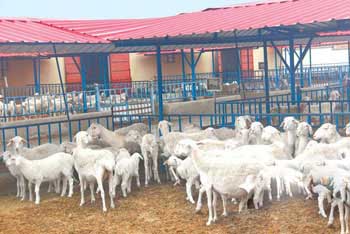
A corner of the facility-based sheep farming compound of Wang Weiji, a farmer from Hua'eryuan Village, Hongshagang Town, Minqin County, Wuwei City. Photo by Ma Shunlong, staff reporter
San Nong Express comprehensive report: In mid-autumn, the air is crisp and clear. Following the Minqin-to-Hongshagang expressway, the reporter arrived at a modern farming compound named “Riyue Animal Husbandry” located on the Gobi Desert. Here, we met 43-year-old Wang Weiji, a farmer from Hua'eryuan Village in Minqin County.
Building a business through hard work in his hometown
Since 2011, Wuwei City has vigorously promoted the main production model of “facility-based agriculture and animal husbandry + distinctive forest and fruit industries.” Wang Weiji invested 350,000 yuan to build one high-standard sheep farming compound, constructing sheep sheds of 1,200 sq m, along with supporting facilities including a disinfection room, duty room, feed room, and water, electricity and road infrastructure. The compound has an annual rearing capacity of 1,800 sheep, sells 1,000 lambs and fattened sheep annually, and generates annual sales revenue of about 1 million yuan. These were just a small step on his path of building farming compounds.
As the number of animals kept grew larger and larger, the original area of the farming compound gradually became an objective constraint on the continuous expansion of farming scale. Under these circumstances, Wang Weiji planned to build another standardized large-scale sheep farming compound on the north side of the original one.
In order to do a good job on the compound planning, Wang Weiji visited the higher-standard farming compounds throughout the county, and also traveled to Shandong, Jiangsu and other places for on-site study and inspection. After drawing on the advanced experience of farming compounds in various places, he began to do the design work himself, scientifically laying out the positions, sizes and internal facilities and equipment of the sheep sheds, disinfection room, duty room, office buildings and other infrastructure, and rationally planning the compound roads and green areas.
From planning and design to construction, he busied himself with building during the day and worked on designs at night, ensuring project quality by following the highest specifications and standards in every step. After more than 200 days and nights of toil, in October 2013, Wang Weiji raised funds from various sources and invested 3.5 million yuan to build the Xiyangyang farming compound with a pen area of 6,000 sq m on the barren Gobi. The compound has a total of 10 standardized, double-row sheep sheds with brick-and-steel structure, each with a pen area of 600 sq m; the pens use three-dimensional lighting with good insulation effect; according to production needs, shade canopies were set up around the exercise yards, and supporting facilities were built including a forage shed, concentrate room, feed processing room, office buildings, disinfection room and duty room; 2 sets of towerless automatic water feeders were installed; information-network-based 3G management technology was put into use; and 20 surveillance cameras were set up, ensuring safe production and scientific management of the compound.
Seeking development by drawing on expertise
At the end of 2013, Wang Weiji searched throughout the county for people with rich sheep-farming skills and relatively high management ability to help him manage the farming compound. Later, a friend recommended to him Pan Fabin, a technician from Quanshan Town, Minqin County, who had been engaged in livestock farming for many years. Eager for talent, Wang Weiji went to his door to invite him. At first, Pan Fabin was unwilling to leave his hometown. When one visit failed, he went a second time; when two visits failed, he went a third time. In the end, Wang Weiji stopped talking about hiring him and merely asked him to take a look at his sheep farm and give some guidance. When Pan Fabin came to the barren Gobi and saw a farming compound of such large scale and such high standards, he finally agreed to serve as the manager of the Xiyangyang farming compound.
At the same time, experts with professional and systematic knowledge of breed improvement, crossbreeding and livestock and poultry epidemic prevention were also indispensable for a scientific compound. Through an introduction from the Gansu Provincial General Station of Animal Epidemic Prevention, Wang Weiji learned that Professor Lang Xia of Gansu Agricultural University had professional farming technology and had been engaged in sheep breeding for many years. So he invited Professor Lang to be his technical advisor and reached a college-enterprise cooperation agreement, under which the Xiyangyang farming compound would build office space and Professor Lang would organize a research team, jointly establishing a breeding laboratory integrating purebred sheep breeding, breed improvement and artificial insemination.
In this way, the farming compound moved step by step onto a path of scientific development, from breed improvement to epidemic prevention, and from daily management to fattening and marketing. By 2014, the compound had an annual inventory of 8,000 sheep, with 3,000 purebred Hu sheep base ewes, and annual sales revenue of nearly 10 million yuan.
Seeking innovation and strength to realize the dream of prosperity
In 2014, on the basis of the Xiyangyang farming compound, Wang Weiji established “Riyue Animal Husbandry Co., Ltd.” He wanted to build a modern enterprise integrating cattle and sheep fattening, purebred breeding of improved varieties, research and development of forage and feed, and disease prevention and control.
In 2015, he renovated the compound, bringing the scale of the two compounds to 20,000 sq m. Under the guidance of experts, he introduced 1,200 improved-breed rams of multiple varieties and 4,600 base ewes for improved breeding. In 2015, the company had an annual inventory of 13,000 sheep, marketed more than 5,000 commercial sheep, and achieved sales revenue of 12 million yuan.
This year, Wang Weiji built 5 high-standard cattle sheds of 14,000 sq m, and introduced 1,500 beef cattle of breeds such as Simmental, Angus and Hereford from Australia. After half a year of transport, isolation and adaptation, they entered the pens and began stocking in early May, entering the normal production stage. So far, artificial insemination has been performed on 200 head. After the project is completed, it is expected to market 500 beef cattle annually, with sales of 30 million yuan, radiating and driving employment for 60 people and generating labor income of 3 million yuan.
From a large-scale farming compound to a modern farming enterprise, Wang Weiji, in the continuous growth of his business, has completed the transformation from a farmer to an entrepreneur, and has also seen the bright prospects of green development. (Reporter Ma Shunlong)