Want to save 10 yuan per mu on spraying? Understanding this one point is enough
What do Chinese people care about most?
Value for money.
Because earning money isn't easy, we ordinary folk still have to budget carefully in daily life, striving to spend the least money to get the most done.
But value for money doesn't mean rough and crude; even cheap things can pursue quality.
Just like during the busy farming season, you can hire a drone to do the spraying.
Normally, hiring someone to spray costs over 100 yuan per person per day, plus food and drink and hospitality, which works out to more than 30 yuan per mu. A drone costs only just over ten yuan per mu for the work, saving both time and money, and the results are good.
From October 3 to 6 this year, the China UAV and Robot Application Competition will officially open at the Xixia National Modern Agriculture Demonstration Zone in Nanchang, Jiangxi. Twenty-three well-known domestic brand crop protection drone companies and five outstanding educational robot companies will appear here together.
Want to see unified work standards and specifications? Come here.
Want to know about equipment maintenance and work protection? Come here.
Want to see crop protection drones that are world leaders? Come here.
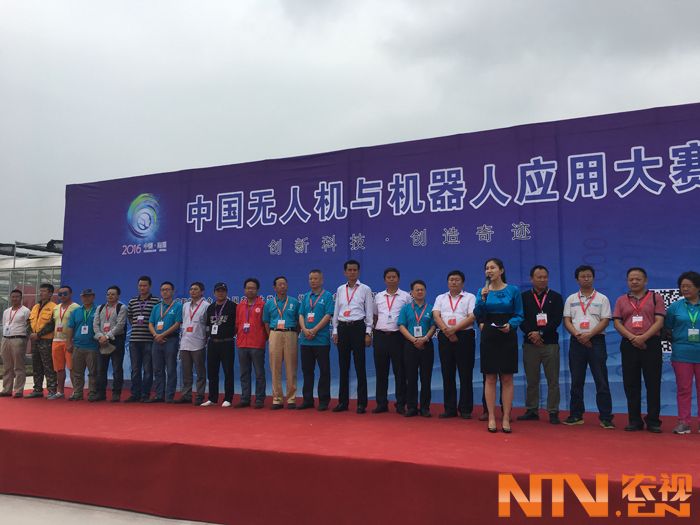
The opening ceremony site
Compared with manual spraying, higher efficiency and lower cost
As a country with 1.8 billion mu of basic farmland, China had, according to statistics, as of June 5, 2016, more than 300 companies producing professional-grade drones, of which more than 200 were crop protection drone manufacturers, producing 178 varieties of crop protection drones of all kinds, with more than 5,000 units in service.
Crop protection drones waiting to take off
Unlike leisure or industrial drones that can fly very high, crop protection service drones can often only fly one to three meters above the crops. This makes their work less dangerous and exempt from airspace regulation.
Compared with traditional manual spraying, crop protection drone spraying is highly efficient, saves water and pesticide, sprays evenly, and saves labor. According to statistics, using drones for spraying can save 90% water and more than 20% pesticide.
For a workload of 20 mu, a drone finishes it in just over 10 minutes. With manual labor, even if 4 people worked for an hour, they couldn't finish it.
What are the application areas of drones
Crop protection drones largely make up for the usage limitations of traditional machinery. For example, in southern regions' paddy fields, hills, mountains, and areas with tall-stalk crops where large equipment cannot get in. Taking Northeast rice as an example, spraying, applying foliar fertilizer, supplementing nutrient solution, and so on can all be done with drones, and the drone's downward airflow helps increase the pollination rate of rice during the flowering period.
Operators on standby
How far are drones from being included in national agricultural machinery subsidies
The key reason crop protection drones cannot be widely popularized is still price. At present, except for a few provinces, crop protection drones have not yet been included in the scope of “agricultural machinery subsidies.”
Why?
——Standards. (Work standards, pesticide application technology standards, aviation pesticide and inspection standards)
However, experts predict that in probably less than three years, everyone's expectations will be realized.