Returning home to start a business: developing ecological specialty agriculture leads to the road to prosperity
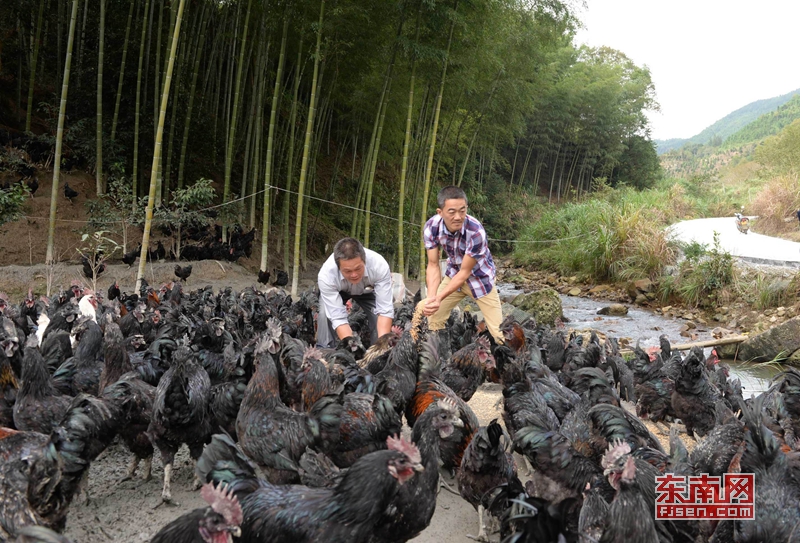
Lin Renxuan (left) and Qiu Zhenshi raise chickens with rice grain beside the bamboo grove.
Pengkeng Village is located 5 km north of the Guiyang Township Government in Dehua County. The whole village has a forest land area of 20,000 mu. Here the vegetation is dense, bamboo seas stretch in patches, and the forest is vast. Although it has such a superior geographical environment, with the advancement of Dehua County's strategy of focusing on the main urban area, a large rural population has moved into the cities, and large areas of farmland have gradually fallen into waste because no one farms them. In recent years, the wave of returning home to start businesses has gradually risen, and people have one after another set their eyes on this "treasure land," carefully studying this ecological specialty path to wealth deep in the mountains. It is reported that the village will also combine targeted poverty alleviation work, using the base to drive the enthusiasm of poor households and villagers, promoting development from a point to the whole area, and also use the abundant forest and moso bamboo resources, with plans to develop under-forest planting and breeding industries such as Dictyophora indusiata (bamboo fungus) and Huanghua Yuanzhi, to promote villagers' income growth.
Ecological free-range rearing: quality is the absolute truth
In late autumn, approaching the Dongbankeng corner of Pengkeng Village, surrounded by mountains, with springs murmuring and no sign of human habitation, yet deep in every bamboo grove sits a chicken coop. From afar one can hear the "cluck cluck cluck" of chickens coming from the woods. They either gather in threes and fives or huddle together in clusters, scrambling to return to the coops. Their calls instantly make this quiet mountain forest very lively. It turns out that the "chicken commander" - Lin Renxuan, the person in charge of the chicken farm - has come to feed them.
"I have to come feed them once in the morning and once in the evening. When they hear my call, they run back from all directions in the mountain forest," Lin Renxuan said. "Because there are no villagers living within 3 km around here, the natural primeval forest and bamboo sea provide a good living environment for the chickens. At the same time, the chicken manure makes this soil more fertile and provides sufficient nutrients for the growth of moso bamboo on the mountain. The villagers are also very happy."
In the nursery room, a group of new little companions has recently arrived. "These chicks were sent to this nursery room just after hatching. There are 6,400 in total. In another 20-some days they can also be released onto the mountain to forage freely." Lin Renxuan picked up a chick, carefully checking its health condition while excitedly introducing it to the reporter.
"Each outdoor free-range site covers five or six mu, and they are all distributed along the stream." Qiu Zhenshi, the chicken farm's technician, told the reporter that the chicken farm was built beside the stream because there are many fine grains of sand and gravel by the stream. When chicks peck and eat the sand and gravel, it helps promote intestinal digestion, so the gizzards will grow larger and healthier.
"The entire Dongbankeng corner has a total of five outdoor free-range sites for chicken flocks and two nursery rooms, with more than 20,000 birds kept in total." Qiu Zhenshi said that choosing to raise chickens in the mountains increases the chickens' amount of exercise, and they are usually fed rice grain, so the chicken meat is more delicious.
"The environment here is good, with mountains and water, and it is far from crowds. If such a rare natural corner were not put to good use, it would really be a pity." Qiu Zhenshi said, "Now most competitors on the market work hard on price, but we pay more attention to the quality of the chicken meat. Although free-range native chickens have a longer production cycle and relatively greater risks, making sure the people who eat them feel reassured is what we care about more."