Reishi mushroom helps farmers open up new prospects for increasing income and becoming prosperous
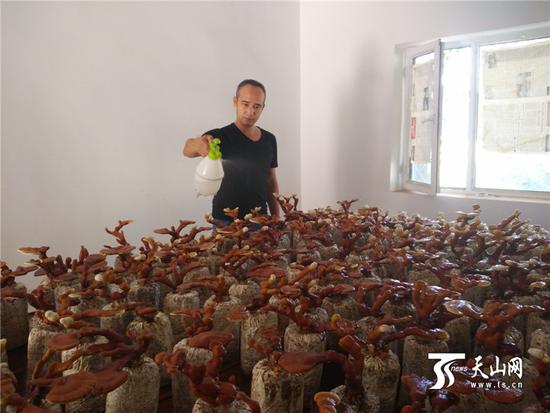
Daily management of reishi mushroom.
Karasu Village in Araltobe Town, Xinyuan County, is mainly based on crop farming and animal husbandry, but the prices of traditional crops and livestock cannot go up, making it difficult for villagers to increase income. The villagers' longing for a moderately prosperous life deeply moved the members of the joint working group from the Ili Prefecture Song and Dance Troupe and the Xinyuan County Quality and Technical Supervision Bureau, who decided to help them open up a new path to prosperity.
Giving Play to Advantages and Opening a New Path Out of Poverty
Working group member Hasmu Kelati had the skill to grow reishi mushroom. As one of China's nine great immortal herbs, reishi mushroom has always had high medicinal and health-care value. The working group then studied and decided to give play to Hasmu's specialty, try growing reishi mushroom in the village, and lead the villagers onto a new path of poverty alleviation and prosperity through specialty industry planting.
As for how to mobilize villagers to develop specialty reishi mushroom planting and promote it, so that more people can benefit from growing reishi mushroom? The working group unanimously believed that to lead the people out of poverty and to prosperity, the people must see something tangible; if they can make money, they will follow you.
With the support of the town Party committee and government and the village "two committees," the working group secured start-up funds. In order to build the laboratory as quickly as possible, all members of the working group pitched in, divided the work and cooperated, bought teaching equipment and devices online, ordered wooden boards and steel frames, and purchased cottonseed hulls, wheat bran and other raw materials needed for reishi mushroom cultivation. After more than ten days of busy preparation, the reishi mushroom teaching laboratory was completed.
"It's out, it's out, my reishi mushroom is out!" shouted Aziguli Kurban, the impoverished household member who was the first to learn reishi mushroom cultivation techniques, excitedly. Watching Aziguli Kurban as happy as a child, the working group members felt deeply gratified. Months of hard attempts had finally paid off, and this further strengthened the working group's confidence in teaching villagers to grow reishi mushroom and become prosperous.
Teaching People to Fish and Helping Them Master a Skill
Seeing the reishi mushroom successfully grown in the laboratory, all members of the working group felt even more confident. The working group and the village "two committees" held many meetings to discuss and selected 12 people from the village's impoverished households to train them in reishi mushroom cultivation techniques, using technical training to lead impoverished households out of poverty. Under the careful guidance of working group member Hasmu Kelati, the first batch of reishi mushroom independently grown by impoverished households had completed inoculation and entered the daily cultivation stage. Working group members also repeatedly reminded the growers that before the mycelium is fully covered, light must be avoided, and they must remember to ventilate twice a day for half an hour each time.
After more than three months of careful cultivation, the first batch of reishi mushroom had reached harvest season. Impoverished household member Mireayi Maimaiti said, "Watching the reishi mushroom I planted grow bit by bit, I feel very happy. I want to learn the cultivation techniques from the working group as soon as possible, and I hope it can bring more income to my family!"
Looking Forward to the Future and Paving a Smooth Road to Moderate Prosperity
At present, the first crop of reishi mushroom grown by 12 impoverished households has been harvested, with 9.6Kg of dried reishi mushroom harvested, bought by medicinal merchants at a wholesale price of 65 yuan/Kg, for a total income of 624 yuan. The total income from the third to fourth crops of reishi mushroom is expected to reach more than 2000 yuan. Seeing the first income from reishi mushroom, impoverished household member Guzilamu Mijiti had the idea of growing reishi mushroom herself. With the help of the working group, she made more than 1000 reishi mushroom bags herself and completed inoculation. It is expected that after three and a half months of cultivation, the first crop of reishi mushroom can be harvested. With 1000 bags planted each year and 3-4 crops harvested per bag, the expected income is more than 6000 yuan. Wild-simulated reishi mushroom can also be grown in the courtyard, and the price can double. Guzilamu Mijiti said, "The working group has handed the techniques to us. I want to be the first to eat crab and take the lead in trial planting at home."
Seeing that the 12 impoverished household members had initially mastered reishi mushroom cultivation techniques, the working group is striving for funding support through various channels. Next year, with the village "two committees" as the main body, a small reishi mushroom bag factory will be established to achieve small-scale batch production. At the same time, a reishi mushroom planting cooperative will be established to uniformly recycle finished products and sell them uniformly. The mushroom bag factory can provide jobs for impoverished households, achieving both planting and wage income, thereby truly helping villagers escape poverty and opening up "money" prospects for prosperity.