A man from Pingdingshan, Henan returns home from working away to raise goldfish and creates tens of millions in wealth
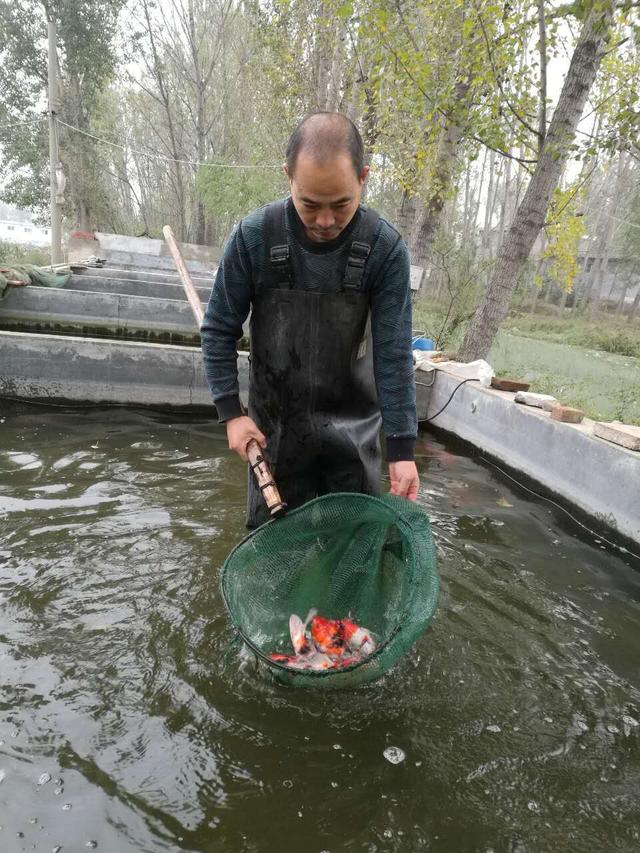
Twelve years ago, Wang Junwei, a villager from Caoxi Village, Cao Town, Zhanhe District, Pingdingshan City, who was working in the south, discovered the business opportunity of ornamental goldfish selling well, and resolutely returned to his hometown to start a goldfish farming business by the shore of White Turtle Lake, embarking on the road to prosperity. Under his leadership and influence, more than a dozen villagers became rich by farming ornamental fish, and Caoxi Village also became a famous ornamental fish breeding base both within and outside the province. The old history of relying entirely on transporting ornamental goldfish from the south was broken in Pingdingshan in the heart of the Central Plains, and it was listed as an advanced science popularization demonstration base in Henan Province.
On November 2, the reporter came to Caoxi Village and met "Goldfish Brother" Wang Junwei, who had just signed a supply contract for 120,000 goldfish with Yang Lianyu, a seller from Anyang. He revealed to the reporter that every year, tens of millions of small goldfish are sent from their ornamental fish breeding base to Beijing, Tianjin, Xi'an, Zhengzhou and other places, and each farming household's annual net income is around 100,000 yuan.
[Spots a business opportunity while working away, returns home to raise goldfish]
In 2005, before Wang Junwei and his fellow villagers started raising goldfish, he and several fellow townsmen were working at an electronics factory in Guangzhou. At that time, Wang Junwei was 34 years old.
One day, after work, Wang Junwei and his fellow townsmen wandered around the outskirts of Guangzhou and came to a goldfish market. Those colorful goldfish of all shapes and forms attracted Wang Junwei. When he heard that these small goldfish ranged in price from dozens of yuan or hundreds of yuan to tens of thousands, and that sales were very large, he thought of his own home near White Turtle Lake, with its abundant water resources. If this project could be brought to his hometown, would it not be a great good deed benefiting his fellow villagers?
Wang Junwei proposed his idea to the goldfish seller, and was immediately mocked by the other party: "You should just keep working your job. This is not like raising grass carp in your hometown!" His fellow townsmen also laughed and said, "Come on! In our hometown we've only heard of people raising fish, never of people raising goldfish." But the stubborn Wang Junwei still decided to try it himself. He quit his job, found a goldfish breeding base in Guangzhou, and became an apprentice. Over nearly a year, Wang Junwei gradually mastered the key techniques of goldfish farming.
At the end of 2005, Wang Junwei brought back to his hometown 10,000 goldfish fry he had purchased. He worked for more than half a year in a pond of more than one mu in front of his home. Those small goldfish that had originally been the size of rice grains all grew to the length of a finger. Watching the brightly colored goldfish swimming in groups and wagging their tails in the pond, Wang Junwei was overjoyed. However, just then, the goldfish began to get sick one after another, first with swollen bellies, then with turning over, and some goldfish also developed rotten spots on their bodies. Although more than a month of treatment followed, the goldfish still lost more than half. Then the 60,000 goldfish fry purchased the second time got sick again, and despite consulting experts, this batch of goldfish all died. Two failures at goldfish farming not only wiped out Wang Junwei's savings from many years, but also left him more than 100,000 in debt.
"At that time I really had reached the point of being deserted by everyone, but I still did not believe the saying that goldfish cannot be farmed in the Central Plains." Wang Junwei said that he secretly borrowed money from others, bought brood fish from Jiangsu and Zhejiang, explored goldfish breeding and hatching techniques on his own, paired goldfish from different places, and improved disease resistance by improving the breed. That year, Wang Junwei's "cross-region pairing" hatching technique succeeded, and coupled with proper disease prevention, the goldfish that year almost never got sick, and that year he made a profit of more than 200,000 yuan.
[Tiny goldfish create tens of millions in wealth]
In 2011, Wang Junwei also worked out a three-dimensional mixed-culture technique for goldfish, increasing the number of fish raised per mu of water surface from the traditional 60,000 to 70,000 to more than 200,000 now, and the farming cost of goldfish was also reduced considerably as a result. By the end of 2013, Wang Junwei himself was making an annual profit of more than 600,000 yuan.
When some local fishery farmers saw that Wang Junwei had made money raising goldfish, they began coming to him one after another to ask about farming experience, and even fishery farmers from nearby counties and districts such as Ye County and Lushan also came specially. Wang Junwei saw a business opportunity in everyone's enthusiastic interest in farming, and believed this was an excellent opportunity to make goldfish farming large-scale and turn it into an industry. So, after some preparation, he decided to join with these farmers to form a farming cooperative. Wang Junwei clearly divided the work in the cooperative: he was responsible for breed research and development and market expansion, provided fry and technology, and uniformly bought back and sold the goldfish, while the other farmers were mainly responsible for farming and regular disinfection and disease prevention. To the farmers joining the cooperative, Wang Junwei also taught his goldfish farming techniques free of charge without reservation.
Under Wang Junwei's leadership and instruction, fifteen farming households, with pond operating areas ranging from two mu to five mu, raised dozens of ornamental goldfish varieties such as pompom, crown pearlscale, ranchu, koi, and lionhead, with each household earning an average of around 50,000 yuan per mu of pond. The farmers gained real benefits from raising goldfish, and more farmers successively prepared to join in. Not only Caoxi Village, where Wang Junwei is located, but also people from some surrounding counties and cities came one after another to Wang Junwei to learn goldfish farming techniques, and Wang Junwei readily accepted them all.
"Goldfish farming is not only about farming, but also about constantly introducing new products. Only then can customers be attracted." In July 2014, Wang Junwei exhibited at the local goldfish market a new red-cap oranda goldfish variety he had newly bred. This new red-cap oranda goldfish had bright colors and did not change color even after long raising, immediately attracting the favor of many merchants. Several merchants from Guangzhou and Beijing even specially visited his cooperative and reached long-term supply agreements with Wang Junwei.
At present, Wang Junwei's farming cooperative sells tens of millions of goldfish every year to Beijing, Tianjin, Xi'an, Zhengzhou and other places, bringing tens of millions in wealth to him and many farming households. The ornamental fish breeding base in Caoxi Village has become a famous goldfish farming village both within and outside the province. Wang Junwei and the farming households in his cooperative have broken the saying that "goldfish can only be transported from the south, and goldfish cannot be farmed in the Central Plains." Wang Junwei and the farmers' farming base has been listed as an advanced science popularization demonstration base in Henan Province.
"Years of goldfish farming experience remind me that technological innovation is the primary pillar for starting a business and becoming rich." Wang Junwei said, "When everyone has the idea of starting a business, I should encourage and support them so we can all become prosperous together. As long as I do a good job in research and development, raise the quality of the goldfish, and lower the cost of the goldfish, I believe there will naturally be plenty of market."