Agarwood Plantation Realizes Farmers' Dream of Shaking Off Poverty
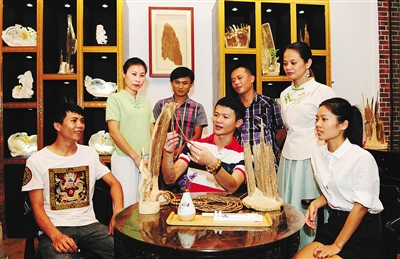
On November 9, Wang Dayu instructs trainees in identifying and appraising agarwood at the industrial park.
Poverty Alleviation Pioneer Roll
After eight years in the company of agarwood, wherever Wang Dayu goes now, he carries a faint scent of agarwood about him.
Walking into the agarwood plantation he has devoted years of effort to building, one is struck by the dazzling array of agarwood products and ornaments. Through his unremitting efforts, a complete industrial chain encompassing agarwood cultivation, processing, exhibition and sales has taken shape, and the impoverished households that followed him in planting agarwood and learned agarwood processing techniques have all shaken off poverty.
Following His Father into Business and Embarking on the Path of Entrepreneurship
Wang Dayu was born in 1983 in Jinshan Town, Chengmai County, into a family of individual merchants. His father's generation was mainly engaged in the sale of agricultural production materials such as chemical fertilizers and pesticides, and his grandfather had a hobby of collecting silver dollars. From an early age, Wang Dayu often accompanied his grandfather to the antique market in Haikou to "hunt for treasures," and sometimes made a few deals as well. Immersed in this environment, he developed a strong interest in doing business.
In 2002, after graduating from a teachers' college, Wang Dayu decided to return to his hometown and go into business with his father. But he was not content with selling agricultural production materials, so he set his sights on the antique market and began trading rosewood (Hainan huanghuali) products on his own. "At the time, I could buy a huanghuali abacus for 20 yuan, but resell it for 800 yuan. The profit was astonishingly high," Wang Dayu said.
Moreover, through constant visits and research, Wang Dayu also discovered that Hainan is an excellent producing area for rare products such as huanghuali and agarwood, but professional cultivation and processing techniques were not yet mature at the time, which led him to spot a business opportunity. In 2011, after six or seven years of traveling, investigating and accumulating experience, Wang Dayu decided to start planting agarwood himself, choosing a site in Jiale Town, Chengmai County, and contracting 30 mu of land for the first time.
Firm in His Conviction, Moving Forward Without Hesitation
Although agarwood is highly valuable, planting it is a very long process, and inducing resin formation is also labor-intensive. Therefore, when Wang Dayu chose to plant agarwood, many relatives and friends opposed it at first. One friend questioned: "How long will you have to wait before you can make money?"
But no matter what others said, Wang Dayu's attitude remained extremely firm. He said he would not only grow agarwood, but also expand the agarwood processing and sales industry, and even transform the entire area, making Jiale an important base for agarwood cultivation and processing, giving Chengmai a brand of agarwood culture, and making Hainan agarwood famous throughout the world.
After persuading his family, he purchased a batch of machines for processing agarwood powder and agarwood pills, and specially hired a master craftsman from Guangdong to train local people in processing, carving and other skills. Using purchased agarwood wood as raw material first, he built a processing and production base in Jiale and expanded the agarwood planting area year by year.
Expanding the Industry to Benefit the Local Community
Facts proved that Wang Dayu's judgment was correct. Agarwood that sold for a maximum of 150 yuan per jin that year rose to 4,000 yuan in just a few years, an increase of dozens of times. In 2014, Wang Dayu initiated the establishment of the Yufeng Agarwood Professional Cooperative. By then, his sales network on and off the island had also spread out, with total annual sales of nearly 20 million yuan.
To help impoverished households shake off poverty, Wang Dayu encouraged workers in his factory to recommend neighbors with financial difficulties to come and work. Beginners receive a subsidy of 1,500 yuan per month, and after mastering the techniques they can receive a fixed monthly salary of 2,500 yuan. Six impoverished households, including Wang Jiao and Kuang Yufeng, became employees of the Jiale Agarwood Processing Factory one after another, not only gaining a job and increasing their sources of income, but also learning a craft.
This year, Wang Dayu also registered the "Lexiangli" trademark, established Hainan Xiangli Cultural Industry Co., Ltd., and built a garden-style agarwood industrial park in Jinshan Town, integrating agarwood viewing, appreciation, exchange and cultural leisure, dedicated to promoting agarwood culture and building a distinctive cultural brand of Chengmai agarwood.
In the Jiale area, series products such as agarwood handicrafts and agarwood tea have long been quietly popular. Here, in addition to the 240 mu of agarwood planted by the Yufeng Agarwood Professional Cooperative, surrounding farmers have also joined in one after another, bringing the total agarwood planting area to nearly 1,000 mu. A relevant person in charge of the Jiale Town government said that based on current conditions, 130 agarwood trees can be planted per mu of land. After 8 years of management, each tree has an output value of about 3,000 yuan. Calculated at a survival rate of 100 trees per mu, the output value per mu can still reach 300,000 yuan. Given the current scale of the agarwood industry, it can also bring 300-400 job opportunities.