Making a fortune selling walnuts: young man from Ye County earns over 200,000 yuan a year
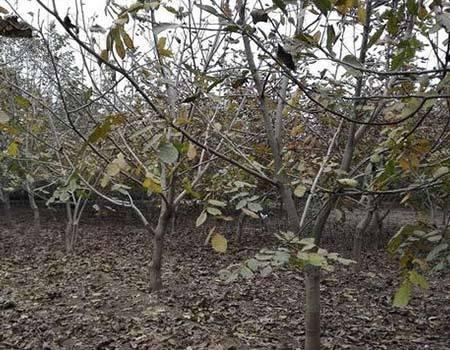
Northwest of Shuangheying New Village in Rhendian Town, Ye County, the walnut trees in a walnut orchard are shedding their green foliage and entering their winter dormancy.
These are no ordinary walnut trees. "This orchard covers thirteen mu. By growing and selling Wenwan walnuts, I have already taken in over 200,000 yuan this year, and I still have 60,000 to 70,000 yuan worth of goods at home." On November 8, orchard owner Liu Yanzhao told reporters.
At Liu Yanzhao's home in Shuangheying New Village, exquisite boxes are arranged inside a cabinet, each holding pairs of walnuts with deep veins and hard shells. "These Wenwan walnuts are all grown by me, with 13 varieties including Sizuolou, Baihuashan, Mantianxing, Wangyong Guanmao, and Shizitou. A carefully selected pair in good condition can sell for three to four thousand yuan, while an average-looking pair sells for several hundred yuan. Word got out that I had successfully grown Wenwan Mahe walnuts, and not only do people from Pingdingshan come to buy, but people from Zhengzhou and Beijing often make the trip too." Liu Yanzhao explained as he opened the boxes.
Liu Yanzhao, now 32 years old, first came into contact with this kind of Wenwan walnut in 2008.
In 2009, Liu Yanzhao spent more than two months buying over 500 saplings in mountainous areas of Jiyuan and several other places.
"They're called saplings, but they're actually roots. Once these roots take, scions or buds are grafted onto them." Liu Yanzhao said that for Wenwan walnuts to develop a good appearance for sale, grafting must be carried out: in spring, branches are grafted, and the grafted branches are called scions; in summer, it is bud grafting.
Scion grafting and bud grafting are key to growing Wenwan walnuts, and also the period of greatest investment. For this, Liu Yanzhao traveled to many places in Hebei. Whenever he heard that some place grew Wenwan walnuts, he would drive there. Because the quantities were small, he could only graft them in batches, box by box. Each time, he carefully packed them into cardboard boxes. Although each box was very light, each one cost a great deal. "Gently carrying one box often meant fifty or sixty thousand yuan, and the most expensive cost seventy or eighty thousand yuan." He said.
After painstaking efforts and an investment of three to four hundred thousand yuan in total, in 2013 the more than 400 Wenwan walnut trees on 13 mu of land finally survived and bore fruit.
During this year's October Golden Week, the number of people coming to Liu Yanzhao to buy walnuts was at least one or two groups a day, and on the busiest day he received six or seven groups of customers. After each group of customers left, they basically never went away empty-handed. Each pair of walnuts cost at least five or six hundred yuan, and during the 7 days, the highest-priced pair sold for 5,000 yuan. By 2015, income exceeded 200,000 yuan. During this year's Golden Week, he took in another forty or fifty thousand yuan. The period around Spring Festival is the peak sales season for Wenwan walnuts, and he confidently said that this year's income should be better than last year's.
While Wenwan walnuts led Liu Yanzhao's family onto the road to prosperity, they also spurred on the people around him. He said that at present, some people in Xindian, Ye County, and Lushan have learned from his experience and begun planting them.
Liu Yanzhao revealed to reporters that his next step is to establish a cooperative so that more people can grow Wenwan walnuts and the industry can be expanded. In addition, he can also provide scions and technical guidance, and in the future the scope for matching walnuts will be broader and larger. While helping more people become prosperous, it can also attract more customers to come and buy.