An In-Depth Analysis of the Current State of China's Waterfowl Industry
China's waterfowl industry includes the meat duck, laying duck and meat goose sectors, annually providing consumers with 7 million t of safe, high-quality, healthy duck meat, 1.4 million t of goose meat and 4.5 million t of duck eggs, as well as 50,000 t of duck and goose down for the textile industry. China is rich in waterfowl breed resources and has initially formed a breeding system capable of meeting the diverse consumer demand for duck and goose meat products. However, breed selection and breeding still need to be strengthened, and a diversified, differentiated and specialized breed breeding system should be established to resolve the current contradiction between waterfowl meat quality and demand and to raise the economic value and benefits of waterfowl farming. China's waterfowl farming methods are at a stage of transformation and upgrading from "extensive to environmentally friendly." For this reason, research and development of resource utilization technologies for waterfowl excreta should be accelerated to improve utilization efficiency. In recent years, China has systematically studied and proposed multiple data sets on the nutrient requirements of ducks and geese, and has formulated scientific and practical Chinese duck feeding standards, significantly raising the scientific and technological content and feed utilization rate of Chinese duck feed and promoting the healthy and efficient development of the duck industry. However, we should further study and establish a Chinese waterfowl nutrition technology system to improve the effectiveness, scientific rigor and practicality of the feeding standards.
The waterfowl industry is a distinctive industry of China. Over the past 30 years, the annual growth rate of duck and goose slaughter volumes in China has exceeded 5%. According to survey data from the National Waterfowl Industry Technology System, in 2011 China's annual slaughter volumes of meat ducks and meat geese reached their peak: about 3.793 billion meat ducks, with meat production reaching 7.69 million t; and 495 million meat geese, with meat production reaching 1.81 million t; duck and goose meat production accounted for about 1/3 of China's total poultry meat production. In 2012, China's duck meat market entered a relatively stable period, and meat duck slaughter volume was on par with 2011. But in March 2013, Jiangsu, Zhejiang and Shanghai successively saw "outbreaks" of H7N9 influenza infection among non-farming personnel. Under the influence of competing reports and spread by numerous media, duck meat, goose meat and duck eggs faced circulation difficulties, consumption dropped sharply, and meat duck slaughter volume in 2013 fell by more than 25%, with the industry suffering heavy losses.
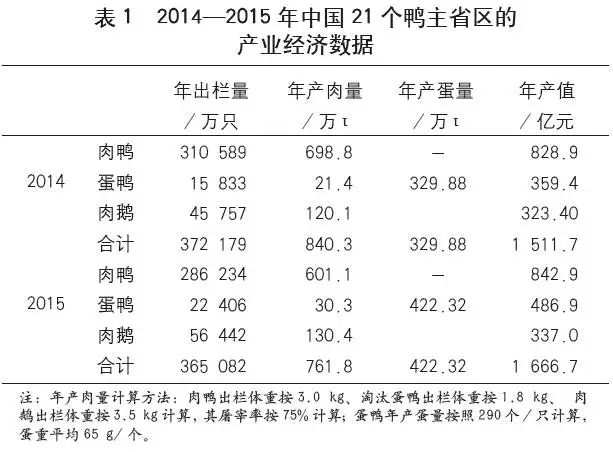
China's meat duck, laying duck and meat goose production in 2014-2015 is shown in Table 1. In China, duck eggs are deeply loved by consumers; in 2015 total duck egg production reached 4.22 million t, accounting for 15%-20% of total poultry egg production. Goose down and duck down are very important products of the waterfowl industry, with an annual output of about 50,000 t and a primary product value exceeding 15 billion yuan. China's current meat duck, laying duck and meat goose industries are concentrated in the relatively economically developed parts of East China, South China and Southwest China. The annual meat duck slaughter volume and laying duck stock in 14 provinces, municipalities and autonomous regions - Shandong, Sichuan, Jiangsu, Anhui, Zhejiang, Hunan, Hubei, Jiangxi, Guangxi, Fujian, Henan, Guangdong, Hebei and Chongqing - account for more than 90% of the national total; Guangdong, Sichuan, Chongqing, Jiangsu, Anhui, Jiangxi, Shandong, Heilongjiang, Jilin and Liaoning are China's main meat goose production areas, with their slaughter volume accounting for more than 90% of the national total.
Specialized Waterfowl Breeds Provide Support for Diverse Consumption
Nearly 1 billion people in China consume duck meat, duck eggs and goose meat products, concentrated in the relatively economically developed eastern, southern and parts of the southwestern regions, and the consumption characteristics of duck and goose meat differ significantly among regions. Beijing, Guangdong, Guangxi and Yunnan focus mainly on roasting and barbecuing, among which Beijing roast duck has become a calling card of Beijing food, while Guangdong and Guangxi roast goose and roast duck are famous nationwide; Jiangsu mainly consumes "brined duck and brined goose"; Hubei, Hunan, Jiangxi, Anhui, Sichuan and Chongqing mainly consume braised duck and braised goose, soy-sauce duck and soy-sauce goose, and pressed salted duck; Zhejiang mainly consumes old duck soup, braised duck and poached goose; Shanghai mainly consumes braised duck and goose, and air-dried goose. Different types of duck meat and goose meat foods require breeds with different production performance characteristics to provide raw material support.
The meat duck breeds currently raised in China mainly include the Chinese Beijing duck, the Beijing duck introduced from the British company Cherry Valley, and local shelducks (Ma Ya) and other breeds. Among these, the Chinese Beijing duck breed accounts for only 10%-15% of the market, the Beijing duck of the British company Cherry Valley accounts for 65%-70%, and local shelduck breeds account for about 20%. Meat duck breeds from the American company Maple Leaf Farm and the French company Orvia hold a very small market share. The Muscovy duck and Muscovy-cross duck of the French company Kelimer Group are mainly raised in Fujian and surrounding areas, hold a relatively large market share, with an annual slaughter volume exceeding 100 million birds, and their slaughter volume in Taiwan, China exceeds 10 million birds per year.
China's local Beijing duck breeds are divided into 2 types. One is the meat-fat type Beijing duck breed, which grows fast, has thick subcutaneous fat and a high sebum rate, and is suitable for processing Beijing roast duck and Guangdong roast duck foods; the other is the lean-meat type Beijing duck breed, which has a high breast and leg meat rate and a low sebum rate, and is suitable for processing brined duck, pressed salted duck and braised duck foods. For example, the commercial generation meat duck of the Chinese Beijing duck can reach a body weight of 3.2 kg at 38 days of age, with a feed-to-gain ratio of 1.90:1, a breast meat rate of 15.5% and a leg meat rate of 12.5%, achieving an extremely high level of production performance. China's local shelduck breeds used for meat production mainly include Huabian duck, Linwu duck and Ji'an red shelduck; these local shelducks grow slowly and have good meat quality, and are mainly used to process traditional duck meat foods such as brined duck, braised duck, pressed salted duck and soy-sauce duck, and are deeply welcomed by consumers.
In China, duck eggs are mainly consumed as salted duck eggs and preserved eggs; in Guangdong and Guangxi, preserved egg congee is a home-cooked food of local residents. China has a great variety of laying duck breeds, unique among all. Shaoxing duck, Jinding duck, Shanma duck, Youxian shelduck and Jingjiang duck are all excellent local laying duck breeds, with egg production at 500 days of age of 280-320 eggs and a feed-to-egg ratio between 2.65-2.85:1. Among them, the Shaoxing duck, after more than 20 years of systematic selection, has developed characteristics such as high yield, early maturity and green-shell eggs; its hybrid combination has an age at first egg of 108 d, egg production at 72 weeks of age can reach 327 eggs, average egg weight 69.8 g, feed-to-egg ratio 2.65:1, green-shell rate 98%, and a year-round stock of more than 80 million birds; the Jinding duck is larger in body size and cold-tolerant, suitable for raising in northern China, with an adult female duck body weight of 1.67 kg, adult male duck body weight of 1.60 kg, egg production at 500 days of age of more than 280 eggs, average egg weight 72 g and a feed-to-egg ratio of 2.85:1; the Shanma duck is the smallest laying duck breed in China, mainly raised in Fujian and Zhejiang provinces, with an adult female duck body weight of 1.35 kg, male duck body weight of 1.32 kg, egg production at 500 days of age of more than 300 eggs and a feed-to-egg ratio of 2.80:1. At present, duck egg consumers in China generally prefer green-shell duck eggs. Therefore, Shaoxing duck, Jinding duck and Shanma duck mainly produce green-shell duck eggs.
China is rich in meat goose breed resources. Roast goose in Guangdong and Guangxi mainly uses local grey goose breeds such as Lion Head goose, Yangjiang goose and Wuzong goose as processing raw materials. Among them, the Lion Head goose is the largest and fastest-growing goose breed in China, with an adult male goose body weight of 8.5-9.5 kg and female goose body weight of about 8.0 kg; brined goose and air-dried goose in Jiangsu and Shanghai use local Yangzhou goose, Northeast Huoyan goose and Sichuan White goose as ingredients; braised goose consumption in Anhui, Sichuan, Chongqing and other places mainly uses local white-feathered meat geese such as Wanxi White goose and Sichuan White goose as raw materials; the Zhedong White goose is mainly used to process "poached goose," and is deeply loved by Zhejiang consumers. In the meat goose farming industry, how to improve the reproductive performance and production efficiency of breeding geese in different regions deserves careful study.
China's Waterfowl Farming Methods Are Rapidly Transforming and Upgrading
China's traditional meat duck, laying duck and meat goose raising methods are mainly based on small-scale farmer dispersed raising and operation, with a low degree of industrialization; most build farming sheds along rivers, lakes and ponds, with simple infrastructure and equipment, and excreta is discharged directly into rivers and lakes, causing water source pollution and frequently triggering disease outbreaks.
Over the past 10 years, as the level of industrialization has risen and farmers' environmental awareness has strengthened, the farming methods for meat ducks, laying ducks and meat geese have rapidly shifted from water-based raising to fully indoor, water-free dry raising models. Meat ducks and laying ducks mainly use fully indoor net-bed raising and deep litter raising. The duck net-bed plus fermentation bed raising method and the laying duck cage raising method have developed rapidly in China, with the aim of directly converting duck excreta into organic fertilizer under aerobic fermentation conditions, reducing pollution of the environment and water sources by duck excreta. Under the policy encouragement of local governments and market regulation, the operation methods of meat duck and laying duck farming have rapidly developed toward intensification, showing a "company + breeding base (cooperative) + farmer" operation model, promoting the development of the meat duck and laying duck farming industry toward standardization and environmental protection.
New changes have likewise appeared in meat goose farming methods, mainly developing a pollution-free meat goose industry away from rivers, lakes and ponds; larger-scale crop-livestock integrationgoose raisingmethods have developed rapidly, and grass planting forgoose raising, grass planting in woodland for goose raising, and fully indoor net raising are currently the main models of goose raising in China.
Advances in Nutrition and Feed Formulation Technology Provide Support for the Healthy Development of the Waterfowl Industry
China's meat duck and laying duck industries consume more than 35 million t of compound feed annually. Studying and formulating feeding standards suited to the growth and development of Chinese ducks is crucial to improving duck feed utilization. Over the past 10 years, China has accumulated a large amount of data in duck nutrition and feed science research and has formulated Chinese duck feeding standards. These feeding standards divide the growth period of commercial meat ducks into 3 stages: the 0-2 week brooding period, the 3-5 week growing period and the 6-week fattening period; and divide breeding ducks into 6 stages: brooding period, growing period, rearing period, pre-laying period, peak laying period and late laying period, recommending respectively the requirements for energy, protein, different amino acids, mineral elements and vitamins and other nutrients for ducks at each physiological stage. At the same time, the duck metabolizable energy values and other feed nutrient contents of 40 commonly used duck feeds are given. These standards are highly scientific and practical and have been fully applied in many large feed enterprises nationwide.
In goose nutrition and feed research, China has likewise accumulated a large amount of scientific data. More importantly, many enterprises, under the guidance of university professors and scientific researchers from research institutions, produce compound feed for geese, promoting the healthy development of the meat goose industry.
Existing Problems
In Terms of Breed Structure
China's traditional brined duck, braised duck and pressed salted duck foods use local shelducks with a body weight of 1.7-2.3 kg and a growth period of 70-100 d as raw materials, but now use the British-strain Beijing duck with a growth period of 40 d and a body weight of 3.2 kg as the material. However, the latter's growth period is too short, the muscle moisture content is high and the intramuscular fat content is low, failing to meet consumers' needs for meat quality. Studying and resolving the contradiction between the fast growth rate and lower meat quality of meat ducks is our task. In particular, we should study and resolve the problem that China's large-bodied meat duck breeds, with an annual slaughter volume of 2.5 billion birds, are monopolized by breeding poultry companies from developed countries, hindering the further development of China's meat duck industry.
Resource Utilization/Environmental Protection Issues
China's meat duck, laying duck and meat goose farming industries still face problems such as the contradiction between the farming environment and waterfowl needs, resource utilization of excreta, and environmental protection, and research and demonstration on the resource utilization of excreta need to be strengthened.
The Feed Utilization Rate of Ducks and Geese Is Relatively Low
There are relatively few data on the nutrition and feed nutritional value of meat ducks, laying ducks and meat geese, and the feed utilization rate of China's waterfowl is still relatively low, with considerable room for improvement in breeding and feeding technology.
There Are Major Misunderstandings in Disease Prevention and Control Technology
China's waterfowl biosafety and disease prevention and control technology cannot meet the needs of industry development, and in the prevention and control of major diseases there is still the misunderstanding of "relying on vaccines." In particular, newly emerging diseases often cause relatively great harm to waterfowl farming and trigger food safety problems. Therefore, research and technical demonstration on the biosafety of waterfowl farming should be strengthened.
Conclusion
The meat duck, laying duck and meat goose industries are an important part of China's rural economy, annually providing consumers with about 8.4 million t of high-quality duck and goose meat and 4.5 million t of duck egg foods.
China's meat duck and laying duck industries are developing rapidly, and traditional water-area farming methods are rapidly shifting to fully indoor, enclosed net raising or deep litter raising methods, showing characteristics of environmental protection, health and high efficiency. Grass planting for goose raising and crop-livestock integration are the main raising methods for China's meat geese, showing characteristics of greenness, environmental protection and high efficiency. Studying and resolving technical measures to improve forage utilization is very important for developing China's meat goose industry.
China has rich duck and goose breed resources and has established a relatively high-level breeding system, providing safe, high-quality raw materials for diversified waterfowl meat food processing. However, selecting and breeding diversified and specialized lines and establishing combination lines is the key to improving the farming benefits of the waterfowl industry.
China has already formulated scientific and practical duck feeding standards, and needs to study and formulate meat goose feeding standards. More importantly, duck and goose feeding standards need to be continuously studied, revised and improved according to scientific and technological development and industrial progress.