Ecological Farming on Assembled Land Has Broad Prospects
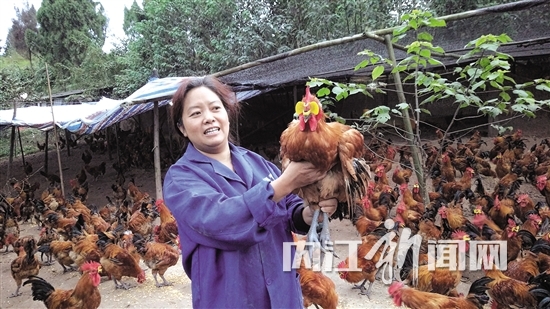
■A sturdy rooster
Huang Bin, a farmer from Yinshan Town, Zizhong County, hatched eggs and sold chicks using traditional techniques for 30 years, but his small-scale operation never made much money. Two years ago, he changed his business thinking and "assembled" idle rural land for farming, raising chickens, ducks and fish, with an annual output of 200,000 chickens and ducks and tens of thousands of jin of fish --
"Boss Huang, please send 100 free-range chickens to 'Baiyun Lake Leisure Villa' on Baiyun Mountain. Hurry up, we're about to run out of stock." Early in the morning on November 6, Huang Bin, a farming operator in Washangou Village, Yinshan Town, received a call from a customer requesting delivery as soon as possible. "Brothers, time to work, catch the chickens!" Huang Bin called out to the workers to get up.
In autumn and winter, after sales pick up, this is not the first time Huang Bin has arranged for workers to get up early...
■From hatching and selling eggs to ecological farming
Huang Bin's parents were both farmers, making a living from egg-hatching techniques passed down from their ancestors. In the 1980s, his parents passed the egg-hatching technique on to Huang Bin, giving him a skill to make a living.
At that time, he hatched three to four thousand chicks a month and kept traveling to various market towns to sell them. Because hatching chicks involved high losses, he could only earn ten to twenty thousand yuan a year. After saving a little money, Huang Bin went to Tibet and Yunnan one after another to "switch careers" and take on small construction projects, but ended up losing everything. Left with no choice, he returned to his hometown and went back to his old trade.
In 2001, starting over, Huang Bin met Tang Min from the Neijiang Breeding Chicken Farm, and they developed feelings for each other and became husband and wife. With the strong support of Tang Min, his "hatching consultant," the chick survival rate greatly improved. After nearly 10 years of operation, Huang Bin accumulated a certain amount of initial capital. After investigating the market, he had a new idea: he planned to extend the egg-hatching business and develop ecological farming in the countryside. "Modern people pay attention to nutrition and health in what they eat. Green food like ecological chickens will certainly not lack a market." Huang Bin believed.
■Ecological agriculture has great potential
He acted as soon as he decided. Because most local villagers had gone out to work, there was a great deal of idle land. After obtaining the consent of village and group officials as well as local villagers, Huang Bin centralized the planning of this idle land and set up a chicken and duck farm with a scale of more than 200 mu. He also contracted a local 120-mu reservoir to raise native crucian carp. Under the "professional technical" guidance of his wife Tang Min, roosters and hens were raised separately. All the "chicken pens" were arranged around the reservoir, with spacious grounds and good air, and drinking water from a living source. The raised chickens had room to move about, were all strong and vigorous and did not get sick. The aggressive roosters had firm, chewy meat; the hens were busy laying eggs. Every day, Huang Bin arranged for workers to cut grass to feed the roosters and collect insects to feed the hens. "Grain paired with green grass keeps the nutrition of roosters and hens up to standard. Hens eating some insects at the right time is even better for laying eggs." Tang Min said.
The reporter came to the site and saw the roosters running and fighting on the hillside, the hens either looking for food in the grass or laying eggs in the sheds, and the fish playing and chasing waves in the water -- what a scene of ecological rural life. Nearby, there was also a leisure sightseeing pavilion under construction, in order to attract people seeking rural leisure to come fishing and taste ecological food.
Huang Bin told the reporter that his farm now normally keeps nearly 30,000 chickens and ducks on hand, ships out one batch every week, and produces about 200,000 chickens and ducks a year. In addition to the local market, they are currently also sold to many cities such as Chengdu and Anyue.