Fu Chenghua, a national-level major grain grower, turns barren fields into a treasure trove
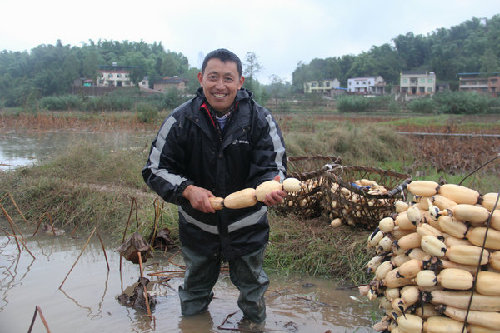
Fu Chenghua, a villager from Group 3 of Qushui Village, Guoliang Town, Dazu District, is a well-known expert at getting rich. He once drifted away from home for many years, but starting in 2013, by renting and farming more than 500 mu of paddy fields from villagers, the "Old Fu" in the villagers' words became "Boss Fu," and he found a sense of accomplishment in the fields of hope.
When he first chose to return home to become a major grain grower, Fu Chenghua was not only tired of the migrant worker's life, but more importantly, he could not bear to watch the village's good farmland lie waste. This "old hand" at farming felt he should plant all these fields with grain.
Two years after returning home to grow grain, Fu Chenghua was named a national-level major grain grower.
Unable to bear seeing fields go to waste, he returned home to take up his old trade
Fu Chenghua, now 51 years old, is a true farmer. He began working in the fields as a child and is truly an expert when it comes to farming.
Years ago, like most villagers, Fu Chenghua chose to go out to work, laboring as a bricklayer on construction sites. Thanks to his solid hard work and rising wages, Fu Chenghua earned more than 60,000 yuan a year and saved up some money. He not only tore down the family's old house and built a two-story Western-style building, but also had a certain amount of savings on hand.
During his days working away from home, Fu Chenghua liked watching TV, and he especially enjoyed watching CCTV's agriculture channel and the stories of major livestock and grain growers. As he watched, Fu Chenghua went from simply being envious at first to gradually seeing the tricks of the trade, and he felt he actually had a chance to be a "major grower" himself.
Every year when he came back from working away, Fu Chenghua would go around the farmland, and every time he saw fields left waste because their owners had gone out to work, his heart ached. "Such good paddy fields, it's really a pity to let them lie waste like this." He sighed that the scene he used to see, when every household carefully tended each plot and crops grew beautifully everywhere, was now gone.
"It's not right for those fields in the village to lie waste. Now I have some money in hand, the state also has support policies for major grain growers, and I'm good at growing grain, so I should be able to try renting these fields to grow grain." Fu Chenghua calculated in his heart. Besides his natural closeness to farmland, the hardship of working away from home was also an important factor that pushed Fu Chenghua to decide to return to his hometown to grow grain. "Home is still more comfortable, and I can make some contribution to my hometown."
In July 2013, after repeated planning, Fu Chenghua finally made up his mind not to go out anymore. He visited villagers door to door in the village and reached agreements with them, renting a total of 520 mu of paddy fields in the high-yield grain and oil demonstration zone at an annual rent of 320 yuan per mu, of which abandoned fields accounted for more than half.
Throwing himself into the farmland with passion
In the familiar countryside, Fu Chenghua quickly found an opportunity to show his talents in the fields. While renting the fields one by one, Fu Chenghua first planted more than 40 mu of rapeseed. In May 2014, he harvested more than 7,000 jin of rapeseed. Calculated at the market purchase price of 3.5 yuan, the income reached nearly 30,000 yuan. "Many people in the village have gone out to work, and few of those left at home grow rapeseed. Once this season's rapeseed was harvested, it was quickly ordered out by the villagers, and demand far exceeded supply." Fu Chenghua began to taste the sweetness of land contracting.
The sweetness did not stop there. As a major grain grower, Fu Chenghua was eligible to enjoy the government's direct subsidy of 200 yuan per mu for major grain growers. After receiving the subsidy in the future, Fu Chenghua would, according to the field rental agreement, distribute the ordinary farmer grain-growing direct subsidy of 125 yuan per mu to each paddy field owner one by one.
In Guoliang Town, Fu Chenghua was a key target of support for the town government. When negotiating field rentals with villagers, staff from the town government's agricultural service center stepped in to help coordinate, so that the fields Fu Chenghua rented were concentrated in connected plots, making cultivation and field management easier.
During the first spring plowing in 2014, staff from the Guoliang Town Agricultural Service Center again helped Fu Chenghua select seeds and came to the fields many times for technical guidance. During sowing and seedling raising, the town government sent three bags of rice seedling strengthening agent; during transplanting, the town government also provided two transplanters free of charge, seizing the right time in the 100 mu of paddy fields suitable for transplanter use. At the same time, the town government also provided Fu Chenghua with 4 types and more than 500 packets of pesticides free of charge, so that he could promptly kill insects and eliminate pests after transplanting was finished.
Starting in March, Fu Chenghua's contracted fields began planting the first season of rice. He still clearly remembers the labor scene at that time: on March 8, Fu Chenghua hired experienced older farmers from the village to sow and raise seedlings. Starting on April 8, more than 80 transplanting workers he hired in the village went down into the fields in waves to begin transplanting. On and off during this period, the transplanting work did not end until early May. Afterward, the workers again went into the fields to clear weeds and vines, and this work would continue for more than ten days.
That season, Fu Chenghua planted two high-yield seedling varieties, Jinsui 916 and Y Liangyou 199. At autumn harvest, each mu could produce 900 jin of rice, and all the rice fields harvested 470,000 jin of rice.
Because of the large early investment in clearing and preparing fields, plus paying the field rent in one lump sum and the huge expense of hiring labor, Fu Chenghua's savings were quickly used up, and he even owed some debts. In the first year, Fu Chenghua, busy from the beginning of the year to the end, did not make much money from the grain fields, but Fu Chenghua was not panicked. He knew that once his experience matured, he would find room to lower costs and increase income.
It is often said, "With grain in hand, the heart is not anxious." That was exactly the case for Fu Chenghua. Especially every July when the grain matured, he stood on the field ridge and watched more than 500 mu of good farmland he had cultivated turn golden every day, and Fu Chenghua's heart bloomed with joy.
Good policy support made him a national-level major grain grower
In the past two years, Fu Chenghua has enjoyed more and more policy benefits.
Fu Chenghua is a major grain grower, and the government's grain-growing subsidy per mu was raised to 230 yuan according to regulations. Well-informed, he now had something to look forward to. "I saw in the newspaper that many people's congress representatives and CPPCC members have suggested the state increase subsidies for major grain growers. The hope is still very good." He hoped such good policies could be introduced soon.
In addition, the government supported major growers in renting full-process socialized services. For one mu of field from transplanting to harvesting, a professional company providing full-process socialized services required payment of 540 yuan, while the financial subsidy was 280 yuan, so an individual only needed to pay 260 yuan. This reduced a lot of burden for Fu Chenghua. However, the land rent also rose to 400 yuan per mu.
"In the past I had to hire many people, and just the labor cost was a big expense. Now with agricultural companies providing services, I don't have to worry much and spend less money." Fu Chenghua personally experienced the course of great agricultural development and praised the achievements of agricultural development in Dazu in recent years without end.
In 2015, Fu Chenghua, who transferred more than 500 mu of land and produced about 470,000 jin of rice annually, was rated a "national-level major grain grower" by the Ministry of Agriculture. He never expected to win a national-level award "without even noticing," and Fu Chenghua was greatly inspired that he had grasped the national trend. The spring of major grain growers had truly arrived!
Diversified operations broaden the road to prosperity
This year, after finishing the grain harvest, Fu Chenghua no longer planted rapeseed, but began planting radishes.
"Of more than 500 mu of paddy fields, this time I first planted more than 200 mu. Planting too much would leave me short on energy, and I was also afraid I wouldn't be able to sell it all." The bold Fu Chenghua seemed very cautious this time. When deciding to plant radishes, he had already contacted buyers. Once the radishes matured, they would be sold to a pickle processing factory, "at a price of more than two mao."
These days, green radish seedlings are emerging from the fields, looking very beautiful under the gray-yellow winter sky.
It is just the thinning period, and Fu Chenghua and his wife's job is to pull out the extra radish seedlings, so the radishes are not planted too densely and do not grow too small. Every day, although they hire workers, the couple still goes into the fields to work themselves. They patrol the fields and keep bending down to thin the seedlings. Fu Chenghua and his wife stay bent over all day, and by the end of the day their backs and waists ache.
"What we do is hard work, and what we earn is hard-earned money." Fu Chenghua comforted himself that no matter how tired he was, it was not as tiring as working as a construction worker away from home before, and every bit of work he did brought income that was his own. Thinking this way, Fu Chenghua did not feel very tired.
This year, having tasted the benefits of renting land, Fu Chenghua acted again. In his own village, he transferred 100 mu of land at 400 yuan per mu, specifically for growing lotus roots. In the first year, the lotus root fields immediately had a bumper harvest.
During this period, Fu Chenghua hired several lotus root diggers every day to dig lotus roots, and drove a three-wheeled motor vehicle himself to haul basket after basket of lotus roots along the field road to a loading point several hundred meters away. After being loaded onto large trucks, they were transported to the Chongqing wholesale market for sale, and the sales were good.
Now one mu of land produces 1,500 kg of lotus root. These days the wholesale price of lotus root is 2.6 yuan/kg, so the gross profit looks considerable, but the wages of lotus root diggers are very high, and Fu Chenghua did not think he could make too much money. Astute Fu Chenghua decided to dig the lotus roots slowly and not finish until March next year.
"Wait, wait until the price is higher before digging, so I can earn a bit more money." Fu Chenghua said this was also experience he had learned from other major lotus root growers.
A bumper grain harvest, a bumper lotus root harvest, and barring accidents, radishes will also have a bumper harvest. Everything in the agricultural business is developing in the direction he envisioned. Under this excellent situation, Fu Chenghua's family is accelerating its pace toward prosperity.
After finishing the work in the fields, Fu Chenghua's wife took charge of a pig farm. They now raise more than 50 pigs, and through careful tending, the pigs in the pens are fat and strong. Fortunately, this year's live pig market was relatively good. Fu Chenghua's daughter-in-law opened a supermarket in the village and also provides e-commerce services, not only sending express deliveries, but also selling local specialties online.
The whole family is busy every day, and Fu Chenghua feels very satisfied. He firmly believes in a simple truth: prosperity comes from hard work. As long as you find the right direction and are not afraid of hardship and work steadily, life has promise and will get better and better.