Huaiji demobilized soldier Liang Yusheng returns home to run integrated farming and breeding and get rich
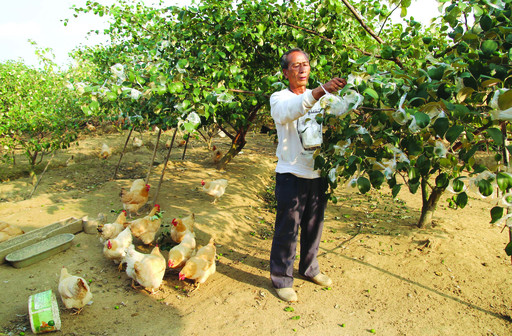
Liang Yusheng inspects the growth of the fruit and chickens in the orchard.
Taking off the military uniform and joining the ranks of migrant workers
The honey dates are ripe, and flocks of orchard chickens forage under the fruit trees... In an orchard at the foot of Chenggai Ridge in Jianshui Village, Liangcun Town, Huaiji County, Liang Yusheng, a demobilized soldier approaching sixty, stands on high ground, enjoying the joy of successful entrepreneurship while also savoring the hardships of that journey, as well as the warmth of his comrade-in-arms' wholehearted help when he was in difficulty.
Taking off the military uniform and joining the ranks of migrant workers
Liang Yusheng is a native of Jianshui Village, Liangcun Town, Huaiji County. In the early winter of 1977, he signed up to join the army and went to serve in the unit where the anti-Japanese heroes the "Five Heroes of Langya Mountain" had once served.
In the early spring of 1979, a battle to defend the southern border began. Liang Yusheng went with his unit to the front line and fought the enemy amid a hail of bullets. After the battle, he was awarded a third-class merit, joined the Party, and became a squad leader.
In the winter of 1982, Liang Yusheng, who had already served beyond his term, took off his beloved military uniform and returned home with his unfulfilled dreams, beginning a new journey in his life.
Together with the young men of the village, Liang Yusheng went to Zhongshan, Guangzhou and other places to work. In order to earn money to support his parents, Liang Yusheng came to a garment factory in Foshan to work. "In a garment factory with more than 1,000 people, there were only a few male sewing machine operators. When the factory director heard that I had been a soldier, fought in a war, and won a merit, he felt admiration in his heart, so he transferred me to the cutting table of the garment factory and also introduced me to contract a garment cutting and processing line, giving me a way to make money." Liang Yusheng cherished this opportunity to contract the garment cutting and processing line very much. "In order to open up the market and increase orders, I often left early and returned late, was so busy every day that I ate only two meals, and kept busy until late at night."
In 1988, with the first pot of gold he earned from working, Liang Yusheng returned home, demolished the crumbling mud-brick tile house, and rebuilt it into a two-story building. "That year I also got married, and later had a son and a daughter," Liang Yusheng said.
Returning home to start a business growing fruit, the first battle ended in failure
After working away from home for more than ten years, Liang Yusheng discussed it with his wife and decided to return home to start a business. "Although the outside world is wonderful, people must eventually return to their roots, and modern rural areas also offer broad horizons."
So in 2003, after Liang Yusheng returned home, he found that many local people grew Gonggan mandarins and Mashui tangerines. "I thought fruit growing had a future, so I contracted 40 mu of wasteland under Chenggai Ridge in the village and planted Gonggan mandarins and Mashui tangerines."
The 40 mu of wasteland under Chenggai Ridge in Jianshui Village was overgrown with weeds and piled with rocks. Liang Yusheng and his wife worked hard from dawn to dusk for more than a month in a row. His elderly parents felt sorry for their son and daughter-in-law and also worked with them. Together they moved away the rocks, cleared the weeds, turned the 40 mu of wasteland into an orchard, and planted Gonggan mandarins and Mashui tangerines.
A few years later, when the fruiting season for Gonggan mandarins and Mashui tangerines arrived, Liang Yusheng was shocked to find that "more than half of the fruit trees planted that year had died, and the surviving fruit trees bore very little fruit. After several years of hard work, our whole family not only failed to make money, but instead lost tens of thousands of yuan."
To repay a life-saving debt, a comrade-in-arms sends "timely rain"
"To develop farming and breeding in rural areas, passion alone is not enough; technology is very important!" Liang Yusheng was unwilling to accept failure and decided to start from scratch learning fruit-growing techniques. "But replacing the more than half of the fruit seedlings lost in the orchard would cost more than 20,000 yuan. At that time there was nowhere to borrow money, and the funds really worried me!"
Just when Liang Yusheng was worrying about how difficult it was to raise funds, one of his comrades-in-arms sent him 30,000 yuan like timely rain.
Liang Yusheng knew that this comrade-in-arms had been disabled by injuries sustained on the battlefield. "After demobilization, his life had never been well-off. This 30,000 yuan was the retirement money of him and his wife. I could not accept it no matter what, and declined several times. But unexpectedly, this comrade-in-arms angrily shouted at me, 'On the battlefield, if you had not saved me, I would have died long ago. How could there still be this 30,000 yuan? Now that you are having funding difficulties growing fruit, I should help you without shirking. You cannot stop me from repaying your kindness!'" Liang Yusheng was deeply moved by his comrade-in-arms' words from the bottom of his heart. "At that time both he and I shed tears, and both of us could not help but recall the scene on the battlefield of risking death and forgetting life."
Liang Yusheng's comrade-in-arms recalled to the reporter, "Once, I was wounded in the head in battle and blood would not stop flowing. Liang Yusheng carried me on his back and ran straight to the field ambulance station in the rear, but we were discovered by the enemy, who kept firing bullets and shells at us. I worried that with Liang Yusheng carrying me, the target was too big and that I would cost him his life, so I told him not to bother with me, to put me down and hurry to catch up with the unit. But Liang Yusheng shouted at me, 'We are comrades-in-arms, brothers in life and death. How can I leave you behind!'"
Liang Yusheng himself did not know how he had such great strength back then. "In one breath I carried my wounded comrade-in-arms on my back and ran several kilometers, then handed him over to the doctors at the field ambulance station."
Liang Yusheng had not expected that what he regarded back then as merely part of his duty on the battlefield would be remembered with gratitude by his comrade-in-arms for most of a lifetime. "After he was demobilized, he came to visit me every year. This time, when I had no funds to grow fruit, he again sent me his only 30,000 yuan, which made me feel even more how precious comradeship in arms is."
Self-taught farming and breeding techniques make him a "local expert"
In 2006, after replanting Gonggan mandarins and Mashui tangerines in the orchard, Liang Yusheng sought advice everywhere from skilled fruit growers in the town and in Huaiji County, learning the cultivation techniques for Gonggan mandarins and Mashui tangerines. At the same time, he also bought many books on fruit tree cultivation. "During the day I worked in the orchard, and at night I taught myself fruit-growing techniques."
Starting in 2010, Liang Yusheng's orchard began to yield returns, "with a net income of more than 100,000 yuan each year."
In 2014, based on market demand and factors such as the aging of some fruit trees over the years, Liang Yusheng newly planted honey dates in the orchard and also raised free-range chickens, adopting an integrated farming and breeding model.
Liang Yusheng enumerated to the reporter the benefits of raising native chickens in the orchard. "Raising native chickens in the orchard can not only lower the cost of raising chickens, but also increase the yield of the fruit trees. When chickens are raised in the orchard, chicken manure becomes organic fertilizer for the fruit trees. The grass, insects and fallen fruit in the orchard become natural feed for the chickens. At noon and in the evening every day, I only need to scatter a small amount of chicken feed such as corn and bran, and those free-range chickens will be full. More importantly, because free-range chickens taste good, they are very popular with chicken dealers and urban and rural food stalls, and there is no worry about sales at all."
Since then, Liang Yusheng has raised several batches of free-range chickens in the orchard each year, "more than 600 in each batch, and raising free-range chickens alone can earn more than 20,000 yuan each year."
In 2015 and 2016, the honey dates Liang Yusheng grew in the orchard bore more than 20,000 kg of fruit each year. Because this kind of honey date is crisp, sweet and juicy with a unique flavor, it is deeply loved by people. "The honey dates can be sold out right in the orchard, earning more than 50,000 yuan each year."
After 13 years of hard struggle, Liang Yusheng finally turned the 40 mu orchard he had contracted back then into a money tree. But he did not forget his original intention and always wanted to do something for the poor villagers in the village. "I am a demobilized soldier and also a Communist Party member. I cannot just look after my own prosperity. Helping poor villagers shake off poverty is my bounden duty."
Liang Yusheng plans to help poor households plant a few mu of honey dates next spring, "and each household will also raise more than 100 free-range chickens under the fruit trees. I will provide honey date saplings and chicks free of charge, and take responsibility for technical support and sales channels, so as to increase their income and help them shake off poverty as soon as possible."