Peacocks sell for 700 yuan each: young man from Yunyang returns home to start a farming business
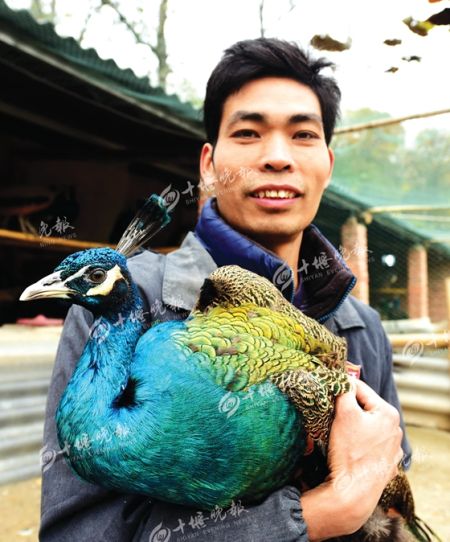
Yang Junwei and the peacocks he raises
After graduating from university, Yang Junwei, a 32-year-old young man from Yunyang District, worked as a teacher and then in e-commerce. Now he has invested 100,000 yuan in his hometown of Meipu Town to raise peacocks.
At Yang Junwei's farm, more than 400 peacocks sometimes fan their tails and sometimes call out "gugu," making it look just like a small zoo.
At first, he invested in peacock farming just to find something for his father to do
On the morning of the 24th, when the reporter arrived at a small courtyard in Group 7 of Lijiagou, Meipu Town, Yunyang District, Yang Junwei was bending over, scattering corn and bran. Blue peacocks surrounded him, scrambling for the food.
Why did he first think of going home to raise peacocks? Yang Junwei, 32, said with a smile that he graduated from Xiangfan University (now Hubei University of Arts and Science) in 2008. After graduation, he taught at a secondary vocational school in the urban area of Xiangyang. In 2011, seeing the prospects of the e-commerce industry, he resigned and, together with his wife, opened 4 online stores, mainly selling women's clothing.
"The online stores can earn 200,000 yuan a year," Yang Junwei said. His online stores were doing booming business.
Yang Junwei's father, Yang Guoqiang, who is nearly 60, had worked away from home for many years, but in 2014 he was found to have heart disease and could only return home. "But my father can't sit still, and he insisted that I find him something to do." Left with no choice, Yang Junwei planned to have his father go into farming.
Not long afterward, Yang Junwei learned that a friend of his was raising peacocks elsewhere. After asking around and hearing that the prospects were good, he devoted himself to studying the trade. He then traveled to Hunan, Zhejiang and other places to investigate and learn, and finally decided to have his father raise peacocks at home. "At first it was purely to find something for my father to do; I didn't plan on earning much money."
After seeing peacocks die one after another, he resolutely returned home to start a business
Without delay, in the spring of 2014, Yang Junwei took out 100,000 yuan of his savings, built more than a dozen small sheds in his hometown, fenced them in with nylon netting, and then went to Hunan to buy peacock eggs and an incubator.
"At the time, one peacock egg cost 63 yuan, and I bought 100 in total," Yang Junwei said. Because of a lack of experience, in the end only more than 20 chicks hatched. Several months passed, and because his father had no experience, only two peacocks were left alive.
When he learned that the investment had failed, Yang Junwei, then in Xiangyang, was unwilling to give up. In June 2014, he went to Zhejiang again and bought more than 180 chicks at 120 yuan each, sending them back to his hometown in Meipu Town.
To ensure that the farming would not fail again, Yang Junwei studied and learned while running his online stores in Xiangyang. In addition to looking up relevant information online, he also went many times to Hunan, Zhejiang and other places to learn, and passed on the techniques he mastered to his father.
In the autumn of 2015, his father's health worsened, and he no longer had the energy to farm. One-third of the 180 peacocks died one after another, which pained Yang Junwei deeply. He had to keep this going! So Yang Junwei gave up his online stores in Xiangyang and returned to his hometown with his wife and children.
"Now my wife lives near the urban area of Yunyang, taking care of the children while managing the online stores, while I devote myself entirely to raising peacocks," Yang Junwei said.
One peacock sells for 700 yuan, and the first batch earned 30,000 yuan
"Raising peacocks requires skilled techniques," Yang Junwei said. Especially for young birds, they must be kept warm 24 hours a day for the first 3 days, after which the heating time must be gradually reduced. Because the initial techniques were not mature and the indoor temperature was too high, some young peacocks fought each other and died.
"Peacocks usually mainly eat corn, bran, soybean meal, bone meal, fish meal and other foods," Yang Junwei said. One peacock needs more than 2 liang of food each day, and they can generally be sold after about a year.
After more than two years of farming, Yang Junwei's first batch of peacocks had grown up. In April this year, after restaurant owners in the urban area of Shiyan and in Xiangyang and other places learned about them, they came to his door to buy them. Yang Junwei sold more than 40 peacocks at an average price of 700 yuan, earning 30,000 yuan.
In July this year, Yang Junwei again bought 400 peacock chicks from Hunan at 100 yuan each. "Now the farm has more than 460 peacocks, large and small," Yang Junwei said. At present, the feed costs about 100 yuan a day, and if all are sold after 1 year, he can earn 300,000 yuan.
He plans to establish a cooperative to help fellow villagers get rich together
Yang Junwei told the reporter that peacocks are divided into two kinds: green peafowl and blue peafowl. The green peafowl is a national first-class protected animal, has a certain aggressiveness, and must not be hunted or killed. The blue peafowl comes from India and was introduced to our country in the 1990s. It is a rare farmed bird encouraged by the state for farming and combines ornamental, edible and health-care value. Blue peafowl meat is a rare wild delicacy with high protein, low fat and low cholesterol. It has high nutritional value and delicious meat, and there is a saying: "Among the water, the old soft-shelled turtle; among the birds, the peacock."
According to the Compendium of Materia Medica, the peacock wards off evil and can neutralize a hundred poisons, and peacock meat and blood have detoxifying effects. The whole peacock is a treasure: the meat can be eaten, the gall can treat illness, and the feathers can be made into specimens. Yang Junwei said that in addition, peacock manure can also be used as organic fertilizer, which is very suitable for crop growth. At the same time, each peacock egg can sell for 60 yuan, and a peacock can lay 40 eggs a year, which adds up to more than 2,000 yuan in income.
"In the near future, I plan to establish an agricultural cooperative and encourage neighboring households to raise peacocks together, so as to lead everyone to prosperity together." Yang Junwei is full of confidence in the future.