Growing pink bananas and cultivating mushrooms under rubber plantations achieves double income growth
"This past year, spending every day with the villagers, I've gotten used to it, and I feel some reluctance to leave. Although my task is complete, the villagers' path to prosperity has only just begun." — Xie Xuefang
A fine drizzle pattered against the banana leaves, the rain soaking through the soil at the edge of the field. Xie Xuefang, deputy mayor of Wupo Township in Tunchang, squatted in the rubber plantation, observing the growth of the pink bananas.
Xie Xuefang, a researcher at the Rubber Research Institute of the Chinese Academy of Tropical Agricultural Sciences, arrived in Wupo Township on December 29, 2015, to serve a one-year temporary posting as deputy mayor. During this year, Xie Xuefang successively carried out projects for growing pink bananas under rubber plantations and growing tea tree mushrooms under rubber plantations, setting more than 200 farmers on the path out of poverty toward prosperity.
He was once a teacher, and "switched careers midway" to do scientific research
The first meeting with Xie Xuefang was at the Wupo Township government office. Xie Xuefang's first impression on the reporter was not that of a researcher, nor that of a deputy mayor, but more like a farmer, revealing simplicity and honesty in his every gesture.
According to the "Action Plan for Talent and Intellectual Support for Western Cities and Counties" of the Provincial Party Committee and Provincial Government, Xie Xuefang and 48 other selected comrades were assigned to local townships to serve temporary terms as science and technology deputy township heads, with a one-year term. On December 29, 2015, Xie Xuefang reported to the Wupo Township government office, put in charge of earthquake and science and technology work, while also assisting with agriculture.
During the interview, the reporter learned that Xie Xuefang was a researcher who had "switched careers midway."
Xie Xuefang told the reporter that he had previously been a teacher. At the age of 38, he successfully passed the postgraduate entrance examination through self-studying ecology, and from then on embarked on the path of scientific research.
Although he was a researcher, Xie Xuefang's main work was the promotion of scientific research achievements, and he did not have much contact with the grassroots, so when he first took up his temporary post, he was a bit "at a loss." "I didn't understand the grassroots environment, and I didn't know where to start. At that time, the township leaders took me around every day, and after a while I became familiar with things," Xie Xuefang said.
Growing pink bananas under rubber plantations, increasing income by two to three thousand yuan per mu
Because he himself was engaged in agriculture, Xie Xuefang first thought of starting with agriculture.
Through his visits, Xie Xuefang learned that the agricultural cash crops in Wupo Township were mainly rubber and areca nut, and it happened that he had done some research on the "economy under rubber plantations," which immediately gave him a direction. "The economy under rubber plantations is not a new planting model, but it had not been developed in Wupo Township."
Xie Xuefang thought of growing pink bananas under rubber plantations, "because pink bananas are very easy to grow, the technical difficulty is low, and there are 3 purchasing points in the township, so there's no worry about sales, and the price is relatively high." Xie Xuefang told his idea to Wang Zonghan, director of the Wupo Township Joint Farm, and Wang Zonghan was very supportive, immediately deciding to set aside 15 mu of land as a demonstration area.
"Come on, let's first take a look at the farm." Led by Wang Zonghan, the reporter and his group arrived at the pink banana demonstration area of the Wupo Township Joint Farm. "Oh, they've already grown this tall, I didn't expect that," Wang Zonghan said. The gratifying growth of the pink bananas surprised him somewhat.
Many pink banana trees were interplanted among the rubber plantation, each about one person tall. Xie Xuefang walked into the field and carefully checked the growth of the pink bananas. "Not bad, they're all growing very well," Xie Xuefang said. These pink bananas were planted in June of this year, and can be harvested in July or August of next year.
After confirming the project of growing pink bananas under rubber plantations, Xie Xuefang applied for 7,000 seedlings, which were sent to the village committees of each village, along with free fertilizer and other supporting supplies. Because they were distributed free of charge, the 7,000 seedlings were quickly snatched up, so Xie Xuefang applied for another 6,000 seedlings, which were again snapped up. "I hadn't planned to distribute a second batch, but I didn't expect the villagers' enthusiasm to be so high," Xie Xuefang said.
Lin Fangqiong of Neilin Village in Wupo Township was one of the "active ones" who received seedlings. He got a total of 2,000 seedlings, with a planting area of 20 mu. "Because they're free, and Deputy Mayor Xie is there to check, we have nothing to worry about," he said.
At present, more than 200 villagers in Wushi Township are participating in the pink banana project under rubber plantations, with a planting area of more than 130 mu. "The pink bananas we promote are a high-yield, excellent variety. Previously, a single locally grown pink banana could produce at most 20 jin, but now the average yield is 50 jin. Calculating this way, after deducting management costs, the net income per mu can increase by more than 2,000-3,000 yuan," Xie Xuefang said.
Growing mushrooms under rubber plantations, earning ten thousand yuan in just over ten days
Xie Xuefang told the reporter that growing pink bananas is only suitable for rubber plantations with trees under 5 years old. After the rubber trees grow larger, their branches and leaves will block sunlight and affect the growth of pink bananas, which inevitably limits the growing of pink bananas. So in rubber plantations with relatively large rubber trees, how can the "economy under the forest" be developed?
Xie Xuefang learned that a company in Wupo Township had previously grown bamboo fungus under rubber trees, and this company also happened to have experience growing tea tree mushrooms. Tea tree mushrooms prefer cool and shady conditions, which happen to be suitable for growing under large rubber trees, so the project of growing tea tree mushrooms under rubber trees came to Xie Xuefang's mind.
After Xie Xuefang reported the project, it immediately received support from the Tunchang County Agriculture Bureau, which allocated 300,000 yuan in funding. Xie Xuefang set up a tea tree mushroom demonstration area in the rubber plantation of the above-mentioned company, and at the same time promoted it to cooperatives in two villages, opening a path in which enterprises lead farmers' professional cooperatives to grow tea tree mushrooms under rubber trees.
Wang Xiaoming is the director of Dahu Village of the Qingti Village Committee in Wupo Township. In 2014, he joined with several villagers to establish the "Jinming Agricultural Planting and Breeding Professional Cooperative." He himself also became the first promoter of the project of growing tea tree mushrooms under the forest.
Wang Xiaoming told the reporter that when the cooperative was first established, what he first did was grow bamboo fungus under the forest, but he did not make any money. "Later, Deputy Mayor Xie came to me and told me about the project of growing tea tree mushrooms under the forest. I thought it was feasible, so I agreed," he said.
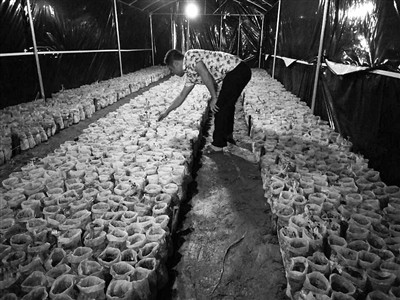
In the rubber plantation next to Wang Xiaoming's home, there are 5 greenhouses, all planted with tea tree mushrooms. Some have already grown to maturity, and some have just sprouted. "These sprouted ones grew back after being picked," Wang Xiaoming told the reporter. About 10-plus days ago, the first batch of grown tea tree mushrooms began to be harvested. Because tea tree mushrooms grow quickly, they grow back the second day after being picked, so there are fresh tea tree mushrooms almost every day.
"Because sales channels haven't been opened up yet, we've only harvested from three greenhouses, averaging about 200 jin per day, which we take to the township to sell. Now in just over ten days we've already sold about 10,000 yuan worth," Wang Xiaoming said. He couldn't handle the work alone, so he also hired eight or nine impoverished households from the village to help, which both reduced his own pressure and helped lift the village's impoverished households out of poverty.
Inviting experts for training
"Teaching villagers to fish"
From the first day of his temporary posting, Xie Xuefang insisted on taking "science and technology serving agriculture, rural areas, and farmers" as his purpose, using science and technology for poverty alleviation. But it is easier said than done.
Xie Xuefang told the reporter that when pink banana planting was first carried out, many villagers did not know how to plant them, and many seedlings were lost. "Later I applied for 1,000 replacement seedlings, and watched them plant in the field while telling them how to plant."
In addition, Xie Xuefang also organized science and technology training at each village committee. He organized 5 sessions of science and technology training, training farmers more than 300 times; he organized heads of cooperatives in Wupo Township to participate in the "Patent Multiplication" series of training carried out by the Provincial Department of Science and Technology in Tunchang. He actively gave play to the bridging role between his temporary posting location and his original unit, inviting experts from the Rubber Research Institute of the Chinese Academy of Tropical Agricultural Sciences 5 times to carry out technical guidance on rubber planting and management.
On December 30 of this year, Xie Xuefang will have completed a full year of his temporary posting, and he will leave Wupo Township to return to his original unit. Speaking of parting, Xie Xuefang said, "This past year, spending every day with the villagers, I've gotten used to it, and I feel some reluctance to leave. Although my task is complete, the villagers' path to prosperity has only just begun," he said.