Specialty farming helps Li Feng get rich
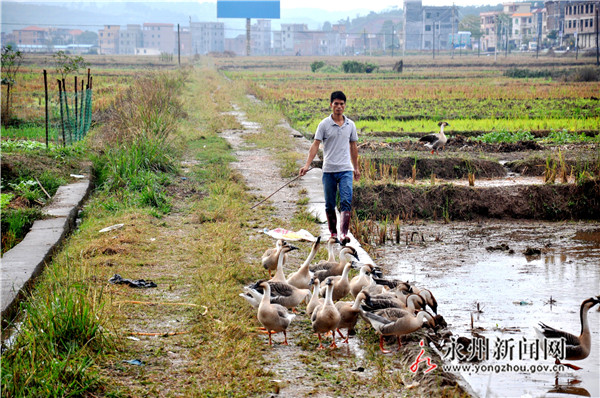
In Tushi New Village, Lanshan County, there is a man whom the surrounding people call "Pig Boss" and "Goose Commander." In his specialty farm, you can see everywhere the beautiful sight of hundreds of "swan geese" from Siberia spreading their wings and soaring in the sky, and you can also witness firsthand the vivid scene of Tibetan fragrant pigs from Tibet running happily through the mountain forests foraging for food. He is Li Feng, a specialty farming professional here. At 37 years old, he makes full use of the local resource advantages and focuses on building an ecological farming industry. He has successively introduced Tibetan fragrant pigs and swans from Tibet and Siberia to settle in Lanshan New Village, adopting an extensive management model of free-range release, allowing the Tibetan fragrant pigs and swans to naturally forage and grow in the mountains and fields. With excellent quality, he has made Tibetan fragrant pigs popular in the market and brought delicious swan meat to ordinary people's dining tables, carving out a new path to wealth through specialty farming.
Ignoring family opposition and wholeheartedly pursuing entrepreneurship, an "outsider" becomes "Pig Boss"
"The reason I chose to raise Tibetan fragrant pigs at the start of my business was purely accidental. It was because I watched an episode of the TV program 'Home in the Distance' that introduced the Tibetan fragrant pig, also known as the 'ginseng pig.' Tibetan fragrant pigs have thin skin, delicious meat, and rich nutrition. In ancient times, they were even one of the emperor's tribute offerings... After hearing this, I came up with the idea of starting my own business raising Tibetan fragrant pigs." Speaking about his entrepreneurship, Li Feng explained his original intention. At the same time, Li Feng also hoped that by free-range raising Tibetan fragrant pigs, he could make full use of the mountain forest land in his hometown that had been abandoned for many years, and after achieving success in farming, drive the people of his hometown to start businesses together and walk the road to wealth together.
"When I mentioned the idea of returning home to start a business, all my family and friends opposed it, thinking I was having unrealistic fantasies, like a toad wanting to eat swan meat."
It turns out that as early as 1999, Li Feng had been running an urban public bus passenger transport business in Dongguan, Guangdong, with an annual income of nearly 300,000 yuan, and his family lived very comfortably. Giving up such a great business and insisting on returning home to do something that even his parents' generation was unwilling to do. When he voiced his idea, it immediately drew strong opposition from family and friends.
The voices of opposition did not make Li Feng give up the dream of entrepreneurship in his heart. In April 2014, he went alone to Tibet and spent all of the more than 300,000 yuan in savings he had accumulated from doing business outside to purchase and introduce more than 130 breeding pigs, releasing them in more than 200 mu of mountain forest land in the village, feeding them a small amount of coarse grains such as sweet potatoes, corn, winter melon, and pumpkins every day.
Tibetan fragrant pigs belong to a grazing-type pig breed, mainly eating weeds and leaves, and there is a big difference from raising ordinary domestic pigs. Relying on the feeding models and technical experience for domestic pigs simply could not achieve success, which made Li Feng, who only knew how to drive, suddenly feel the hardships of entrepreneurship.
Not understanding farming technology, he invited two technicians from the pig farm where he bought the piglets to teach him farming techniques; lacking farming experience, he squatted in the mountain forest land all day "dancing" with the pigs, devoting himself to studying the living habits and patterns of Tibetan fragrant pigs. After several months of effort, the more than 130 Tibetan fragrant pigs gradually adapted to the growing environment here and successively gave birth successfully. Li Feng, an "outsider" who only knew how to drive, gradually figured out the techniques for raising Tibetan fragrant pigs. At the same time, relying on the farming techniques he had mastered and a down-to-earth drive, his Tibetan fragrant pig farming industry gradually moved toward scientific and large-scale farming, and he also jointly established a cooperative with more than 30 ecological farming enterprises.
In April 2015, a merchant from Yantian, Shenzhen, found Li Feng and spent 20,000 yuan to buy 8 Tibetan fragrant pigs. After deducting various costs such as feeding, he directly earned a profit of nearly 10,000 yuan, earning Li Feng his "first bucket of gold" in Tibetan fragrant pig farming.
"Last year alone, I sold more than 200 Tibetan fragrant pigs, mainly to Shenzhen, Guangdong, and other places. And now all the more than 200 Tibetan fragrant pigs being raised are ordered in advance." Li Feng said that because they are all raised free-range in mountain forests, each Tibetan fragrant pig has a petite body, low fat content, thin skin, delicious meat, and rich nutrition, and is widely favored in the market, with demand exceeding supply. With a raising cycle of one and a half years per pig, a 50 kg Tibetan fragrant pig at a market price of 60 yuan per kg, after deducting other costs, each meat pig can yield a profit of more than 1,000 yuan, and annual income can reach several hundred thousand yuan.
Introducing foreign swan breeds, letting "Pig Boss" become "Goose Commander" again
Having had a first taste of the sweetness of specialty farming, Li Feng by chance heard someone introduce that swan meat is a top-grade wild delicacy, with very high nutritional value and medicinal value, and is known as the world's "king of green food" and "emperor on the table." Now, with the permission of the relevant national authorities, it can be artificially raised and eaten, and its economic benefits are good.
Li Feng felt this was another excellent opportunity to expand his farming scale, so without another word, after going through the relevant departments to obtain the legal procedures for raising wild animals, in March 2016 he spent more than 100,000 yuan to purchase and introduce more than 600 young swans, "swan geese," from Siberia.
The "swan goose" is also called the wild goose or black-beaked goose. It mainly inhabits wilderness, marshes, and other places, preying on various plants and algae, and also eating soft aquatic animals. In order to develop the swan industry well, he invested almost all of his time and energy. Every day besides eating, he basically stayed with the swans, devoting himself to studying farming techniques and living habits, and making full use of the cooperative's resources by inviting two outstanding graduates of Hunan Agricultural University who were starting businesses at home to come to his home for technical guidance.
According to Li Feng, because all the swans use a combination of wild free-range raising and artificial domestication, there is not a single net in the base. The swans can fly whenever they want and come and go freely. Apart from feeding them a small amount of corn every day, they all forage on their own. In addition, because he started feeding them from a young age, in the swans' eyes he is their "lead goose." Every time they fly out, he does not have to worry that they will not return. Now the swans have already regarded this place as their home.
After nearly half a year of careful raising, Li Feng's more than 600 young swans all grew into large swans weighing 5-8 jin, and all of them can now be sold externally. At the current sale price of 400 yuan per swan, he can obtain an economic income of more than 100,000 yuan.
Changing the traditional sales model, building an ecological farm to drive the surrounding economy
In order to let more people understand the deliciousness of swan meat and further expand swan sales channels. In October this year, Li Feng raised more than 200,000 yuan and built a wild swan original ecological farm covering more than 200 sq m in his own courtyard. While changing the traditional sales model, he further expanded sales channels.
"The swans raised by Boss Li can fly and are delicious, and the price is affordable. I have bought them here several times before. Friends all say they taste good and have high nutritional value. This time I came specifically to bring a friend from Chenzhou to buy some together!" During the interview, the author happened to meet Mr. Chen, who lives in the county seat, coming with his friend to buy geese.
According to Li Feng, the ecological farm is now in the trial operation stage, mainly featuring raised wild swans and Tibetan fragrant pig dishes, and every week quite a few customers come to order meals. In the next step, he will also cooperate with nearby farmers running melon and fruit plantations and vegetable bases to build an original ecological farm integrating food, leisure, entertainment, and sightseeing. While tasting ecological food, customers who come to visit can also watch the entire farming process on site, go to the fields to plant vegetables and pick fruit, enjoy leisure fishing, and experience a different kind of pastoral pleasure. At present, every week quite a few customers drive over to buy geese and order meals to "try something fresh."