Writing Deep Love for His Hometown on the Arduous Road of Entrepreneurship
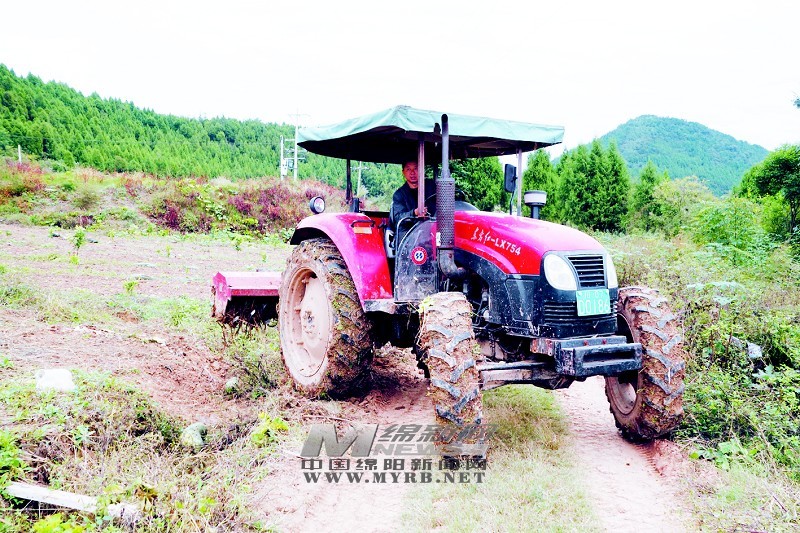
Lai Qiang driving agricultural machinery to level sloped land □ Yuan Lin
"If there's no production building, I build a shed myself; if there's a shortage of labor, I jump in myself. Seeing that the workers can earn ten or twenty thousand yuan in wages from me each year, and thinking that my honey pomelos will soon bring returns, I don't regret it at all." Lai Qiang, 51 this year, is a resident of the town seat of Wenxing Township, Zitong. Recalling the hardships of starting his business, he sighs with emotion.
At the end of 2012, Lai Qiang contracted nearly 300 mu of mountain land in several villages including Gaofeng, Guanghui and Zhaoyao, and introduced Liangshan Ci bamboo, thick in flesh and skin, embarking on the road of entrepreneurship. Today, from bamboo cultivation alone, his annual income reaches more than 200,000 yuan. At the same time, he has also led more than 10 nearby farming households to develop bamboo cultivation, increasing their incomes and becoming better off together.
Having tasted the sweetness of success through land transfer, Lai Qiang became even more determined in his confidence to start a business in the countryside. Last year, upon learning that the county was vigorously developing the honey pomelo industry, Lai Qiang quickly sprang into action and contracted more than 500 mu of mountain land to plant honey pomelos.
Industrial development is easier said than done. Leveling the land, digging ditches and building channels, constructing new roads, weeding and fertilizing... Add to that the large planting area, and neither labor nor machinery can be spared. In response, Lai Qiang invested more than 300,000 yuan to buy a full set of large and small agricultural machinery. A few months later, the land was finally leveled, and all of it was planted with the newest variety - "Sanhong honey pomelo."
Honey pomelos take 3-5 years from planting to harvest, and during this period there is not only no income, but also a great deal of manpower and money spent each year on weeding, fertilizing, pruning and so on. So Lai Qiang made use of the open space between the honey pomelo rows to intercrop vegetables. At the same time, he contacted pickle manufacturers and signed purchase contracts, launching order-based vegetable production. Because market conditions were relatively good, the sales of vegetables such as winter melon, pumpkin, green vegetables and chili peppers remained steady, and the income from a year was basically enough to cover expenses for labor, chemical fertilizers and pesticides. In addition, taking advantage of the favorable terrain near the mountain slopes, Lai Qiang also developed livestock and poultry farming. The 1,000 free-range chickens he stocked this year are about to be ready for market.
In the process of starting his business, Lai Qiang always kept the migrant workers from the surrounding area in his heart. Last year, more than 30 workers were employed long-term on Lai Qiang's contracted land, and over the course of a year, their wages amounted to about 300,000 yuan. Aunt Jing, in her 50s, told the reporter: "During the busiest time last year, I worked 26 days in a month and earned more than 1,500 yuan. Usually, when there was less work, I still earned more than 1,000 yuan, and lunch was provided too. This is all hard cash." She never expected that in her old age she could still earn so much money at her doorstep, "much more worthwhile than farming my own land."
Not only that, when developing the honey pomelo industry, Lai Qiang did not forget the surrounding workers either. He gave each worker who came to work 5 pomelo seedlings for free, leading them to develop the honey pomelo industry together.
Lai Qiang insists on passing on the planting techniques he has learned to nearby farming households. At present, he has applied to establish a bamboo industry association, preparing to make the bamboo industry bigger and stronger. He has also decided to contract paddy fields with good water conditions that have been left abandoned by farming households, to plant lotus roots, and to plant purple sweet potatoes on the abandoned sloped land. To solve the villagers' difficulty in selling grain, he mobilized his family to purchase farmers' surplus grain and delivered fertilizer and other production materials to households short of labor, solving their practical difficulties. Inspired by him, some local college students have also begun to entertain the idea of returning home to start businesses.
Speaking of the future, Lai Qiang is full of confidence. He said that with so many pomelo trees planted, a large amount of fertilizer is needed, and farmyard manure is most beneficial to the growth and quality improvement of honey pomelos. Next, he will build a Zhengda pig breeding base, contract a bit more hillside land, and raise free-range chickens, ecological pigs and ecological sheep to develop three-dimensional agriculture. "In a few more years, more workers will be needed here. I'll strive to let all the folks who work away from home come back to work."