The Self-Upgrade Path of a Fruit Farmer in Linyi, Shanxi
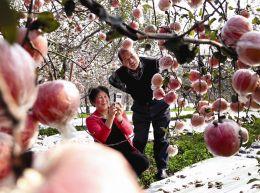
Wu Zhongding and his wife in the orchard
Wu Zhongding, a fruit farmer from Linyi, has been awarded the National Agriculture, Animal Husbandry and Fisheries Harvest Award for Agricultural Technology Promotion Contribution, and has been conferred honorary titles including "Horticultural Production Expert" of Shanxi Province, "Shanxi Top Ten Rural Science and Technology Wealth-Building Leaders," "Shanxi Province Green Development Pacesetter," and "Shanxi Province Top Ten Farmer Science and Technology Champions." His orchard has successively obtained Good Orchard Certification from the China Quality Certification Centre and Export Fruit Orchard Registration Certification from the Shanxi Entry-Exit Inspection and Quarantine Bureau, and has been designated as a "National Apple Industry Technology System High-Quality and High-Efficiency Standard Demonstration Orchard" and a Shanxi Province "Fruit Standardized Production Demonstration Orchard." The "Lao Wu Brand" apple has been rated as a Famous Trademark of Shanxi Province.
The path Wu Zhongding has taken has brought a demonstration effect to the fruit farmers of Linyi. How to self-adjust and adapt to the market -- Old Wu has his own methods, and he has also cultivated a group of followers.
Ten yuan each -- "Lao Wu" apples sold by the piece
When it comes to growing apples, the person Linyi fruit farmers admire most these days is "Lao Wu" -- Wu Zhongding. While others sell their apples by weight, Wu Zhongding sells his by the piece -- 10 yuan each, and still demand exceeds supply.
Wu Zhongding, 58 this year, is a fruit farmer from Shangdoushi Village, Jiaobei Township, Linyi County. Having grown apples for more than 30 years, he has grown from a layman into a nationally renowned agricultural technician, and his orchard has become a "National Apple Industry Technology System High-Quality and High-Efficiency Standard Demonstration Orchard."
In recent years, fruit prices have fallen, and many fruit farmers lament the sluggish apple market and weak prices. But Wu Zhongding's apples have not only been unaffected by the market -- their price has kept rising. While others sell apples for just over one yuan per jin, Wu Zhongding's "Lao Wu" brand apples sell for ten yuan each. The Zhongding Apple Professional Cooperative, led by Wu Zhongding, has 205 member households, and their best apples also sell for around 5 yuan per jin. Moreover, influenced by Wu Zhongding, apple purchase prices throughout Jiaobei Township are higher than elsewhere, and fruit farmers across the entire township benefit from Old Wu's success.
On November 28, the reporter arrived at Jiaobei Township in the western part of Linyi County. Everywhere along the way were orchards and farm tricycles loaded with carts full of bright red apples. A brand-new asphalt road leads directly to Wu Zhongding's orchard. Just past noon, the orchard was buzzing with voices. More than 50 people who looked like fruit farmers were gathered around a fruit tree in heated discussion. "I think we should prune this branch and this one," said a man of about 40, gesturing at the branches as he spoke. Before he finished, several people around him cut in with a flurry of voices: "That one and the middle one have to go too, otherwise next year's crop will definitely suffer."
Among the crowd, a middle-aged man holding a microphone was watching everyone's comments with a smile. When the discussion had run its course, he deftly cut a long branch from a nearby apple tree, quickly stripped off the remaining leaves, and used it as a pointer. "What everyone just said is right -- this one and this one must also be pruned. You must combine the theory you've learned with practice. Pruning directly affects next year's fruit set and affects everyone's income."
This middle-aged man was Wu Zhongding -- not very tall, wearing an inconspicuous black woolen coat, with several withered yellow apple leaves clinging to his shoulders and back. The 56 fruit farmers studying with Wu Zhongding came from various townships across the county. After this group of trainees finishes their training, more than 70 young farm owners from across the province will come here to study precision cultivation of fruit trees. This winter alone, Wu Zhongding will train more than 500 trainees.
Trainee Wang Yinwu is a fruit farmer from Shangwang Village, Danzi Township, Linyi County. He told the reporter that he had heard before that Teacher Wu Zhongding's apples sold well, and he had felt somewhat unconvinced. But after coming to study, he discovered the gap. Most people think the more trees you plant, the more fruit you get, and the more money you make -- but in the end, too much fruit means it's not worth anything. "Teacher Wu's fruit is never hard to sell. One of his apples is worth several jin of ours. Why? Because apples grown with scientific management are simply better -- big, red, and sweet. Cut one open and every one has a rock-candy core. The market recognizes them, so they command a high price. When I go back, I'm going to apply what I've learned here to my own orchard. If you grow good fruit, why worry about selling it?"
Looking back, he once worried about the difficulty of selling fruit
Wu Zhongding began planting apple trees in 1984. At the time, the village had a 15-mu orchard that had never borne fruit for over a decade. When he was in high school, Wu Zhongding had learned fruit tree cultivation techniques from a teacher for a period. He felt that this 15-mu orchard simply lacked scientific management, and that with proper care it could bear fruit.
Under the puzzled gaze of others, Wu Zhongding paid more than 2,700 yuan to contract the village orchard. After taking it over, he sought out experts and technical specialists everywhere to "diagnose" the orchard. At the time, there was a fruit and mulberry station in the county (now called the Linyi County Fruit Industry Development Centre), and he went there almost every week to discuss the orchard's condition with the experts. With the experts' help, after pruning the trees for ventilation and light, and applying fertilizer, the following year Wu Zhongding's contracted orchard unexpectedly had a bumper harvest. This caused a sensation throughout the village. In 1985, Wu Zhongding used the money from selling fruit to buy a four-wheeled agricultural vehicle and a 14-inch colour TV.
In the 1980s and 1990s, orchards relied on planting multiple varieties of fruit trees to increase yields. As the trees grew, densely planted orchards began to show signs of canopy closure. With small spacing between trees and leaves and branches shading each other, orchard ventilation and light penetration were poor, fruit colouration was poor, and both quality and yield declined. By 1997, this situation had led to a widespread "difficulty in selling fruit" among Linyi fruit farmers.
Watching the fruit hang on the trees unsold, Wu Zhongding was so anxious that blisters broke out all over his mouth. With no other option, he hired a vehicle himself, loaded up the apples, and went to Guangdong, Hebei, and other places to sell them. Recalling those days, even now Wu Zhongding feels a bitterness in his mouth. He remembers passing through Hunan while selling apples -- when he went, the locals were transplanting rice seedlings; when he returned, they were already harvesting rice. Watching others bring in a harvest made him feel even worse. Rushing back and forth, he couldn't take care of things at home, and the apples didn't fetch a good price -- most of the time he barely broke even.
At this point in the conversation, Wu Zhongding's wife Yang Huicai, standing nearby, couldn't hold back her tears either. "During those years, the two of us were so focused on planting and selling apples that we couldn't take care of our two children. We couldn't pick them up from school or drop them off, couldn't cook for them -- the children went hungry all the time. It wasn't until they started middle school and there was a school canteen that they stopped going hungry. Even now, when our eldest son talks about being short, he still says it was because we starved him while he was growing."
For Wu Zhongding, the biggest gain from going out to sell fruit was finding the reason why fruit was hard to sell. When his apples reached markets elsewhere and were compared with others', the quality gap was so great that they simply couldn't fetch a good price. "Their apples sold for 1.5 yuan per jin and moved quickly; mine sold for 50 fen and barely moved at all. As for the apples of the villagers back home, no one even came to buy them -- they rotted and stank, and in the end were dumped in ditches. What does that show? It shows that good fruit is never hard to sell, and bad fruit no one wants even if you beg them."
Having identified the root of the problem, Wu Zhongding began implementing variety improvement in his own orchard. At the same time, following the "thinning" technique promoted by the county, he reduced the tree density in his orchard, progressively thinning from more than 80 trees per mu down to 30. At the time, many in the village thought he was foolish -- to saw down trees that were bearing fruit perfectly well. But the year after thinning, the trees grew vigorously, and per-mu income matched that before thinning; in the third year after thinning, average per-mu yield was controlled at 2,500 kg, but apple quality improved dramatically -- almost all were premium apples with a diameter of 85 mm or more. Having tasted the sweetness of scientific fruit growing, Wu Zhongding became firmly committed to scientific cultivation. He learned every technique the county promoted, and whenever there was an opportunity to go out and study, he would pay his own way to attend.
Because his apples were of better quality, Wu Zhongding's apples always sold for more per jin than others'. At first, while others' fruit was bought at 1 yuan, fruit merchants paid 1.5 yuan for Old Wu's apples -- 50 fen more per jin. Gradually it became 1 yuan, 2 yuan more per jin, then 3 yuan, 5 yuan, until now one apple sells for 10 yuan. Today his apples are sold in 38 large and medium-sized cities across the country, and every year demand exceeds supply.
Promoting scientific planting, leading villagers to prosperity together
During the interview, Wu Zhongding repeatedly mentioned to the reporter a "6+2" model. The "Six Major Technology Integration" model is a standardized scientific apple management system currently being vigorously promoted in Linyi County, comprising six major techniques: fruit tree thinning, fruit bagging, orchard grass planting, pollination for increased yield, pollution-free pest control, and reflective film mulching. Old Wu added two more of his own -- integrated water and fertilizer management, and IoT (Internet of Things) management -- to increase technological content and improve quality.
Paper and film double bagging. Traditional Linyi apples were prone to problems of imperfect fruit surface and poor colouration. When the apple first sets fruit, a plastic film bag is applied. This protects the fruit surface and keeps it smooth, and also prevents pest damage. When the fruit reaches a certain stage of growth, an opaque paper bag is applied over the film bag. By scientifically timing the bagging and removal, the red colouration of the fruit can be ensured. This technique alone has been promoted across more than 200,000 mu in Linyi County. Through bagging, apple quality has improved, and the selling price per jin has increased by 1 yuan. The fruit tree thinning technique has enabled the transformation of 100,000 mu of old orchards across Linyi County, increasing income by 2,000 yuan per mu per year. The orchard grass planting technique -- planting clover in the orchard -- both enhances soil organic matter and regulates the orchard's microclimate... And Old Wu's integrated water and fertilizer management involves adding nutrient solution and organic fertilizer during irrigation so that the fruit receives balanced nutrition. The IoT uses imaging equipment to observe apple growth remotely with high precision, enabling timely management and analysis.
Today, Wu Zhongding has moved beyond his initial idea of growing fruit trees to earn money and improve his life, and has become a spokesperson for promoting scientific fruit tree cultivation. He has built a high-standard apple field training school in his own orchard, personally demonstrating and teaching techniques to fruit farmers who come to learn from him. After several years of training, Wu Zhongding has built a 100-person agricultural science service team and established a three-tier science and technology service network at the county, township, and village levels, conducting over a hundred science and technology lectures in rural areas each year. In recent years, more than 20 on-site observation meetings with over a thousand participants have been held in his orchard alone. Spontaneously organized observation groups of a hundred people from other regions have come more than 200 times. To date, Wu Zhongding's training courses have trained a cumulative total of over 100,000 person-times. Even fruit experts from Russia, Australia, the Philippines, Chile, the United States, Israel, and other countries have come to Wu Zhongding's orchard for technical exchange.
Wu Zhongding's high-tech IoT transmits new technologies and high-standard production processes in real time via video technology to fruit tree experts and farmers across the country, and can also directly connect with urban residents, allowing consumers to monitor the entire production process, participate in it, and enjoy the pleasures of rural life. Old Wu's orchard has also become a rural tourism destination for urban residents to relax and experience country life.
In Wu Zhongding's own words, "Mountains of gold and silver are not as good as giving someone a good orchard!" This preeminent fruit farmer of Linyi takes even more pleasure in seeing the joyful faces of his fellow villagers when they sell their apples.