Small mushrooms, big industry: the "wealth umbrella" of farmers in Wensu County
Yukake Tagake Village is **one of the most remote and out-of-the-way villages in Wensu County. People here do not live prosperously, there are relatively many poor households, and the village's economic foundation is weak. In order to better help local people escape poverty and become prosperous, the Zhejiang Jinhua Municipal Aid-to-Xinjiang Command not only distributed mushroom spawn bags to local residents free of charge, but also provided guidance from technicians, truly helping villagers from the source to achieve prosperity through "self-sufficiency."
"The Party and the government took our difficulties into consideration and gave each of the 14 poor households in our village 6000-8000 bags of mushrooms (spawn bags) free of charge. Now I have learned the cultivation techniques and also have sales channels. From now on I will work hard to earn money, escape poverty as soon as possible and live a happy life." Not long ago, a reporter came to Yukake Tagake Village, Tumuxiuke Town, Wensu County, for an interview. Villager Abuduaini Yasheng, full of confidence about the future, said this.
**Tumuxiuke Town in Wensu County is 30 km from the seat of Wensu County, and Yukake Tagake Village is the most remote village in the town, 15 km from the town government. It is located at the southern foot of Tomur Peak in the Tianshan Mountains, with agriculture and animal husbandry as the main activities. The contradiction of many people and little land is prominent, and the economic foundation is relatively weak. In order to help local people become prosperous as soon as possible, the Zhejiang Jinhua Municipal Aid-to-Xinjiang Command, together with the Wensu County Party Committee and government, took local conditions into account and encouraged villagers to develop the "little umbrella industry" of cultivating greenhouse mushrooms, leading local poor households to increase income and become prosperous.
Abuduaini Yasheng's family has 4 members. The family's 8 mu of walnut land and 12 of corn are the main sources of income for the whole family. Ordinarily, Abuduaini Yasheng is a quick-witted, restless and diligent person, always pondering how to make a fortune, but he lacked both funds and techniques. Relying only on the little income from farming at home, the family could only manage to have enough food and clothing.
"At the beginning, I was very hesitant. Could cultivating these tiny mushrooms really make me prosperous? Later, after listening to the introduction by the staff of the Jinhua Municipal Aid-to-Xinjiang Command and the training and guidance of the technical managers, and encouraged by the village officials, I took 6000 bags of mushrooms (spawn bags) with a try-it-and-see attitude." Abuduaini Yasheng explained.
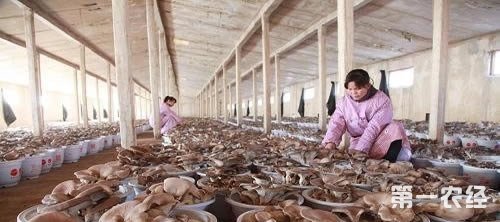
After receiving the mushrooms (spawn bags), Abuduaini Yasheng, following the technician's instructions, placed the mushrooms (spawn bags) under the walnut trees in his own vegetable plot. All the spawn bags took up less than 1 fen of land. Then he arranged them neatly in rows, simply built a shed, and covered the shed with plastic film and cotton quilts. When it was hot, he sprayed water twice a day; when the weather turned cool, he sprayed water once a day. Two months later, umbrella-shaped mushrooms grew from both ends of the spawn bags. As the mushrooms grew larger and larger, the spawn bags produced more and more mushrooms, and one mushroom after another grew into large "umbrellas." On August 13, Abuduaini Yasheng began gathering his mushrooms and taking them to the county seat's vegetable market to sell. The first time, he picked 73 kg of mushrooms, but sold only 33 kg. It turned out that Abuduaini Yasheng's mushrooms had grown too large, and because too much water had been sprayed, the roots of some mushrooms turned yellow, making them unwelcome in the market and among consumers. With this experience, Abuduaini Yasheng began to manage the mushrooms carefully. Every two days, together with the other 13 villagers, he went door to door at 2 a.m. every day to pick mushrooms, and at 5 a.m. they were loaded onto a truck in a centralized way and taken to the county seat. In the end, they sold them wholesale to vegetable vendors at a price of 4-5 yuan per kg, with daily sales reaching about 150-200 kg.
"Each spawn bag can basically produce about 5 kg of mushrooms. Because this was the first year of cultivating mushrooms, not understanding the techniques led to some spawn bags producing no yield. But this has already given me confidence to become prosperous. Cultivating mushrooms does not take up land, has no cost, is simple and easy to do, does not take much time, and the mushrooms grow quickly. Market demand is large, and people call every day to order mushrooms, so there is no worry about sales at all." Abuduaini Yasheng said that mushrooms can be picked in batches every 2 days. Not only can they be taken to the market to sell, but some can also be given to relatives, friends and neighbors to taste, and they have received everyone's praise.
Through cultivating mushrooms, Abuduaini Yasheng, who single-mindedly wanted to escape poverty, summed up the lesson that "only hard work can bring prosperity." Next year he plans to attend the village's cultivation technique training class, learn mushroom-growing techniques well, and continue to expand the scale of mushroom cultivation in sheds. Now, relying on greenhouse mushroom cultivation, Abuduaini Yasheng has not only increased his income somewhat, but has also filled his family with hope for the future.
In recent years, Party and government bodies at all levels in Wensu County and the Jinhua Aid-to-Xinjiang Command have taken multiple measures. Poverty alleviation and assistance have been precisely targeted and well focused. Using courtyards to develop specialty planting has become a highlight of farmers' and herdsmen's diversified income growth and prosperity, among which helping them plant greenhouse mushrooms is especially favored by farmers and herdsmen of all ethnic groups.