20 ewes help Wang Liwen realize his dream of escaping poverty and becoming prosperous
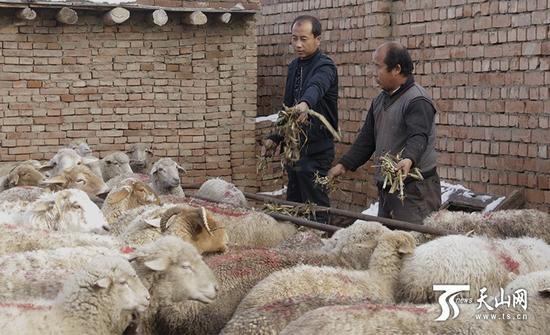
Wang Liwen (right), a farmer from Bahu Village, Er Gong Town, Jimsar County, introduces sheep feeding conditions to town officials.
"With 20 ewes, every one of them pregnant with lambs, in less than two years I will be able to shed the label of poor household." On December 1, **Wang Liwen, a farmer from Bahu Village, Er Gong Town, Jimsar County, told officials from the poverty alleviation office with full confidence.
Wang Liwen is a poor household in the village because his wife has been ill year-round. This year, Jimsar County used a blood-generating model to advance targeted poverty alleviation, implementing a poverty alleviation sheep project in each township, and Wang Liwen received 20 poverty alleviation ewes and 200 chickens.
Under the guidance of livestock experts, over the past year Wang Liwen raised them carefully, tending the sheep and chickens. The 200 chickens were sold at market, and the 20 ewes were each fed until plump and strong. Even more gratifying, every one of them was pregnant with lambs, and in another two months, the lambs will be born one after another.
A reporter learned from the Jimsar County Poverty Alleviation Office that this year Jimsar County started by clearly investigating basic conditions such as household circumstances, causes of poverty, sources of income and income levels, made detailed comparisons and calculations, and strictly followed the procedure of "village-level appraisal, township review, county-level confirmation" to carry out precise identification of poor people. In February it determined that the whole county had 244 rural poor households and 774 people.
On the basis of precise identification, it was made clear that the 244 poor households would escape poverty over three years: 111 households with 359 people in 2016, 85 households with 265 people in 2017, and 48 households with 150 people in 2018, implemented through wall-chart operations.
For the 111 households with 359 people planned to escape poverty in 2016, support measures were formulated household by household according to one policy per household, specifying concrete support tasks, standards, measures and timelines, achieving household-by-household investigation and baseline assessment, household-by-household account records, household-by-household support plans, household-by-household paired assistance, and household-by-household follow-up implementation, making the support work targeted and time-effective.
For poor households willing to engage in livestock breeding, including Wang Liwen, household-level poverty alleviation projects were implemented, issuing to poor households 2,518 productive female breeding sheep, 295 cattle and 1,900 chickens. Paired assisting county leaders and units bought cattle and sheep for poor households, helped repair sheds and pens and repair houses, provided necessary means of production, helped develop agricultural and livestock production, and invested 1.96 million yuan in support funds.
A reporter learned from the Publicity Department of the Jimsar County Party Committee that, according to arrangements, Jimsar County advanced its poverty alleviation project around multiple aspects including infrastructure construction, industrial support, transfer employment, education security, medical security, social security as a fallback, modern cultural guidance and ecological environmental protection, applying comprehensive measures and achieving practical results.
It is understood that in 2014 and 2015 Jimsar County had already helped 1,072 households with 2,485 people escape poverty, and this year passed acceptance assessment.