Four-story building used for pig farming: nearly 8,000 pigs produced per mu of land per year
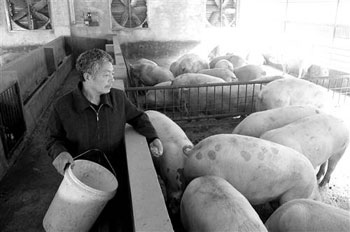
The curtains open, and the pigs enjoy a sunbath.
In Wenhui Livestock Breeding Co., Ltd., located in Baiguo Village, Jianlong Town, Bishan District, a four-story building stands out particularly.
Local villagers say that this building is not inhabited by people, but by big fat pigs. These pigs take elevators to get around, enjoy air conditioning when it is hot, and underfloor heating when it is cold. Their life is very comfortable.
Recently, the author walked into this small building to find out whether the rumors were true.
Three-dimensional farming has many benefits
Approaching this special small building, one can see that what "lives" inside really is one big fat pig after another. The building not only has ordinary stairs, but also a steel-framed lift.
The keepers can only use their legs to walk the ordinary stairs when going in and out. Only the pigs can enjoy the treatment of riding the "elevator."
It seems the rumors were not exaggerated at all.
Why was there such a "whimsical idea" to let pigs live in a building?
When the author asked, Zeng Youwen, the person in charge of the company, said with a smile: "There are so many benefits to doing this!"
"This four-story small building covers less than one mu, but it can produce nearly 8,000 hogs for slaughter in a year. If replaced with traditional pig housing, it would probably take 4 mu of land." Zeng Youwen said.
Zeng Youwen said that, moreover, compared with traditional pig housing, this kind of "pig building" has better ventilation and lighting, which is good for pig growth; at the same time, cleaning work and manure collection are also easier.
Warm in winter and cool in summer, the pigs are in great shape
Zeng Youwen led the author into the small building, and a wave of warmth rushed over them.
The author touched the floor with his hand. It really was underfloor heating! It was simply too luxurious!
Zeng Youwen said that an automatic temperature control system is installed in the small building to turn the underfloor heating on and off. When the temperature is below 25°C, the system starts working and supplies heat through stainless steel pipes buried in the floor. If the temperature exceeds 30°C, the system automatically shuts off.
In summer, the temperature is regulated through a water curtain fan cooling system. This system is composed of a paper porous wet curtain, a water circulation system, and fans. When air passes over the surface of the wet curtain, its own temperature is lowered because of the large amount of water evaporation. When the fans draw air, they continuously introduce cool air that has been cooled by the wet curtain into the room, thereby achieving the cooling effect.
In addition, electric "curtains" are also installed in the small building, which can be adjusted according to sunlight and temperature conditions to achieve shading, ventilation, heat avoidance, and warmth retention.
"We just want to create a good environment for the pigs that is warm in winter and cool in summer, so that the pigs raised this way will be healthy and get sick less often." Zeng Youwen said.
Green and ecological, with good quality
With underfloor heating running, this four-story building probably costs quite a bit a day, right?
"Our boiler uses biogas, so it hardly costs anything." Zeng Youwen answered with a smile.
Zeng Youwen said that supporting biogas facilities are built next to the "pig building," including a 1,700 cubic meter biogas slurry storage tank, a 600 cubic meter anaerobic fermentation tank, and a 90 cubic meter biogas storage tank, with a maximum daily biogas output of 170 cubic meters.
"The biogas produced every day is not only completely enough for our own use, but the surplus also provides clean energy for 28 nearby villagers' households." Zeng Youwen said. "We also buried 'underfloor heating' at the bottom of the biogas slurry storage tank, which can ensure that biogas output does not decrease in winter."
In addition, before pig manure enters the tank, it must undergo mechanical solid-liquid separation. The separated solid part is excellent organic fertilizer. The biogas slurry produced after biogas generation can not only be used as fertilizer, but also has insecticidal and sterilizing effects.
Therefore, in addition to pig breeding, the company has also planted 200 mu of vegetables, making full use of this biogas slurry and dry manure to achieve "zero use" of chemical fertilizers and pesticides, and also achieve "zero discharge" of breeding pollutants. The weeds and excess vegetable leaves brought by vegetable planting can be used to feed pigs, thus forming a virtuous cycle.
Zeng Youwen said: "Through the 'pig-biogas-vegetable' cycle, not only can the amount of feed used be reduced and the quality of pigs improved, but green and organic vegetables can also be produced, which better meets the consumption needs of modern people."