Strawberry soilless cultivation with organic fertilizer: Master Lai shares his growing experience
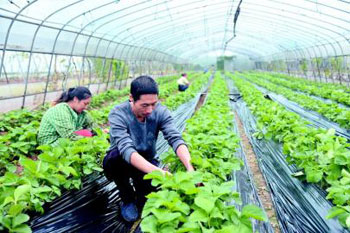
Lai Shiyong (front) and a worker are covering strawberries with film to keep them warm.
The direct result of long-term use of chemical fertilizers in crop cultivation is soil compaction, an increase in pests and diseases, and crops becoming prone to root rot and other "tricky ailments." How can soil maintain its fertility while also regaining health? How can exhausted land be given a chance to breathe? This newspaper has already published a series of articles introducing methods for improving soil. This article on soilless cultivation is hoped to offer some reference for farmer friends.
Recently, Lai Shiyong, head of Guangyuan Jinchun Ecological Agriculture Co., Ltd., who has been engaged in strawberry cultivation and worked with agricultural science and technology for nearly 10 years, revealed his growing secrets to this writer: gradually replacing soil cultivation with soilless cultivation, and replacing inorganic fertilizer with organic fertilizer, to ensure healthier soil and better-tasting strawberries.
Soilless cultivation vs. soil cultivation: which is more cost-effective?
In 2009, after returning from his studies at the Chinese Academy of Agricultural Sciences, Lai Shiyong worked out an organic ecological soilless cultivation method. "In plain terms, soilless cultivation means crops do not need to come into direct contact with soil and grow only in a 'substrate,'" he explained. The "substrate" is made up of furnace slag, sand particles, and composted and rotted farmyard manure, among other materials. The specific method is: build beds about 30 cm wide in the plot, build up the sides with bricks, then use plastic film to separate the crops from the soil, letting strawberries and other crops grow freely in the organic fertilizer covered on the plastic film.
"The most important thing is that it can increase the per-unit yield of crops, improve their quality, and secure greater market prospects." When talking about the advantages of soilless cultivation, Lai Shiyong rattled them off: first, it is ecological and conserves fertilizer, with no need to apply chemical fertilizers, as all the nutrients are concentrated in the beds. Second, it prevents disease and avoids harm, because crops do not come into direct contact with soil, avoiding infection by pests and diseases. Third, it saves labor and time. Fourth, it saves water. Fifth, it increases yield and income. Taking greenhouse strawberries grown by soilless cultivation as an example, the yield per mu can reach more than 3,000 jin, an increase of about 1,000 jin compared with soil cultivation, and income can increase by nearly 10,000 yuan.
Today, in Lai Shiyong's agricultural park, soilless-cultivated strawberries and soil-cultivated strawberries each occupy "half the kingdom." "Although the upfront one-time investment cost for soilless-cultivated strawberries is relatively high, in the long run, once a bed is built it can last seven to eight years, and only a small amount of organic fertilizer needs to be renewed each year, which is very economical," Lai Shiyong said.
Replacing inorganic fertilizer with organic fertilizer: beneficial bacteria win completely
"Using organic fertilizer not only allows crops to absorb more beneficial bacteria, but also lets soil that has depended on chemical fertilizers for years recuperate and recover." Lai Shiyong gave an example: tomatoes grow very vigorously in the early stage when receiving chemical fertilizer nutrients, but when it comes time to set fruit, root rot, canker, and other diseases can cause them to drop prematurely before ripening, making all the grower's previous efforts wasted.
"Organic fertilizer not only provides comprehensive nutrition for crops, but also has long-lasting fertilizer effects. It can increase and renew soil organic matter, promote microbial reproduction, improve the soil's physical and chemical properties and biological activity, and provide the main nutrients for the growth of green food." Lai Shiyong said that traditional farmyard manure contains harmful substances such as weeds and insect eggs, and applying it directly to the field is not conducive to crop growth. Biological organic fertilizer, by contrast, is a type of fertilizer that combines the effects of microbial fertilizer and organic fertilizer, made by composting farmyard manure, rendering it harmless, and fully decomposing it. This kind of biological bacterial fertilizer is different from traditional farmyard manure: after treatment, the mortality rate of insect eggs reaches more than 95%, and it is not only odorless and non-toxic, but also has the advantages of high efficiency, long-lasting effect, and disease resistance.
Next, Lai Shiyong will also interplant vine crops such as loofah and bitter melon in the strawberry greenhouses, and it is expected that income can increase by 4,000 to 5,000 yuan per mu. Calculated this way, his 40 mu of vegetable greenhouses are expected to bring in millions of yuan in income in a year.