How can ecological agriculture fit into the people's vegetable basket?
On December 10, in the greenhouses of the Sun Family Vegetable Planting Professional Cooperative in Panzhai Community, Chengxi Subdistrict, Guoyang County, cucumbers hung beneath the vines, peppers clung among the leaves, and spinach, broccoli and celery were a lovely green. Five or six vegetable harvesters were busy in the greenhouse cutting and bundling vegetables. These greenhouses have not only enabled the village's poor households to realize their dream of escaping poverty, but have also let city residents enjoy the green products brought by ecological agriculture.
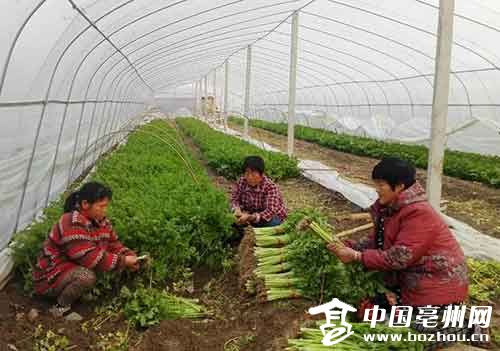
In the greenhouse of the Sun Family Vegetable Planting Professional Cooperative in Guoyang County, workers are harvesting celery
In the greenhouse of the Sun Family Vegetable Planting Professional Cooperative in Guoyang County, workers are harvesting spinach
More than 100 vegetable greenhouses yield a net profit of over 1 million yuan
Sun Chenghong is the person in charge of the Sun Family Vegetable Planting Professional Cooperative, overseeing a vegetable garden of more than 100 greenhouses covering more than 300 mu. When the reporter arrived at his vegetable greenhouse planting base, he was busy contacting sales and transport matters, and his wife was busy in the greenhouse rushing the harvest together with the workers.
Most of what the cooperative grows is out-of-season vegetables, focusing on 6 major varieties: zucchini, tomatoes, eggplant, peppers, bitter melon and cucumbers. The ones currently in harvest season are spinach, celery and broccoli. Sun Chenghong told the reporter that as of now, his vegetable sales have exceeded 11 million yuan, with a net profit of about 1.1 million yuan.
Yet just 5 years ago, Sun Chenghong was only an ordinary migrant worker. In 2011, when he came home for the New Year, Sun Chenghong discovered while buying New Year goods that out-of-season vegetables were surprisingly expensive. After recognizing this market, that same year he contracted 60 mu of land in the village. Limited by funds, he built only two sunlit greenhouses, and all the rest were open-field vegetables.
"Without any experience or technology, the first year's operation was not good. Even so, I did not lose money and even made a small profit, much better than working away from home." Sun Chenghong said this also increased his confidence to continue expanding the planting scale.
Later, Sun Chenghong consulted agricultural technology experts many times and traveled to Shangqiu in Henan, Xuzhou in Jiangsu and other places to investigate and learn others' planting techniques. In 2013, on the basis of the cooperative, Sun Chenghong also established a family farm, and the planting scale continued to expand while the varieties increased year by year.
Putting an "ecological and environmentally friendly" label on greenhouse vegetables
The reporter noticed that some mesh equipment and lamps were installed in the vegetable greenhouses. Sun Chenghong said those were insect-proof nets and insect-killing lamps, used to kill insects. In addition, many sticky insect boards were also placed in each greenhouse. No matter what kind of pest touches these things, it is sure to die.
The installation of insect prevention tools is one of the physical methods Sun Chenghong adopted to prevent and control pests and diseases. Sun Chenghong told the reporter that since his vegetable greenhouses began operating on a large scale, he has always adhered to the concept of ecological and environmental protection, striving to provide city residents with purely green, natural and organic vegetables. For this purpose, he also hired a technical expert from Shouguang in Shandong at a high salary specifically to provide guidance.
"Vegetables fear pests and diseases the most. Once they encounter these, farmers generally use pesticides to solve the problem, but I have many methods, none of which have anything to do with pesticides." Sun Chenghong said that in addition to equipment-based insect killing, high-temperature insect killing is also the most commonly used method in summer. This method uses the "greenhouse sealing" approach, bringing the temperature inside the greenhouse to around 70 to 80 degrees, under which insects and various pathogens can all be killed.
In order to make the vegetables more "green", Sun Chenghong did not hesitate to invest, adding integrated fertilizer and water equipment and applying organic fertilizer to the vegetables. This method not only allows the land to save fertilizer and retain moisture, but the vegetables grown are also more delicious.
Today, the Sun Family Vegetable Planting Professional Cooperative has been rated as a "National Vegetable Standard Garden", "Anhui Provincial Farmers' Professional Cooperative Demonstration Cooperative" and so on. The 6 kinds of vegetables grown by Sun Chenghong have also passed national green food certification, and it is precisely because of this label that his vegetables have been recognized by more people, with sales becoming increasingly popular.
Poor households who come to work earn an annual income of no less than 15,000
While chatting with the workers, the reporter learned that most of those cutting and bundling vegetables in the greenhouses are idle laborers from poor families in the village. Their daily working time does not exceed 8 hours. They work when there is work and rest when there is none. The labor intensity is not great, but their annual wages all exceed 15,000 yuan.
"As long as they are poor households coming to work in the vegetable greenhouses, we give them priority in hiring; for poor households wanting to develop greenhouse planting, the cooperative provides about 30,000 yuan worth of vegetable seedlings free of charge each year, and the later technical guidance, sales contact and other links are also 'paid for' by the cooperative." So said Sun Chenghong.
It turns out that in 2014, the Guoyang County Poverty Alleviation Office invested nearly 100,000 yuan in financial poverty alleviation funds to support the development of the Sun Family Vegetable Planting Professional Cooperative and established the cooperative as a poverty alleviation and development demonstration base, absorbing poor households to participate in operations and adopting the "four unifications" management model of unified seed supply, unified technology, unified management and unified sales, thereby broadening the income-increasing channels for poor households.
"Remembering poverty alleviation while becoming wealthy, our cooperative has a responsibility to help more poor households escape poverty." Sun Chenghong said that the cooperative has successively adopted methods such as absorbing poor people for employment and the base + poor households development model. At present, it has provided employment for more than 200 poor people, connected with more than 20 poor households, and driven 5 large vegetable planting households.