Brazilian Fruits Take Root on Longyou Farm, Planting Transformation Diversifies
It is said that the world's most exotic fruits are Brazilian fruits, with their many varieties and unusual flavors, drawing countless people to travel across the ocean just to taste them. What is exciting is that this summer, a bold farmer in Longyou planted Brazilian fruits in Longyou. After 3 months of careful tending, they are slowly adapting to Longyou's soil and temperature. Now the jabuticaba has borne fruit, the miracle fruit tree also has bright red fruits hanging on it, and the Brazilian cherry tree is lush with branches and leaves, growing well.
Yesterday, the highest temperature in Longcheng rose to 17°C. In Yan Jianhong's fruit greenhouse at Zijing Farm in Zhijiang Village, Zhanjia Town, it was quite warm. Seeing the fine weather, Yan Jianhong was pruning branches in the greenhouse early in the morning. "The main trunk must get plenty of sunlight, which helps flowering and fruiting." As it turns out, the fruit tree he was pruning is the famous Brazilian fruit "jabuticaba." What is most unique is that its flowers bloom on the trunk, and its fruits also grow on the trunk. Their color changes from green to red and then to purple, finally becoming purple-black, just like grapes hanging on a tree, which is also the origin of the name "tree grape." "With good management, it can flower and fruit 7 times a year," Yan Jianhong said. Since being introduced from Fujian in September, the two 17-year-old jabuticaba trees at the greenhouse entrance have already flowered and fruited three times. Since it is a new fruit, the first three batches of ripe jabuticaba were all given free to visitors to taste. "With proper management, one tree can produce more than 50 kg of fruit a year. At a market price of four to five hundred yuan per kg, the returns are still fairly considerable."
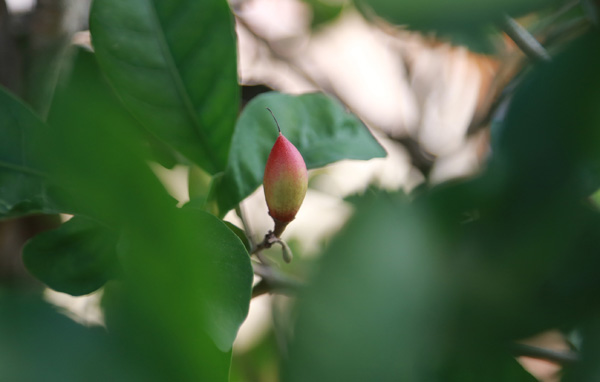
In the greenhouse, Yan Jianhong also introduced another Brazilian fruit tree - the miracle fruit. "Look, these two have already borne fruit." Through the lush green leaves, following the direction of Yan Jianhong's finger, several bright red fruits the size of black beans could indeed be seen. It is called a magical fruit because it contains a flavor-altering protease. Although it cannot truly change the taste of food, it can change people's sense of taste, so after eating miracle fruit, anything sour tastes sweet. "I only introduced two miracle fruit plants, mainly to let guests have a taste and experience its magic."
"A farm must transform its operations, diversify its fruit planting, and have fruit in all four seasons, then customers will naturally come." After touring the Brazilian fruit planting base in the greenhouse, Yan Jianhong explained the reason for this "fruit reform." According to him, the farm originally had 100 mu of grapes and was Longyou's earliest grape-growing base. Over the years, as the planting area expanded, the market gradually became saturated. For farm operations, the grape ripening period is concentrated in summer, which means there is no selling point in the other seasons.
"We must try, and boldly go out." This year, Yan Jianhong learned that jabuticaba cultivation has good economic returns and that the growing method is relatively simple. The only thing to solve is how to ensure that tropical fruits survive locally. He went to Fujian three times to inspect and learn from experience. After a long period of study, in September this year he introduced more than 300 Brazilian fruit seedlings to the base. To combat the frosts of the south, Yan Jianhong said he plans to put plastic film on the outdoor jabuticaba in a few days, "to maintain soil moisture, apply lime wash to the trunks, and so on." Yan Jianhong has already prepared countermeasures.
This weekend, Yan Jianhong and Quzhou Evening News also planned a "Sheep Pot Digging" festival at the farm. In addition to a whole-lamb banquet, he will also hold an on-site promotion event for these Brazilian fruit trees.