Pingdu greenhouse strawberries begin harvesting, grown naturally over 52 days
The 120 strawberry greenhouses of the Qingdao Yijun Grain and Vegetable Professional Cooperative in Landi Central Community, Nancun Town, Pingdu City have begun harvesting, and these strawberries were grown naturally over 52 days. However, it is not easy for residents to taste these strawberries. Due to soil improvement and the use of biological bacterial fertilizer, these organic strawberries sell for about 10 yuan more per unit than strawberries on the market, yet they were fully booked early before harvesting even began. Now is just the beginning of the harvest period, and in about 10 more days these strawberries will enter the peak production period, when it will be easier for residents to taste them. It is understood that a 1000 sq m strawberry greenhouse can continue to be harvested from now until May or June of next year, with a net income of about 150,000 yuan, playing a major role in increasing farmers' income.
"Really sweet, really fragrant, really tastes like strawberries." On December 18, an ecological restaurant in Qingdao organized members to go to the Qingdao Yijun Grain and Vegetable Professional Cooperative in Landi Central Community, Nancun Town, Pingdu City for picking. They tasted this year's earliest batch of strawberries here, could not stop eating them, and bought one or two boxes to take home before leaving. Because picking has just begun and the quantity is limited, many members were not yet able to buy any. "It will be about 10 more days before they are largely on the market." said Ma Chunyu, chairman of the cooperative.
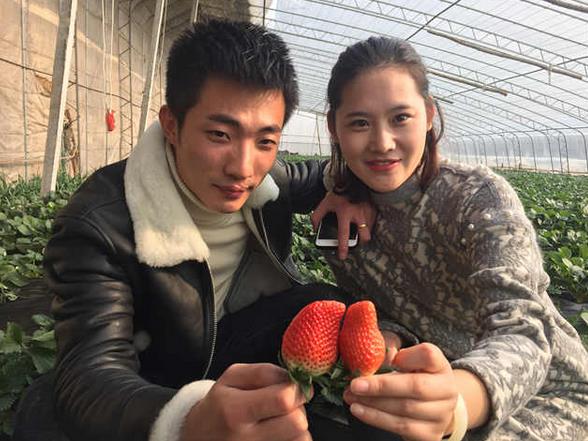
This year, the Qingdao Yijun Grain and Vegetable Professional Cooperative expanded its strawberry planting scale, with a total of 120 greenhouses, more than 80 of which are located in Songjiaying Village. The reporter followed Ma Chunyu to Songjiaying Village and entered the strawberry greenhouse of Song Faqing, the village party secretary. This greenhouse is fully equipped with modern facilities. "There is no need for people to climb up to the two-person-high greenhouse roof and work hard anymore; now everything is managed by machines." Song Faqing said that for several strawberry greenhouses in their family, he and his wife can usually handle the work completely by themselves.
After entering the greenhouse, one still cannot see red strawberries all over the greenhouse. Many strawberries are still whitish and greenish, which also shows that it is not yet time for them to ripen in large quantities. "A few days ago, only 10 boxes were picked in the whole greenhouse, and they were snapped up before picking even started. If you come again, there really are none to pick, so you have to wait two days." It is understood that the cooperative's strawberries are mainly sent to Beijing and Qingdao, and are basically booked before picking. Although each jin is about 10 yuan more expensive than other strawberries on the market, many people still like to eat them and are willing to buy them.
Although it has just started and there are relatively few ripe strawberries now, picking one ripe strawberry and eating it really gives a good taste. It is very sweet, and after eating it there is still a fragrant aftertaste in the mouth. Cut one strawberry open and look; the middle is solid, which shows that no swelling agent was used. "Our strawberries are all grown naturally. It takes 52 days for them to mature. They grow naturally. Those strawberries that use chemicals can mature in 20 or 30 days. Of course their taste cannot compare with our strawberries." Ma Chunyu said proudly.
It is understood that these strawberries at Song Faqing's home were transplanted after the Mid-Autumn Festival. So what is needed to grow strawberries without pesticides and without swelling agents? "Before transplanting strawberries, the soil must first be sterilized." Song Faqing said that their strawberry greenhouses have all joined the cooperative, and the cooperative's land has all undergone soil improvement. Humic acid is brought from the Greater Khingan Mountains to increase the fertility of the land, and before transplanting strawberries, beneficial bacterial fertilizer must also be used so that beneficial bacteria kill harmful bacteria in the soil, making the strawberries less likely to get sick.
After soil improvement and the use of biological bacterial fertilizer, the transplanted strawberries can grow healthily with almost no special management, requiring only watering at the appropriate time and flower and fruit thinning after flowering. Speaking of watering, the irrigation water source is also very important in ecological agriculture. "For the bases we choose to join the cooperative, we first test whether their groundwater has been polluted. If everything else is done well but the water is polluted water, then the vegetables and fruits produced cannot be eaten either." Ma Chunyu said they are very strict about this point.
Strawberries need flower and fruit thinning because during the flowering process, one strawberry plant can open 7 flowers at a time, and three or four need to be retained; any more will compete with the strawberries for nutrients. If too many fruits set, they will also compete with each other for nutrients, which can affect the product quality of the strawberries. "Last year one of our members did an experiment, keeping only one fruit on one strawberry plant and pinching off every flower that appeared, so the nutrients were supplied exclusively to this one fruit. As a result, the strawberry grew especially large and set a record for our cooperative."
At present, the cooperative mainly has two strawberry varieties, namely "Tianbao" and "Hongyan". "Now we are still testing the new strawberry variety 'Miaoxiang'. This strawberry does not need flower and fruit thinning. If it succeeds, we can try planting it next year." Among these varieties, some are dominant varieties that have long been planted locally, while others were found by tasting them one by one after traveling all over nearby strawberry-producing areas. "When we have time, we go to other people's strawberry-growing places. We have been to no fewer than one hundred places, first to learn from their management experience, and then to look for new good varieties." Ma Chunyu said that seeing strawberry planting so successful now, they also feel very gratified.
The reporter noticed that the cooperative not only has strawberries, but also fruit cucumbers, Chinese cabbage, potatoes, and cherry tomatoes, all available. "We have already applied to the Ministry of Agriculture for pollution-free agricultural products for six varieties, and they are now in the approval process." Ma Chunyu said.
That day, Li Wei, director of the Nancun Town Agricultural Service Center, also came to the cooperative. It was they who helped the community service center provide guidance on production technical regulations and helped them carry out production according to the requirements for pollution-free agricultural products; and with the help of the service center, they obtained higher-level funds to build a laboratory for pesticide residue testing for the cooperative.
On the wall of the laboratory are the "Rapid Detection Process for Pesticide Residues in Agricultural Products" and the "Opinions on Handling Samples Exceeding Standards in Vegetable Pesticide Residue Testing". "During the detection process of the pesticide residue rapid detector, for test samples with a detection inhibition rate of >=50%, the sample can be judged as exceeding the standard. Samples exceeding the standard are sent to the municipal testing center for qualitative and quantitative analysis. Vegetable farmers are required to delay market release or vendors are required to stop sales, and the farm's vegetables exceeding standards are handled according to the relevant contents of the signed letter of commitment."