Tsinghua Master's Graduate Abandons High Salary to Return Home and Raise Original Ecological Agricultural Products, Selling as Far as Beijing
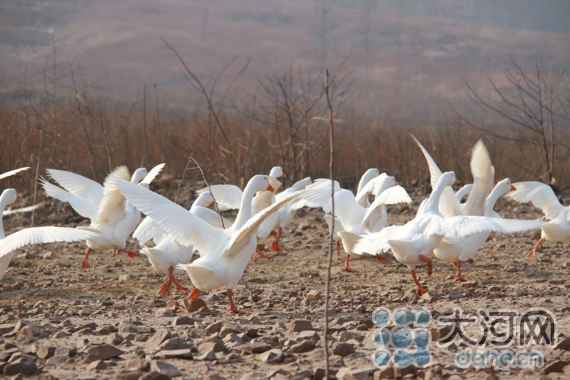
The large white geese at the farm
A single free-range egg sells for 3 yuan, mutton from the mountains is "delivered online" to Beijing, and the farm "opens" on mobile phones. These astonishing entrepreneurial achievements were actually accomplished by a young man from Ye County. His original intention in leaving Beijing to return home and start a business was to let everyone eat original ecological agricultural products and lead the villagers of his hometown to prosperity.
Free-range chickens foraging in the grass on the hillside
Golden thatch grass, fresh green rapeseed, colorful pheasants darting back and forth through the woods, cows mooing, lambs basking in the winter sun, large white geese swimming leisurely in the pond... In Youfangtou Village, Xiali Township, Ye County, Jing Qi's "Yuanyuan Qipin" farm is like a pure natural animal wellness retreat, where the animals enjoy the gifts of nature.
Jing Qi introducing his entrepreneurial experience to reporters
On December 17, when the reporter arrived at the farm, "Yuanyuan Qipin" farm owner Jing Qi was communicating with an online customer about a pickup issue. What was surprising was that this bespectacled, gentle middle-aged man was a genuine academic high-achiever and had once been an executive at a central state-owned enterprise. What reason made him give up a high salary and return to the mountain valley of his hometown to raise sheep and chickens? With this question in mind, we walked into this farm together.
Tsinghua Master's Graduate Gives Up High Salary, Leaves the City to Return Home and Raise Sheep and Chickens
In 1976, Jing Qi was born in Shiyangzhuang Village, Yeyi Township, Ye County. In 1997, he was admitted with a high score to Hunan University's Automation major. From 2001 to 2014, he worked for a nationally influential telecommunications company - FiberHome Communications, where he served as director of the company's telecommunications network department, with an annual salary of several hundred thousand yuan.
After starting work, Jing Qi also pursued a master's degree in communication engineering at Tsinghua University, while his wife held a master's degree from Renmin University of China. In the eyes of relatives, friends, and classmates in his hometown, Jing Qi and his wife were typical social elites. They bought a house and car in Beijing and lived a comfortable life.
"The friends around me are all a group of rural kids who squeezed through the single-plank bridge of the college entrance exam and leaped over the dragon gate, with master's degrees or above, respectable jobs, and considerable incomes," Jing Qi said. Having lived long-term in big cities like Beijing, they discovered some common problems: clenbuterol, gutter oil, fake mutton, and strawberry plumped with growth promoters were unavoidable around them, and more and more people were suffering health problems; as their children came into this world one after another, they began to place food safety in an important position. To eat meat that tasted like meat, they had to drive a thousand li to bring it back from their hometown; to eat vegetables that tasted like vegetables, they rented a tiny plot in the suburbs; to eat healthy eggs, they ordered "high-end" expensive organic eggs...
In 2014, 38-year-old Jing Qi made a very "willful" decision in his life: resign and return to his hometown to raise sheep and chickens. "We have a native-land emotional complex embedded in our bones. We hope to find a piece of land and do something solid for the food safety of our family, relatives, friends, and more people; we also hope to bring a little change to our hometown with our own strength," Jing Qi said with emotion.
Jing Qi's idea of returning home to start a business frightened all his relatives except his wife. "I was strongly opposed at the time. He now has a successful career in Beijing, so why must he return to the countryside?" said Jing Qi's older brother Jing Weixin.
To Choose a Site for the Farm, His Wife Wore Out Two Pairs of Shoes Running Around with Him
With the passion and dream of entrepreneurship, Jing Qi ultimately resigned and returned to his hometown Ye County to find a suitable farm. Jing Qi walked through almost all the mountains and rivers of his hometown, considering not only the natural environment and distance from pollution, but also government planning, property rights relationships, and villagers' wishes. At that time, his freelancer wife helped him do a lot of preliminary survey work. His wife, who wore out two pairs of shoes in succession, joked: "Remember to buy me shoes with the farm's first income in the future!"
After wearing out iron shoes, he finally found a pure land. Through his arduous search, Jing Qi received a lot of help from relatives and classmates in his hometown, and finally found an ideal site at the foot of Funiu Mountain - Daoguquan Natural Village in Youfangtou Village, Xiali Township, Ye County. This is a remote mountain village named after a natural spring, surrounded by mountains and streams, with clear springs and spiritual nourishment, simple folk customs, and relatively flat hillsides, making it uniquely suited for developing a farm.
Jing Qi and three friends invested a total of 3 million yuan, contracted 500 mu of barren mountain land in Daoguquan Village, and registered Ye County Tianxiang Agricultural Development Co., Ltd. From building roads, erecting power lines, digging wells, and constructing sheds, they built a farm on the bare mountain. With the arrival of the first batch of more than 100 sheep and several hundred free-range chickens, Jing Qi's farm was officially open for business.
The Sheep Shed Was Once Swept Hundreds of Meters Away onto the Hillside
The road to success is not always smooth sailing. In 2014, Ye County suffered a severe drought. To ensure water for humans and livestock, dozens of mu of peanuts on the farm yielded nothing, and the sparse peanut vines all became winter feed for the sheep; due to lack of experience, a large number of purchased chicks died, with a final survival rate of less than 30%; plateau sheep purchased from remote areas could not adapt to the local climate, leading to successive deaths from illness; in May 2015, a hailstorm unprecedented in a century swept the sheep shed hundreds of meters away onto the hillside, with direct losses reaching more than 300,000 yuan...
"The wind was especially strong that night. When I opened the door, wow, what huge hailstones. I looked over toward the sheep pen and was stunned - the sheep were standing there, and the shed was gone." Recalling the scene at that time, Jing Qi still felt lingering fear.