How much does a Buddha's hand bonsai cost per pot on the market?
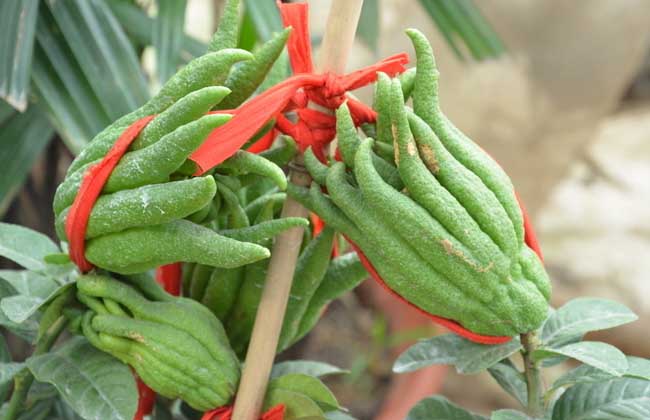
Buddha's hand, also known as Buddha's hand citron, five-fingered tangerine, five-fingered citron and so on, is a shrub or small tree of the genus Citrus in the family Rutaceae. It gets its name because when the fruit matures, its carpels separate to form slender, curved finger-like segments resembling fingers. It is usually used as a traditional Chinese medicinal material, but its unusual fruit shape also makes it a common ornamental plant. Let's take a look below at how much a Buddha's hand bonsai costs per pot!
How much is a Buddha's hand bonsai per pot?
The price of a Buddha's hand bonsai ranges from a few yuan to several hundred yuan, mainly determined by the size of the bonsai and the number of fruits. The ornamental value of the Buddha's hand bonsai is very high; the flowers are pure white and fragrant, blooming in clusters, and are very endearing. When the fruit ripens, its shape resembles extended fingers, a clenched fist, a fist with fingers, or a hand within a hand - shaped like a human hand and remarkably true to life. Moreover, the ripe Buddha's hand continuously gives off fragrance, eliminates odors, purifies indoor air, and inhibits bacteria. Its fruiting period is long, lasting 3 to 4 months or even longer, allowing for long-term enjoyment.
How to grow a Buddha's hand bonsai
1. Soil: Buddha's hand prefers acidic soil, and the pH value should be kept at around 5.3. The potting soil ratio is 60% humus soil, 30% river sand, and 10% peat soil or furnace ash residue. A diluted liquid fertilizer can be applied once every ten days to half a month. Too much water easily causes root rot, so the method of watering by testing the soil moisture should be adopted - do not water if the surface layer of the potting soil is not dry, and water thoroughly each time, all year round.
2. Fertilizing: Buddha's hand has luxuriant branches and leaves, stays green all year round, and produces large fruits, so it needs a lot of fertilizer. Apply rotted cake fertilizer once in early spring, then apply rotted liquid fertilizer once every 10 days to half a month. During the flowering period, phosphorus fertilizer should be the main type to promote flower bud differentiation. Before winter, apply a heavy fertilizer and water thoroughly once, then cover the soil with barnyard manure and compost to ensure safe overwintering.
3. Watering: Buddha's hand likes moisture but is most afraid of waterlogging. Soil that is too wet or water accumulating at the bottom of the pot will cause the root system to mold and rot. From flowering to fruit ripening, Buddha's hand is quite sensitive to water requirements; excessive watering during this period easily causes root rot and the dropping of flowers and fruits. If the potting soil is too dry, it easily causes the flower stalks and fruit stalks to form abscission layers and drop off, so the soil for potted Buddha's hand is best kept in a state of being neither dry nor wet.
4. Pruning: After being potted, Buddha's hand initially focuses on vegetative growth, with the terminal buds growing continuously and no self-pruning tendency. Therefore, attention should be paid to pinching the main shoots of Buddha's hand to promote branching and dwarf the crown, and to thin out dense and weak branches. After Buddha's hand sets fruit, bud removal should be carried out in spring and summer according to growth and fruiting vigor, pinching the terminal shoots of fruiting branches and thinning flowers and fruits, to promote balance between shoots and fruits at each stage and prevent the phenomenon of alternate bearing (on-years and off-years).
5. Flower removal: The flowers that Buddha's hand opens from April to early June are mostly unisexual flowers on the previous year's autumn shoots, cannot set fruit, and should all be removed. The flowers that open around the end of June on the current year's spring shoots are mostly bisexual flowers and can set fruit; each short branch can keep 1 to 2 flowers, and the rest should be thinned out to promote the growth of large fruits. During the flowering and fruiting period of Buddha's hand, attention should also be paid to removing new buds sprouting on dry branches to prevent fruit drop.
Precautions for Buddha's hand bonsai
1. Buddha's hand prefers a warm, humid environment with plenty of sunlight, is not tolerant of severe cold, and is afraid of frost and drought. It is best cultivated in areas with ample rainfall and no freezing in winter.
2. The most suitable humidity for Buddha's hand is 70 to 90%. In dry seasons, water should be sprayed on the leaves 1 to 2 times a day, and water can also be sprinkled on the ground to increase air humidity.
3. The suitable growing temperature for Buddha's hand is 15 to 30°C. In hot seasons, it should be moved to a cool, ventilated and shaded place. When the temperature is below 5°C, cold protection is necessary.
4. Buddha's hand does not easily set fruit, so various methods must be used to promote fruit set. During the bud stage, before flowering and after flowering, organic fertilizer must be applied, and a diluted organic liquid fertilizer should also be applied once a week. Then thin the buds - deformed buds and diseased or weak buds should all be removed. Too many buds must not be kept; only the two or three best-growing buds near the top of the branch can be kept, and excessive fruit set should not be required.
5. Buddha's hand is prone to yellow leaf disease and leaf drop. For yellow leaf disease, a 1% ferrous sulfate solution can be poured on it. If root rot occurs, the pot should be repotted immediately: take the plant out of the pot, rinse the roots, remove the rotten roots, disinfect them, and plant in disinfected plain sandy soil for care, so that it gradually recovers its vitality.