How much does a small-leaf red sandalwood bracelet generally cost?
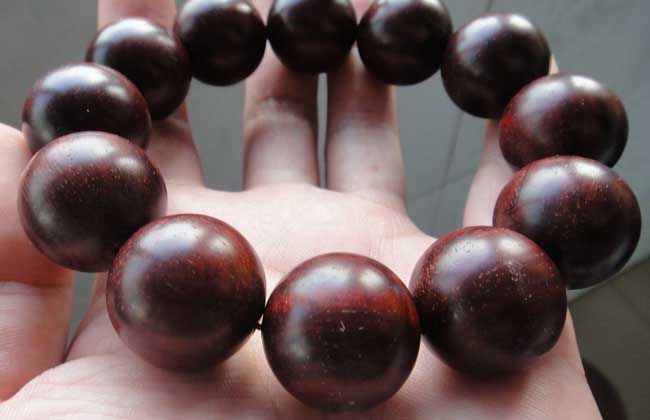
The small-leaf red sandalwood, whose scientific name is red sandalwood (Pterocarpus santalinus), also known as Indian small-leaf red sandalwood, is praised as the "king of woods". Only small-leaf red sandalwood is true red sandalwood in the real sense; the other so-called "sandalwoods" are not red sandalwood. Bracelets made from small-leaf red sandalwood are loved by people today, but it is extremely rare and very expensive. Let us take a look below at how much a small-leaf red sandalwood bracelet costs!
How much does a small-leaf red sandalwood bracelet cost?
The market price of small-leaf red sandalwood is relatively expensive. The factors affecting the price of small-leaf red sandalwood bracelets are naturally the material, appearance and rarity, but because small-leaf red sandalwood bracelets use less material and are generally made from the leftover scraps from furniture-making, the price is not very high either. Poorer-quality material costs between 500 yuan and 1,500 yuan, while slightly better material costs between 2,000 yuan and 6,000 yuan.
How to identify small-leaf red sandalwood
1. Density: The density of a small-leaf red sandalwood bracelet is greater than that of water. If it is a real small-leaf red sandalwood bracelet, it will sink to the bottom when placed in water.
2. Color: The color of a small-leaf red sandalwood bracelet is purplish-red, rich in luster and oily, while a fake small-leaf red sandalwood bracelet has no luster and will turn dark black after a period of time.
3. Scratch mark: If you gently scratch a small-leaf red sandalwood bracelet on white paper, you can see a mark, while a fake one leaves none.
4. Grain: The grain of a small-leaf red sandalwood bracelet is fine, dense and slender, appearing to float gracefully, while the grain of a fake bracelet is coarser and lighter in color.
5. Fragrance: A small-leaf red sandalwood bracelet has a subtle fragrance, very faint. If there is no fragrance or the fragrance is too strong, further analysis is needed.
Price factors of small-leaf red sandalwood
1. Look at density: Density is one of the important factors determining the quality of a small-leaf red sandalwood bracelet. Generally, bracelets with relatively low density usually have less oiliness.
2. Look at oiliness: The oiliness of a small-leaf red sandalwood bracelet refers to its glossiness and whether it is translucent.
3. Look at pores: Many beginners think that a small-leaf red sandalwood bracelet must have pores to be real, but this is not the case. On the contrary, the fewer or smaller the pores, the higher the density of the small-leaf bracelet.
5. Look at specific gravity: Those with high specific gravity usually have sufficient oiliness and are not easy to crack, but bracelets with absurdly high specific gravity should be given a bit more attention.
6. Look at color and luster: Generally, high-quality small-leaf red sandalwood prayer beads give off a satin-like luster, while those of poorer quality appear very "forced" in terms of luster.
7. Look at feel: Compared with other woods, the wood of small-leaf red sandalwood feels more solid. You can select the best small-leaf red sandalwood prayer beads through comparison.
8. Look at grain: The grain of small-leaf red sandalwood is interwoven. The grain of ordinary wood is very messy, but that of small-leaf red sandalwood is not messy; instead, it creates a sense of beauty.
9. Ox-hair grain: The ox-hair grain of small-leaf red sandalwood is generally relatively delicate and concentrated. The more ox-hair grain there is, the better the quality.
10. Look at the wood: The older the red sandalwood wood, the better. Some also judge the preciousness of red sandalwood by its age. Generally, the older the tree age, the rarer it is. Red sandalwood over 800 years old can be considered a treasure.
11. Look at golden stars: Golden stars exist in only a small portion of small-leaf red sandalwood, so small-leaf red sandalwood with golden stars is better in quality and more precious than small-leaf red sandalwood without golden stars.
12. Look at quality: The standard for judging is very simple. If a piece of wood contains no cracks or fillings, it shows that the quality of this red sandalwood is very good. Red sandalwood is very prone to forming a hollow core during its growth stage, so red sandalwood without missing material appears very precious.