How much does a yew bonsai cost per pot? An overview of market prices
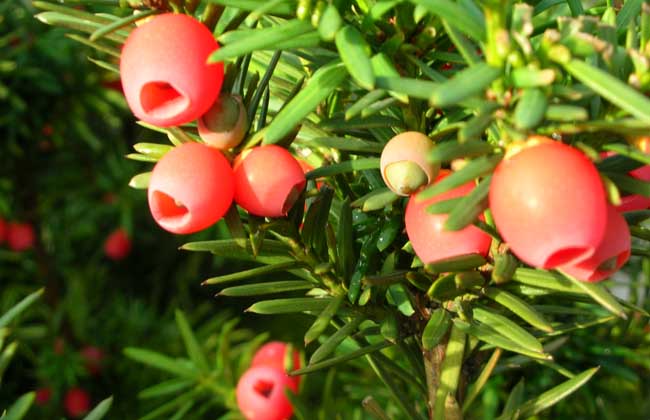
The yew has very broad development prospects in landscaping and indoor bonsai. For example, in the high-grade bonsai made from it, yew bonsai treated with dwarfing techniques have a simple and elegant shape, with compact but not crowded branches and leaves, spreading but not loose, and have multiple ornamental values: the stems, branches, leaves and fruits can all be appreciated. Now let us take a look at how much a yew bonsai costs per pot!
How much does a yew bonsai cost per pot?
Specification (height) Price (yuan/plant) Specification (height) Price (yuan/plant) Specification (height) Price (yuan/plant) 30 cm 8 yuan 40 cm 12 yuan 50 cm 25 yuan 60 cm 60 yuan 70 cm 80 yuan 90 cm 100 yuan 1 m 130 yuan 2 m 400 yuan 903 m 800 yuanNote: The yew is recognized worldwide as an endangered natural rare anti-cancer plant. It is an ancient tree species left over from the Quaternary glaciation and has a history of 2.5 million years on Earth. At present, yew bonsai on the market are mainly priced according to the height of the yew, but market conditions vary from place to place, so everyone can compare when buying.
How to grow yew bonsai
1. Light: The yew is a shade-loving and drought-tolerant plant, so it should be placed indoors. In summer, it should be properly shaded and must not be placed in a room with west-facing sunlight, nor placed at the air outlet of an air conditioner or next to a heater, as that will increase the evaporation of water from the yew leaves, causing the branches and leaves to dehydrate and eventually the leaves to curl and dry up. In summer, the light duration should be as short as possible, while in autumn and spring it can be longer.
2. Potting soil: For the yew, choose a slightly larger flower pot and make several more holes in the lower part of the pot to enhance drainage and air permeability. The soil should be loose, rich in humus, fertile, water-retaining, fertilizer-retaining and breathable, with a slightly acidic soil pH, and loam is best. Clay is not breathable, and sandy soil has poor fertilizer and water retention, so neither is suitable. In addition, a mixed growing medium made from peat soil, perlite, etc. and loam can also be used.
3. Water: When a little yellow-white appears on the surface of the yew pot soil and the leaves curl slightly, there is no need to water; simply spray the leaf surface. When the soil turns white, it should be watered. Water thoroughly in one go so that the pot soil fully absorbs enough water. For outdoor placement, water once every 15 to 20 days; indoors, water once every 20 to 25 days. Keep the soil moisture content at about 40%. Note that watering too much or too frequently will cause root rot in the yew.
4. Fertilizing: For each potted yew, apply 0.2 jin of organic fertilizer and 0.02 jin of compound fertilizer. Farmyard manure and cake fertilizer (such as cottonseed cake, peanut cake, and sesame cake) can also be added. Fertilizer should be applied as much as possible along the pot wall and must not be close to the yew roots. Generally, newly bought yew bonsai contain nutrient soil, so no fertilization is needed within 3 months; afterward, apply once every 2 to 3 months.
5. Repotting: After about a year, the potted yew sapling gradually grows larger and its root system becomes well developed, so it then needs to be transplanted and repotted. Break the old pot without damaging the original soil ball, move it into a new pot, and water it to settle the roots, ensuring that the root system and soil are closely combined and that survival is ensured. If conditions permit, the yew sapling can be transplanted into open fields, where it will grow faster.
6. Pruning: If the lower branches and trunk of the yew bonsai grow too densely, dry, yellow leaves may appear and fall off. Part of the overly dense lower branches and trunk can be pruned away. During pruning, it can be shaped freely, such as umbrella-shaped, tower-shaped, round-shaped, etc. To keep the yew crown beautiful, the terminal buds and some lateral buds can be appropriately removed.
7. Pests and diseases: Under normal conditions, the yew has very few insect pests. If the yew is found to turn yellow or have pests and diseases, it can be watered or sprayed with thiophanate-methyl and potassium dihydrogen phosphate. During the rainy season, the yew may develop root rot, stem rot and root rot, especially young trees; at this time, dikesone can be sprayed for care. In high-temperature and dry seasons, leaf blight and red blight are likely to occur, which can be prevented and controlled by spraying Bordeaux mixture.
Precautions for yew bonsai
1. For newly purchased yew bonsai, it is best to spray the leaf surface with a 800-fold to 1000-fold potassium dihydrogen phosphate solution about every three or four days, generally before 10 a.m., or around 4 p.m. After spraying three to four times in a row, gradually reduce it to about once a month.
2. The climate in the north is dry with little rain. When the soil surface is dry, it can be watered. Note that it should be watered thoroughly in one go, especially in summer. The air in the north is dry, so the leaf surface is prone to drooping from lack of water. When the leaf surface does not look plump, use a small spray bottle to spray water on the leaf surface from bottom to top (in summer, it can be sprayed every day).
3. When growing yew bonsai in summer, it should be properly shaded. In winter, at minus 20 degrees Celsius, the yew price does not need insulation, but during the dormant period (from early December of the current year to the end of February of the following year), it should not be watered.
4. Yew bonsai should not be watered with tea water. In particular, Beijing's water quality is relatively hard and has a high alkali content, so the water must be left to stand for a day before being used for watering and spraying.
5. In Central China, the yew growth period is from early April to the end of October each year. During this period, outdoor plants should be watered once every 15 to 20 days, and indoor plants once every 20 to 25 days.
6. Watering the yew too much or too frequently will cause root rot and lead to death. Especially when there is heavy rain in summer, for outdoor placement, excess rainwater should be drained promptly to prevent the yew from being soaked in water for a long time.