How much does a Duolang sheep cost? Market price reference
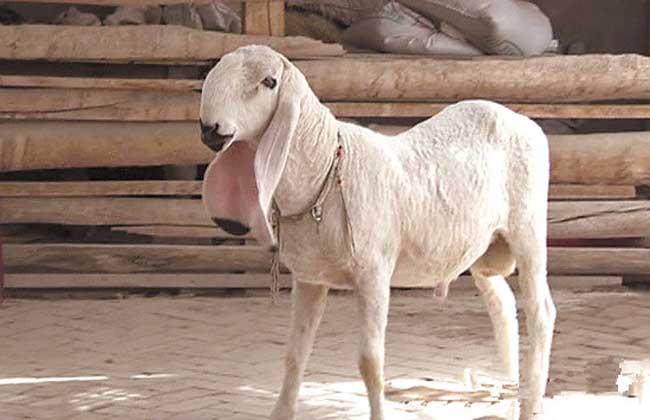
The Duolang sheep is a dual-purpose meat and fat sheep breed produced by crossing the local Maigaiti sheep with the Afghan Wargil fat-tailed sheep. It is also known as the Duolang sheep or Maigaiti sheep. It has the characteristics of a tall body, fast growth and development, early maturity, high meat production and reproduction rates, strong adaptability, stable heredity, and a high feed conversion ratio. Let us take a look below at how much a Duolang sheep costs!
How much does a Duolang sheep cost?
Duolang sheep are in very tight supply and are expensive. Because of their strange and amusing appearance, Duolang sheep from ** are an extremely rare breed and have become a new star in China's pet world. In **, a good breeding sheep costs several hundred thousand yuan, and online reports mention ones costing over a million or even tens of millions. Purebred, beautiful Duolang sheep are currently being speculated up to 14 million yuan each, and the cheapest still costs more than 200,000 yuan. This breed is not something an ordinary farmer can raise.
Appearance characteristics of the Duolang sheep
The Duolang sheep has a well-proportioned structure, a large body with a long and deep torso, rounded ribs, a deep and wide chest, and relatively full front and rear quarters. The head is medium-sized, the nasal bridge is raised, and the ears are especially long and wide. The vast majority of rams have no horns, and ewes generally have no horns. The tail shape includes W-shaped and U-shaped forms. The body coat is grayish-white or light brown (the color of the head and limbs is darker, being light brown or brown), with abundant down hair and good wool quality. The vast majority of the wool is semi-coarse, while a small number of sheep have relatively fine wool with good evenness and no kemp. However, some wool contains brown or black pigmented fibers, and some fiber bundles form small ring-shaped locks.
Production performance of the Duolang sheep
1. Meat production performance: Duolang sheep are raised under year-round barn feeding conditions and have good meat production performance, with not only a high dressing percentage but also a high meat-to-bone ratio. In particular, lambs of the current year grow quickly and are early maturing, gaining weight rapidly after weaning. Sheep within one year of age can reach a dressing percentage as high as 53-56%, and the meat is delicious and tasty. The average live weight, carcass weight, dressing percentage, net meat weight, and meat-to-bone ratio for current-year male lambs were 46.21 kg, 24.91 kg, 53.94%, 13.30 kg, and 1:4.72 respectively; for current-year female lambs they were 37.63 kg, 19.9 kg, 52.89%, 13.33 kg, and 1:3.31 respectively; for adult rams they were 99.76 kg, 59.75 kg, 59.89%, 40.56 kg, and 1:5.55 respectively; and for adult ewes they were 64.45 kg, 35.5 kg, 55.20%, 25.78 kg, and 1:4.47 respectively.
2. Wool production performance: The wool of the Duolang sheep is grayish-white, with some brown and a small amount of white. Most of it is semi-coarse wool. Among the semi-coarse wool types, the content of kemp is low and the content of heterotypical fibers is high. The fleece weight for yearling rams is 1.48 kg ± 0.06 kg, for ewes 1.26 kg ± 0.05 kg, for adult rams 2.6 kg ± 0.05 kg, and for ewes 1.56 kg ± 0.05 kg. In the brown wool of adult sheep, down fibers account for 61%, heterotypical fibers 37.5%, coarse fibers 1%, and kemp 0.5%. In the grayish-white wool of adult sheep, down fibers account for 70.2%, heterotypical fibers 28.8%, coarse fibers 0.9%, and kemp 0.1%. In the light brown wool of yearlings, down fibers account for 63.4%, heterotypical fibers 35%, coarse fibers 1.4%, and kemp 0.2%.
3. Reproductive performance: Duolang sheep have relatively high reproductive capacity and reach sexual maturity earlier than ordinary sheep. Generally, male lambs reach sexual maturity at 6-7 months of age, female lambs are first mated at 6-8 months of age, and most yearling ewes have already given birth to lambs. Ewes generally come into estrus in two seasons, spring from March to May and autumn from August to October, but under good feeding conditions they come into estrus year-round. Most ewes can give birth three times in two years, and under good feeding and management conditions they can give birth twice a year. The twin lamb rate is high, reaching 30%, and there are also cases of three or four lambs in one litter. A single ewe can produce 15 lambs in her lifetime, with a maximum of 32. The reproductive survival rate is about 150%.