How much does a cherry blossom sapling cost? An overview of the market
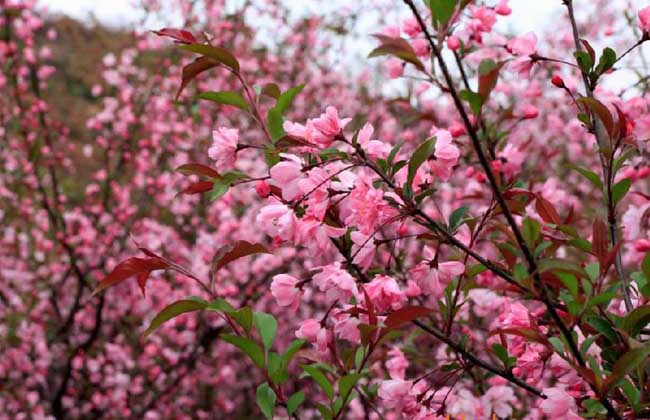
Cherry blossoms are bright and gorgeous in color, with lush and vigorous branches and leaves. They are often used for ornamental planting on hillsides, in courtyards, along roadsides and in front of buildings. They can also be planted in large numbers to create a “sea of flowers” landscape, or dotted in groups of three to five in green spaces to form clusters of brocade, creating the pictorial mood of “a touch of red amid ten thousand greens.” Now let us take a look together at how much a cherry blossom sapling costs!
How much does a cherry blossom sapling cost?
Category Ground diameter Price Category Ground diameter Price Category Ground diameter Price Cherry blossom sapling 2 cm 12 yuan Cherry blossom sapling 3 cm 22 yuan Cherry blossom sapling 4 cm 35 yuan Cherry blossom sapling 5 cm 90 yuan Cherry blossom sapling 6 cm 150 yuan Cherry blossom sapling 7 cm 280 yuan Cherry blossom sapling 8 cm 420 yuan Cherry blossom sapling 10 cm 800 yuan Cherry blossom sapling 12 cm 1500 yuanNote: The price of cherry blossom saplings is also related to the variety, quality and market location of the cherry blossoms. When purchasing, please refer to the actual price.
The cultivation environment of cherry blossom saplings
Cherry blossoms are a temperate and subtropical tree species. They like sunlight and warm, humid climatic conditions, and have a certain cold resistance. They are not strict about soil requirements and are suitable for growing in loose, fertile, well-drained sandy loam, but they are not tolerant of saline-alkali soil. The root system is relatively shallow, and waterlogged low-lying land should be avoided. They have a certain tolerance to cold and drought, but are weak against smoke and wind, so they are not suitable for planting in coastal areas with typhoons.
Cultivated varieties of cherry blossom saplings
1. Tokyo cherry: The bark of the Tokyo cherry is purplish brown, smooth and glossy, with horizontal stripes. Flowers and leaves are alternate; the leaves are elliptical or obovate-elliptical, with serrate margins, pointed tips and glands, dark green and glossy on the surface, and slightly lighter on the back. Stipules are lanceolate-linear, with finely cleft serrate margins and glands at the cleft tips. Each cluster bears three to five flowers in umbel-like inflorescences; the sepals spread horizontally, and the petal tips are notched, white, red or pink. The flowers open together with the leaves in March or bloom after the leaves.
2. Somei Yoshino cherry: The Somei Yoshino cherry is a horticultural variety of cherry blossom and a deciduous tree about 5 to 12 m tall. The flowers have five petals. The flower color is pale red when the flowers first open, and gradually turns white when fully bloomed. Because it is artificially bred, it cannot set fruit and reproduce naturally and can only be propagated by cuttings and transplanting. It has the same petal shape and color as the Yoshino cherry, and the same flowering period, so they can bloom and fade at the same time. In Japan's Kanto region, the flowering period is roughly late March to early April.
3. Kanhizakura: Kanhizakura is also called Fei cherry, bellflower cherry, Fujian mountain cherry, etc. As the name implies, it is a red cherry that blooms in the cold early spring. Kanhizakura may indeed be considered the earliest cherry blossom to open in mainland China in a year, generally flowering in mid-February. Both its Chinese name and Latin scientific name can explain this: the inflorescence looks like a series of long bells strung together.
4. Mountain cherry: Mountain cherry is the most widely introduced cherry blossom in China. Because of its diverse varieties and flower colors and its relatively long flowering period, it has won favor in Japan and around the world. The original variety of mountain cherry is single-petaled. Wild plants are found in mainland China from Jiangnan to Northeast China, extending to the Korean Peninsula and Japan, but as a garden planting it is less common than its variety, the Japanese late cherry. The Japanese late cherry has many horticultural varieties, with flower colors ranging from pure white, pinkish white, deep pink to pale yellow and light green. The newly grown young leaves also have their own appearances, from yellow-green, red-brown to purplish red. The petals range from single, semi-double to double. The emergence of every late cherry variety is the result of careful breeding.
5. Weeping cherry: Weeping cherry is a variety, also called weeping large-leaf early cherry or large-leaf early cherry. Most cherry blossoms introduced to China have branches that grow upward or spread outward. The weeping large-leaf early cherry is also like most cherry blossoms in the early stage of growth, but after reaching a certain height, the large branches grow horizontally and the small branches are upright or drooping, forming willow-like cherry branches similar in shape to the dragon-claw pagoda tree. The flowers of the weeping large-leaf early cherry are pale red tinged with white, and the flower shape is compact. Together with the quiet and elegant feeling brought by its weeping branches, it is often praised by Japanese people as the most beautiful cherry blossom.
6. Yunnan cherry: Yunnan early cherry is also called red-flowered tall-pot cherry. It blooms before the leaves, with deep red flowers, about 25 petals, a flower diameter of about 2.5 cm, semi-open flowers that droop, and red sepals. The young leaves are tea-brown. The flowering period is from late February to early March. This type of cherry is native to Yunnan and is also distributed in Nepal, Bhutan and Myanmar. It was first widely cultivated in Kunming, Yunnan, and since the 1980s has been promoted to major cherry planting areas across the country. The flowers of the red-flowered tall-pot cherry are mostly semi-double, with colors from deep pink to red, dense like clouds, blooming in late February in early spring, almost at the same flowering period as Kanhizakura.
7. Edohigan: Edohigan can grow into a large tree about 15 to 25 m tall. Somei Yoshino was created precisely by crossbreeding “Edohigan” and “Oshima cherry.” Many representative ancient trees in Japan are Edohigan. The shape of the calyx tube is very distinctive, with the lower part swelling round into a pot shape. The flowering period is relatively early, and it got this name because it blooms during the spring equinox. The petals are about 1 cm long. The flower colors include pure white and red-purple, but pale red is more common. This cherry tree is very robust and long-lived, and many are large trees 15 to 20 m tall. The flowering period is late March (Tokyo), mid-April (Sendai, Kanazawa), and late April to early May (Morioka).