How much does a porcupine breeding stock cost per animal on the market?
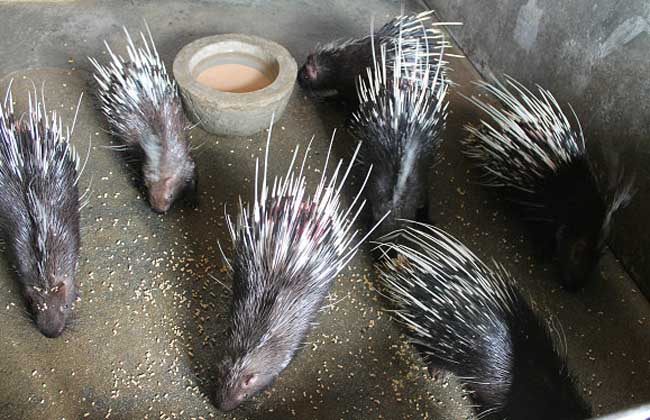
The porcupine combines meat, medicinal and ornamental value in one, and also has high craft value, which is why it is very popular with consumers. As people's various demands for porcupines accumulate over time, supply can no longer meet the growing demand. Domesticating and breeding porcupines is therefore of special significance and has very broad market prospects. Let's take a look below at how much a porcupine breeding stock costs per animal!
How much does a porcupine breeding stock cost per animal?
Porcupine breeding stock is very expensive. At present, the domestic price of porcupines is 5000 to 11000 yuan per group (1 male and 3 females, 4 animals in total), but the prices of porcupine breeding stock and commercial porcupines vary from place to place. Commercial porcupines cost 70 yuan per jin, and porcupine breeding stock costs 100 yuan per jin (usually sold by the group). The above prices may differ somewhat depending on the region, but the range will not be too large.
Is porcupine farming a scam?
Porcupine farming is not a scam. Excessive capture has caused the number of wild porcupines in natural populations to drop sharply, and factors such as the continuous destruction of the ecological environment and the heavy use of pesticides and chemical fertilizers have caused the natural ecological environment of porcupines to deteriorate continuously, intensifying the contradiction between social demand and output supply. Artificial breeding of porcupines can not only effectively protect the survival, reproduction and ecological balance of wild animals, but also bring greater economic benefits to farmers, while also meeting people's daily needs. However, farmers must be especially careful when buying breeding stock, and must not fall into the trap of breeding-stock speculation.
How can a porcupine farm be identified?
1. The farm has not been around long enough: even professionals need a certain amount of time to temper themselves in special breeding, often going through repeated setbacks, and it is very hard to gain real skill. Their technology and product quality are often immature. Because some farms have just been established, have no foundation and no strength, yet are also selling breeding stock, they often close down and disappear after a few years. Those introducing breeding stock must be very cautious.
2. The farm has no strength: the biggest fear for those introducing breeding stock is being cheated. If a farm's assets are not more than several hundred thousand, it has no strength to hire good management talent or technical talent, and has no good production facilities. It simply has no strength or credibility, and even if a complaint after being cheated is won, it has no ability to pay compensation. Therefore, only farms with capital strength are reliable.
3. No professional training: breeding technology training is an important manifestation of a farm's technical strength. Is the technical force strong or not? Is the training quality high or not? Is the training content a summary of mistakes made in its own breeding process? Are there a large number of practical case studies? Does it have its own unique knowledge? Is there an assessment after training? If there is no training, or the training is just reading from a script, it may all lead you to take detours in breeding. This is the key to the safety of your investment.
4. No good after-sales service: dedicated after-sales service means doing no other work in the company and focusing specifically on after-sales service for customers, and there must be at least 3 people so that there is time to train each customer and provide after-sales service. If they also do production and sales, there is simply no way to guarantee service time and service quality for customers, and in the end only the customer suffers.
5. The farm stinks to high heaven: everyone knows that harmful bacteria are the source of odors. A farm with odors indicates many harmful bacteria and very poor animal quality, and also shows extremely poor management level, professional technology and enforcement of rules. Therefore, introducing breeding stock from a farm that stinks to high heaven is very risky. As for the products of such a farm, let alone being cheap, even if they are given to you, you must absolutely not take them.
6. A family-style farm: the farm has only a few people putting on an act to fool customers, while production is done by only a few family members or a husband-and-wife team, with no professional knowledge, very few personnel and poor production facilities. Even the pens are temporary structures, and there is not even an incubator or a backup generator, yet it is very easy to fool those introducing breeding stock who have poor judgment.
7. The farm frequently changes its name: some irregular farms often use this method, firing one shot and moving on. Today it is this farm name; after cheating a few customers, it then changes to another farm name, or changes the farm name along with its own name and phone number. In fact, seeing through this method is very simple, because if their farm has licenses, the license name does not match the actual farm name, which clearly shows that this is not a regular farm. If it has no license, then there is even less reason to discuss introducing breeding stock.
8. No breeding license: the state's management of wild animals is becoming increasingly strict. For example, in the breeding of wild animals, without the forestry department's “Wild Animal Domestication and Breeding License” and “Wild Animal Business License”, their sale and transport are illegal, and once caught, the animals will be confiscated, fines will be imposed, and offenders may even be sentenced to prison. Moreover, farms selling special animals must also have the animal husbandry department's “Animal Epidemic Prevention Qualification Certificate”, otherwise they violate regulations, their products cannot be used as breeding stock, and there will also be problems in future production and sales.