Market price of black goats
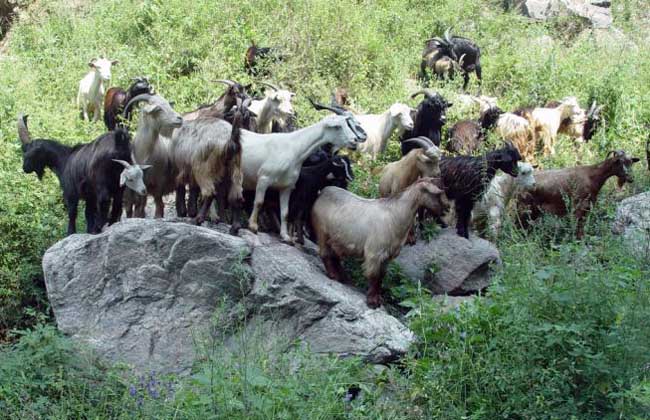
Black goats have long enjoyed a high reputation in southern China and Southeast Asia, and are mainly distributed in areas below 2500 m in altitude. Their distinguishing features are a whole body of black hair, fast growth and development, thick and full hide, soft and fine fur, high lean meat rate, tender meat, good flavor and little gamey smell, and they have very high breeding prospects. Let us take a look at the market price of black goats below!
Market price of black goats
Usually the prices of cattle and sheep change with market conditions, and the price of black goats is the same. Generally, the south prefers black goats, and the price is relatively higher than in the north, about 15 yuan-20 yuan per jin, with one goat costing about 700-1200 yuan, and a better and larger one about 1400-1800 yuan.
Breeding advantages of black goats
1. High reproductive performance: ewes generally produce 1.7 litters per year, with 193% for the first birth and 246% for the 2nd to 4th litters. Newborn and two-month-old male lambs weigh 2.35 kg, and female lambs 2.22 kg.
2. Fast growth and development: at 6 months of age, body weight and body height are 25.5 kg and 58.2 cm for males, and 23.8 kg and 55.1 cm for females. At 12 months of age, body weight and body height are 37.2 kg and 65.8 cm for males, and 34.9 kg and 60.7 cm for females. Adult body weight and body height are 74.6 kg and 76.7 cm for males, with a maximum weight of 125 kg, and 56.2 kg and 68.5 cm for females, with a maximum weight of 80.5 kg.
Gain-increasing measures for black goats
1. Crossbreeding improvement: use Boer goats to cross with black goats to produce a first hybrid generation, and then cross the female parent of the first hybrid generation with Boer goats. The hybrid goats can reach 25-30 kg at 4 months of age, equivalent to the adult weight of local goats. Under grazing conditions, the meat yield at 10 months of age is 12.5 kg, twice that of local goats of the same age.
2. Pay attention to deworming: change deworming from twice a year in spring and autumn to once every 2 months, rotate the use of albendazole and avermectin for oral deworming, and use amitraz externally by spraying to kill insects. At the same time, clean the goat pen every day, and regularly use bleaching powder and Baidusha to disinfect the pens and facilities for hygiene, thereby preventing parasitic infections and other diseases.
3. Off-season mating: in order to achieve good returns from marketing at the Mid-Autumn Festival and Spring Festival, carry out off-season breeding of the flock. Ewes producing winter lambs are mated from July to September, give birth from December to February of the following year, and wean from April to June. When the lambs are weaned, it is exactly the regreening growth period of forage grass, and grazing can achieve good daily weight gain. By August to October, they can be marketed when their weight reaches 40 kg. Ewes producing spring lambs are mated from October to November, give birth from March to May of the following year, and wean from July to August. After weaning, grazing plus supplementary feeding enables the lambs to reach 40 kg for marketing from November to December.
4. Careful management of ewes: after ewes become pregnant, feed more tender forage grass, carrots and other green juicy feeds, and also pay attention to the addition of trace elements and vitamins and the supply of salt. Appropriately increase the amount of bran in the concentrate to help promote bowel movement and defecation. 2-3 days before giving birth, appropriately feed peanut cake, soybean milk and other protein-rich lactation-promoting feeds, as well as green, juicy, mildly laxative feeds, to prevent insufficient milk after the ewe gives birth. After lambing, while supplementing concentrate, increase the feeding amount of root tubers, juicy feeds, vitamins, and calcium and phosphorus to increase milk density and promote lamb development. If the ewe has scarce milk, take 250 g of kelp and 100 g of lard, cook them into soup in a pot, and let the ewe drink it all at once; after 6 hours the milk yield will increase significantly. After that, feed once every 3 days for 3 consecutive times, and supplement sufficient green juicy feed, and a significant milk-promoting effect can be achieved.
5. Strengthen supplementary feeding: every day after the sheep return from herding, at 8 p.m. supplement with grass meal and mixed concentrate (60% corn meal, 28% soybean cake, 10% wheat bran, 2% salt, multivitamins and trace elements). During the dry grass period, add 8% peanut bran as well as vitamins and minerals to the concentrate. When lambs are 10 days old, train them to eat tender grass; at 15 days old, supplement with roasted corn meal and other mixed concentrate, with a daily feeding amount of 50-200 g per goat, ensuring that after weaning at 3 months of age the lambs all survive, are all strong, and grow quickly.
6. Magnetized water and feed: every day use 2 pieces of Qiangde Nano 863 to treat water, forage and concentrate, to improve feed utilization and strengthen the goats' constitution.