What is the market price of a Barred Plymouth Rock chicken?
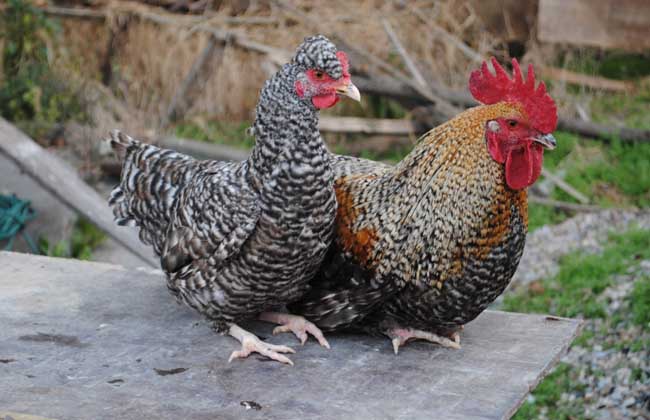
The Barred Plymouth Rock is a dual-purpose breed (egg and meat), named after its place of origin in Wenshang County, Shandong Province, and is distributed in some cities and counties adjacent to Wenshang County. It is a typical lean-type rare game fowl, with little subcutaneous fat and firm muscle, so its adult chickens have high economic value and very good market prospects. Let us take a look at the market price of Barred Plymouth Rock chickens below!
Market price of Barred Plymouth Rock chickens
The market price of Barred Plymouth Rock chickens varies according to different farming methods and breeds. Meat-type birds are too fat, usually with thick legs, and those weighing more than five jin are not worth much, at seven yuan per jin wholesale. Egg-type birds are thinner and even less valuable, and those under three jin are unwanted. Free-range-type birds are valuable; generally yellow Barred Plymouth Rocks wholesale at ten yuan and retail at fifteen or sixteen yuan per jin, or fifty-one yuan each. Good free-range Barred Plymouth Rock chickens sell for over 200 yuan each and are still in short supply, so the price is hard to define.
Reproductive characteristics of Barred Plymouth Rock chickens
1. After laying hens reach 14 weeks of age, the volume and weight of the ovaries and oviducts begin to increase relatively quickly; after 17 weeks of age their growth rate is even faster, and by 19 weeks of age the reproductive system of most chickens is close to maturity. In a normally developing hen, the ovary weighs about 4 grams at 14 weeks of age, reaches more than 25 grams at 18 weeks of age, and can reach more than 50 grams at 22 weeks of age.
2. During the period from 18 to 20 weeks of age, bone weight increases by 15 to 20 grams, of which 4 to 5 grams is medullary bone calcium. Medullary bone calcium is unique to female poultry approaching sexual maturity; it exists in the bone cavity of long bones, and during the process of eggshell formation it can release decomposed calcium ions into the blood to form the eggshell, and after feeding during the daytime non-eggshell-forming period it can be synthesized again. If medullary bone calcium deposition is insufficient, problems such as cage layer fatigue syndrome are often induced during the peak laying period.
3. During the period from 18 to 22 weeks of age, each chicken gains about 350 grams on average; the weight gain during this period is crucial for maintaining the duration of the subsequent peak laying period. Insufficient weight gain will manifest as a short duration of the peak population distribution period and an increase in the culling and death rate after the peak.
Growth characteristics of Barred Plymouth Rock chickens
1. The growth period of the Barred Plymouth Rock chicken is 4-6 months; roosters weigh about 2.5 kg, and hens weigh about 2 kg.
2. The feeding stages of the growth phase are divided into three stages.
(1) Brooding stage: from hatching to the first twenty days; during these twenty days all feed is extruded (puffed) feed. Where extruded feed is unavailable, it is best to scald the feed until cooked, then dry it and feed it, to reduce intestinal diseases.
(2) Early rearing stage: from the completion of the brooding stage to the following twenty days; during these twenty days of the rearing stage, 20% green feed can be added (that is, cabbage, pumpkin, carrot, celery, zucchini, etc.; any vegetables that people can eat can be used as green feed for these chickens, mixed with crushed cornmeal and other coarse grains and fed together). Various vegetables contain large amounts of vitamins and various nutrients, which greatly increases the tastiness and edibility of the Barred Plymouth Rock chicken and can also greatly reduce production costs.
(3) Growing stage: within three months after the early rearing stage; during this growth period the amount of various green feeds added can reach about 45%. Note that the moisture of the mixed feed must be well controlled; it should not scatter or drip water when grasped in the hand. During the laying period, reducing green feed to about 35% is more scientific.