How much do raw crystal stones cost? Market analysis
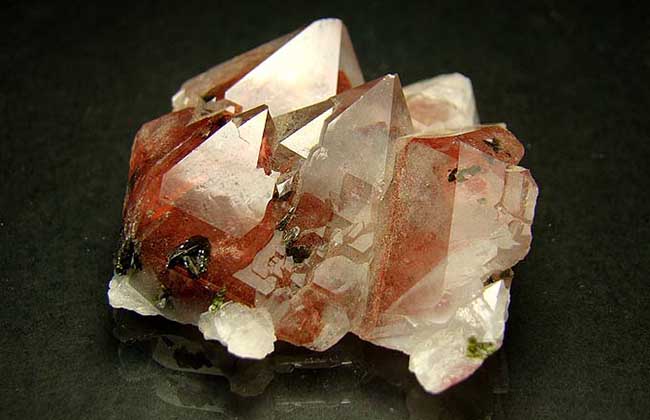
Crystal is also known as shuiyu, shuijing, yuying and so on. In mineralogy it belongs to the quartz family. When pure, it forms colorless and transparent crystals; when it contains trace elements such as Al and Fe, it appears pink, purple, yellow, tea-colored and so on. Those containing associated inclusion minerals are called inclusion crystals, such as rutile quartz, green phantom quartz, red rabbit-hair quartz and so on. Now let us take a look at how much raw crystal stones cost!
How much do raw crystal stones cost?
Raw crystal stones are generally not worth much; white crystal costs just a few dozen yuan per kilogram. Good crystals that are also large in size cost hundreds or even thousands, because this kind of material is very suitable for making large crystal balls, and even better ones can sell for tens of thousands. Natural crystal prices can be just around a hundred yuan or so; white crystal, pink crystal, smoky crystal, amethyst, citrine and the like can all be had for just around a hundred yuan. Of course, the finest among crystals, green phantom quartz and rutile quartz, are very expensive; good-quality ones exceed a thousand, or even tens of thousands.
How to identify raw crystal stones
Raw crystal stones generally retain a certain crystal form, so the naked eye can often be used to distinguish whether they are “natural” or “synthetic” crystal. Natural crystal generally appears as hexagonal prismatic crystals, usually with a pyramid at one end; on the crystal faces there are often special growth striations, growth hills and dissolution pits, and inside the crystal there are often gas-liquid-solid three-phase inclusions as well as inclusions such as cotton, cracks, phantoms and blue needles. Synthetic crystal, on the other hand, generally appears as hexagonal tabular crystals; on the crystal faces there are often round micro-raised “pebble”-like structures, the seed crystal (crystal seed) is clearly visible, and under a magnifying glass, breadcrumb-like inclusions or gas-liquid two-phase needle-like inclusions growing perpendicular to the seed plate are commonly seen.
Common types of raw crystal stones
1. White crystal: White crystal is one of the crystal family, appearing transparent and opaque; the fully transparent one is also called colorless crystal. In mineralogy it belongs to the quartz family, and its main chemical component is silicon dioxide. The silicon dioxide content of purely natural white crystal is as high as 99.999%, its chemical formula is SiO2, and its natural crystal shape is hexagonal prismatic. White crystal is the most representative, most functionally versatile, most abundant, most widely used and most helpful gemstone among crystals, and is called the “king of crystals”.
2. Amethyst: Amethyst is also known as purple shuiyu, purple shuijing, purple shuibi and so on. Viewed from different angles, it can show blue or red purple tones, and it is usually made into facets in a mixed or step cut. Naturally occurring amethyst forms a beautiful purple color because it contains minerals such as iron and manganese; the main colors include light purple, purple-red, deep red, bright red, deep purple, blue-purple and so on, with deep purple-red and bright red being the best, while overly light purple is rather ordinary. Amethyst with gemstone value is generally produced in volcanic rock, pegmatite, or in geodes in limestone and shale. Amethyst is widely distributed in nature, with major origins including Brazil, Russia, South Africa and Madagascar.
3. Citrine: Citrine has a hardness of seven. Gem-grade citrine is extremely rare, and orange-yellow is considered the finest. The vibration frequency of its energy affects the human solar plexus; it belongs to the rational body, governs wealth luck, and can create unexpected wealth. Citrine is called crystal topaz in the gemstone world, and its color ranges from light yellow, true yellow, orange-yellow, olive yellow to golden yellow. Because its brightness and color saturation are both excellent, as long as it is transparent and bright it is called top grade, and it is also far more transparent than topaz, so it is highly favored by consumers and is often cut into pendants or ring faces. Because natural citrine is extremely scarce, its price is also relatively expensive.
4. Smoky crystal: Smoky crystal is also called smoky quartz, ink crystal, tea crystal and so on. It is radioactive, its energy is deep and heavy, and most are hexagonal prisms. Its appearance is transparent crystal, varying in size, with shapes such as geodes, druses and crystal tips. Its color is formed by natural radiation, with varying shades including light brown, dark brown and black-brown. Representative origins are Brazil, the United States, Africa and other places.
5. Pink crystal: Pink crystal is also called rose crystal, furong crystal, furong stone, rose quartz and so on. It is a type of quartz stone and a famous love gemstone. Its texture is brittle. Because it contains a trace amount of the element titanium, it forms a pink color. Pure pink crystal allows ultraviolet light, visible light and infrared light within a certain wavelength range to pass through, and has properties such as optical rotation, piezoelectricity and electrostriction. Its transparency ranges from opaque to semi-transparent to transparent.