How much does white crystal cost? Market price analysis
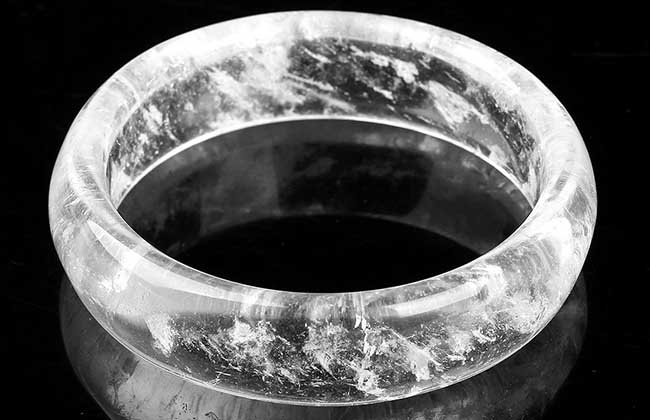
White crystal is one of the Seven Treasures of Buddhism. Among the entire crystal family, it is the most widely distributed, the most abundant and the most widely used, and is known as the “King of Crystals”. Generally speaking, white crystal forms in quite a variety of natural shapes, including the most common massive form, hexagonal prismatic form, columnar cluster growth of white crystal druses, and skeletal forms created by overlapping growth. Let us take a look below at how much white crystal costs!
How much does white crystal cost?
White crystal is the most widely distributed and most abundant in the entire crystal family. Generally, the opaque kind is called quartz, while the transparent kind is called white crystal. The best and largest production area in the world is in our country, so the price and value of ordinary round-bead bracelets are relatively low, and the poorer grades are rarely sold. At present, for top-grade white crystal round beads and ordinary fancy styles, those below 10 mm do not exceed 20 yuan per strand, and those above 12 mm do not exceed 30 to 40 yuan per strand.
How to use white crystal
1. Wearing a pendant made of white crystal on the body has balancing energy and is best able to perform the function of “keeping one safe”; it works best as a “talisman” or “peace charm”.
2. Raising a crystal column to the forehead for meditation can expand conscious energy and project it outward through this; it is most effective for prayer and making wishes.
3. Using a white crystal column to arrange a Seven Star Array allows various kinds of visualization and has the greatest effect.
4. For minor outdoor corner clashes from house corners, placing a crystal bead or crystal column in the corresponding spot can effectively neutralize the clash. For indoor door-against-door clashes, placing a crystal ball on the “path of movement” can also effectively neutralize the clash.
5. Placing white crystal on a desk helps children strengthen concentration and memory, thereby improving academic performance.
How to tell real white crystal from fake
1. Size: when buying a crystal ball, if you see at a glance that the sphere is very large, then you can be certain without hesitation that it is a glass imitation. Natural crystal balls are generally smaller in diameter, usually 2 cm to 5 cm. A pure crystal ball with a diameter of 10 cm is already a top-grade natural crystal ball, while one reaching 20 cm is extremely rare, so a large crystal ball you see is definitely an imitation.
2. Specific gravity: natural crystal is usually relatively heavy, and natural crystal of the same size will be heavier.
3. Birefringence: natural crystal has birefringence. Under a polariscope, natural crystal will show changes in light and dark every 90° of rotation, and the light below can pass through. Synthetic crystal, however, becomes dim and the light below cannot pass through. Crystal glass and fused crystal are even more dim and lusterless.
4. Inclusions: when selecting white crystal, the surface luster of natural crystal is mostly “pale cyan” and contains “inclusions”, some of which are bright flakes. Artificial crystal looks very pale and transparent on the outside, and some contain regular oval flocculent matter, which is the formation layer of artificial crystal. “Crystal glass” and “fused crystal” have no inclusions at all.
5. Fast heat conduction: natural white crystal is crystalline and conducts heat quickly, while glass is non-crystalline and conducts heat slowly. After wearing white crystal for a short while, you will find that the crystal is in sync with body temperature, while glass will feel warm.
6. Feeling the energy: after being nourished by the essence and spiritual energy of heaven and earth for hundreds of millions of years, natural crystal contains cosmic consciousness and emits cosmic energy. Held in the hand and sensed carefully, it produces a subtle vibration like an electric current, which is uplifting.
7. Looking for double images: place a crystal ball on paper with text or lines, and observe the changes in the text or lines below. If you see double images of the text or lines, then it is a crystal ball; otherwise it is an imitation. Be sure to rotate the sphere for observation, because crystal is anisotropic while glass is isotropic.
8. Hardness: natural crystal is hard. Gently scratching the ornament with crushed stone will not leave a mark; if there is a mark, then it is fake crystal.
9. Inspect with a polariscope: under a polariscope, one that shows four light and four dark changes when rotated 360 degrees is natural crystal; one that does not is fake crystal.
10. Inspect with dichroism: natural amethyst has dichroism, while fake crystal does not have dichroism.
11. Inspect with a magnifying glass: inspect under transmitted light with a ten-times magnifying glass. Basically, any that can be found to contain bubbles are fake crystal.