How much do discus fish cost? An introduction to market prices
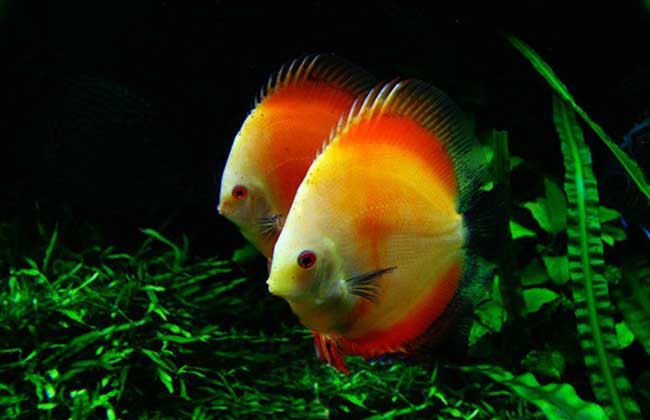
Discus fish is the collective name for the yellow-brown discus, the discus, and Heckel's discus under the genus Symphysodon, also known as "iron disc" and "seven-color swallow", among others. It originates from the Amazon River basin in South America and belongs to the cichlid family among tropical fish. It has a great many color varieties and is a breathtaking sight, and has long been known by the laudatory title "king of tropical fish". Now let us take a look together at how much discus fish cost!
How much do discus fish cost?
There are extremely many varieties of discus fish, and prices differ greatly between varieties. Even within a single variety, prices differ greatly according to size, body shape, body color, and so on. Small discus fish are relatively cheap, almost all under 30 yuan. As ornamental fish, discus fish generally cost several tens to several hundred yuan each. For ordinary varieties kept at home with a size between 8 and 10 cm, the price is around 60 to 100 yuan.
How should discus fish be kept?
1. Water quality for keeping: For discus fish, the keeping temperature is likewise maintained at 28°C. The pH value is between 6.0 and 6.5.
2. Keeping style: Discus fish have very high space requirements, so a very large space is needed to keep them. At least 1 liter of water is needed per 1 cm of fish, so that the fish have enough room to move.
3. Activity area: Generally, discus fish like to move about in places with water algae, and suitable water fleas and rocks should be set up.
4. Needed equipment: Keeping discus fish generally requires essential materials and equipment such as a fish tank, filter, heater rod, bio-cotton, and air pump.
How to select discus fish
1. Eye socket: The eye socket of juvenile discus fish is not necessarily red, but the smaller the eyes the better. Take care that the eye membrane is not whitish or asymmetric left and right. However, generally speaking, the redder the eye socket of a discus fish, the better its condition; also, the brighter the better is required, and dull, lusterless eyes usually indicate disease.
2. Fins: The fins of discus fish must extend freely and show no signs of damage. The pelvic fins should form a "V" shape, and the scales must be smooth with no scratches.
3. Body sides: The vertical stripes on the sides of the discus fish must be symmetric left and right and uniform in thickness.
4. Body shape: The rounder the body shape of the discus fish, the better. Roundness is divided into three aspects: outer roundness, inner roundness, and the roundness of the mouth. Outer roundness is the circle formed from the mouth to the dorsal fin and then to the tail and to the anal fin; inner roundness is the circle formed by the bases of the dorsal fin and anal fin.
5. Body: The body of the discus fish shows no white spots, no overall darkening, and no shrinking of the fins or tail or other early signs of disease, and the fish does not rub against objects in the aquarium in an abnormal manner.
6. Size: When buying fish, it is best to buy ones around 5 cm, as this makes it easier for the discus fish to adapt to the environment. Fish above 7 cm are, on the one hand, often much more expensive, and on the other hand, you cannot enjoy the pleasure of raising the fish yourself. Furthermore, we all know that the water quality of every place is different, and discus fish produced by some farms that mainly breed discus fish are kept in a soft water environment treated with anion softening in order to ensure the hatching survival rate and the growth survival rate, and it is very hard to keep them alive once back home.
Note: Besides the basic points for choosing fish, do not pay attention to so-called strains. A strain is just a name; as long as it is a discus fish you like, that is fine. Moreover, there are tens of thousands of discus strains on the market, and how to pick the one you like among them is what matters most. Also, the charm of keeping discus lies in crossbreeding discus to cultivate new varieties. What is more, discus fish kept in a planted tank are mainly for appreciation.