How much does South Red Agate cost? Read this one article to understand the market
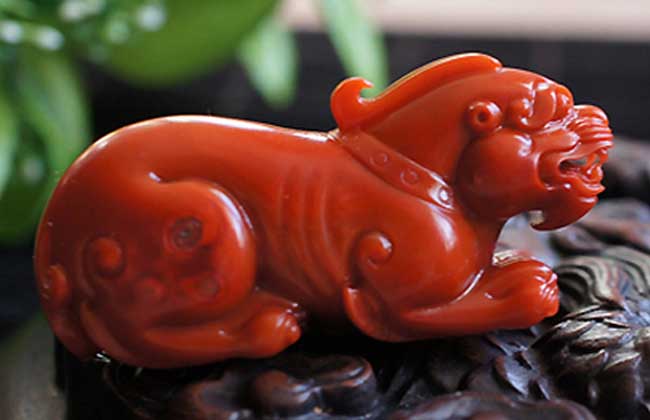
South Red Agate is a variety unique to China, also known as red jade, red qiong, qiong jade, etc. It has a fine, oily texture and is rare in yield. It was already nearly exhausted by mining during the Qianlong period of the Qing Dynasty. Throughout China's successive dynasties, South Red Agate was highly valued, and it is also a very rare and precious material. The price of old South Red Agate has risen sharply, and it has very high collectible value. Let us take a look below at how much South Red Agate costs!
How much does South Red Agate cost?
The price of ordinary South Red Agate, measured by unit price, is about 1 yuan to 100 yuan per gram, mainly determined by quality. For example, some with color that is not very full, with a lot of white frozen material, or with quite a few flaws will cost no more than 10 yuan per gram, while if the color is full, there is little frozen material, and there are almost no flaws, the price shoots straight up, with the lowest price still 100 yuan per gram. If the quality of the South Red Agate is relatively good and it meets the above characteristics of little frozen material and almost no flaws, and it happens that the color of this piece of South Red Agate is exactly the most favored colors such as brocade red or persimmon red, then generally the price of this kind of South Red Agate can easily exceed 1,000 per gram. If it also has exquisite carving craftsmanship and other factors, the price per gram will at least exceed 10,000, or even more. Of course, this type of South Red Agate usually costs more than a million per piece, and ordinary people absolutely cannot afford it, but its collectible value is also quite high. Therefore, the price of South Red Agate per gram can be over a hundred or over ten thousand, determined by many factors.
Identification methods for South Red Agate
1. Characteristics: Hold South Red Agate close to strong light, and when looking toward the strong light, you can see that the red color of South Red Agate is formed by the gathering of countless cinnabar dots. This characteristic is not possessed by other South Red Agate. If the South Red Agate is very red and light cannot penetrate it, this identification method is not applicable.
2. Texture: General South Red Agate has a gelatinous texture. Even when observing a fully red South Red Agate bead against the light, you can see the color becoming transparent from the inside out, and when observing a colorless South Red Agate bead with the naked eye, there is also a hazy feeling, as well as an oily, moist feeling similar to Hetian jade.
3. Color: The common colors of South Red Agate are brocade red (including persimmon red), rose red, cinnabar red, red-white material, striped red material, and cherry red, all roughly defined as the color types of South Red Agate. These colors, with transparent or semi-transparent transitional variations, including nearly transparent colorless, are all roughly defined as the color range of South Red Agate.
Maintenance methods for South Red Agate
1. South Red Agate ornaments should be handled gently and placed gently, avoiding collisions with hard objects. Although South Red Agate has relatively high hardness, it is also easily broken under impact. In particular, hollow-carved South Red Agate works are also easily damaged. Usually, when placing or carrying them, they should be stable and secure, or stored in a soft-lined box.
2. South Red Agate ornaments should avoid oil stains and dust as much as possible. If there is dust in daily life, use a soft bristle brush for cleaning. If oil stains or dirt adhere to the surface, it can be brushed in warm mild soapy water, then rinsed clean in clear water.
3. South Red Agate ornaments should be wiped with a soft white cloth, because South Red Agate has a very fine texture and is easily scratched. In order to help maintain and preserve the original quality, a soft white cloth must be used when wiping.
4. South Red Agate ornaments should avoid direct exposure to strong sunlight, or being placed in an environment that is too cold or too hot, so as to avoid damage from thermal expansion and contraction.
5. South Red Agate ornaments should avoid contact with perfume, shampoo, chemicals, and other chemical reagents as much as possible, to avoid corroding their surface and affecting their vividness and brightness.
6. The storage space for South Red Agate ornaments should maintain appropriate humidity, especially in the relatively dry winter, when the air should be kept moist. For example, when making water-pocket South Red Agate, the thinner the South Red Agate layer is made, the better, and the water pocket part should be revealed, which in the trade is called “revealing the pocket”, to improve its ornamental value. Although South Red Agate is dense, it still has certain micropores. Because the outer wall becomes thinner, moisture will also dissipate over time, so water-pocket South Red Agate should often be soaked in water to maintain the balance of moisture within it.
7. South Red Agate ornaments are not suitable for the sunlight demagnetization method. If exposed to the sun for too long, it is easy to make the color of South Red Agate fade, while water-pocket South Red Agate will lose moisture through evaporation, thereby losing its collectible artistic and economic value.