What is the general market price of malachite?
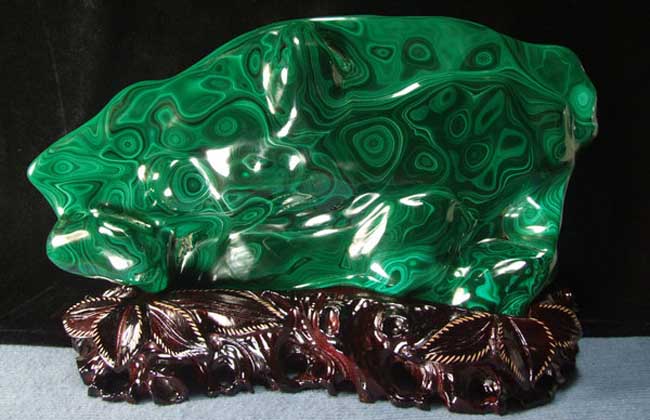
Malachite is an ancient jade material. It got its name because its color closely resembles the green of the spots on peacock feathers. In ancient China, malachite was called lüqing, shilü, qinglanggan, and other names, and it was mostly used as an ornamental stone. At present, as the value of malachite has risen, the price of rough malachite has increased somewhat, and some people are quite optimistic about investing in rough malachite. Now let us take a look at how much malachite costs.
The price of malachite
Malachite is considered a low-grade gemstone in the eyes of jewelry experts. Even so, in recent years, driven by various jewelry trends, the price of rough malachite is no longer stagnant and has risen considerably. It is said that in the past the price of rough malachite was only a few dozen yuan, and one could buy a cartload for a thousand yuan. But now the price of rough malachite has clearly risen and is priced by the gram. It is no exaggeration to say that it can reach a thousand yuan per gram. Of course, such rough malachite is top-grade malachite.
Identification of malachite
1. The color and typical banding of malachite are not easily confused with other gemstones, but it is very similar to beryl and chrysocolla. The most important way to distinguish them is still by color. The "green" of malachite closely resembles the spot green on peacock feathers, and it is mostly yellow-green to dark green. With professional tools, one can also compare them by hardness, density, and refractive index. The hardness of malachite is 3.5 to 4.5, and its density is 3.54 to 4.1 grams per cubic centimeter.
2. Malachite is full of textures, and no two pieces of malachite are the same, so when buying the genuine article there is no need to worry about matching someone else's piece. Genuine malachite has natural textures, good color and luster, and a delicate texture. Imitations tend to have relatively rigid textures, dimmer surface luster, and rough workmanship with no texture. Texture is the most direct way to distinguish genuine malachite from fake malachite.
3. Malachite on the market is generally divided into banded synthetic, fibrous synthetic, and cellular synthetic. The chemical composition of synthetic malachite is basically similar to that of natural malachite, with a relatively large difference only in the thermal spectrum. Therefore, thermal difference analysis is an effective method for identifying natural malachite and synthetic malachite, but it is a destructive test. Synthetic malachite is not a counterfeit product; it is the mainstream product sold on the market today. It has passed national jade identification. Imitation synthetic malachite has no radial structure, so when purchasing, one only needs to pay attention to its structure.
The benefits of malachite
[Nature and flavor] Bitter, sour, astringent in flavor, cold in nature, toxic.
[Benefits] Detoxification, removing decay, killing insects; for external use, it treats nasal polyps, eyelid erosion, sores, and stubborn tinea.
1. Malachite also contains natural copper elements, which can activate the natural antioxidant enzyme (SOD) in the skin, thereby allowing the antioxidant enzymes in the skin to play their greatest role and achieving an antioxidant effect. Wearing malachite jewelry can slow the formation of the skin's stratum corneum, thereby achieving the effect of making the skin delicate, soft, and tender.
2. The ancient Egyptians once ground malachite into powder and applied it to festering wounds to achieve healing. Therefore, wearing malachite jewelry can absorb the natural energy contained in malachite, absorb external radiation, and reduce irritation to the skin.
3. French scientists once extracted a natural active substance from malachite. This substance is extremely safe, can improve the skin cells' natural resistance, remove residual impurities within cells, and thereby enhance cell activity. Moreover, this malachite extract liquid is green and safe and will not place any burden on the skin. This is also the fundamental reason why modern people are enthusiastic about malachite jewelry: it is natural and harmless.
4. After scientific identification, well-known cosmetics on the market all contain trace copper elements with the same atomic structure as the copper in malachite. Because it has antioxidant and anti-aging effects, skin care products such as malachite extract liquid have even appeared.
The uses of malachite
1. As a pigment: Grinding malachite into powder allows it to be used as a pigment. This pigment was often used in early traditional Chinese painting. Azurite was used as a blue pigment, and malachite was used as a green pigment. Malachite in particular is as emerald green as peacock feathers, and when used as a bright color it is very natural and clear.
2. As jewelry: Most malachite is made into jewelry and ornaments. Common items of this kind include beaded bracelets and brooches. In addition, there are also gemstone ring faces and model pendants, and it is also carved into seals for use.
3. As a decoration material: Because malachite has a low-key and elegant beauty, many people use malachite as an interior decoration material. Russians in particular inlay malachite into tables or tabletops, making the interior decoration look very tasteful. For example, the large columns of St. Isaac's Cathedral in Leningrad are inlaid with a great deal of malachite.
4. As a medicine: Malachite is also used as a medicine. For a long time, in many places malachite has been ground into powder and then applied to festering wounds, so that the injured person's wounds can heal quickly. Malachite can also treat many diseases, so it is only natural that malachite is used as a medicine.