How much is the price of Balin chicken-blood stone?
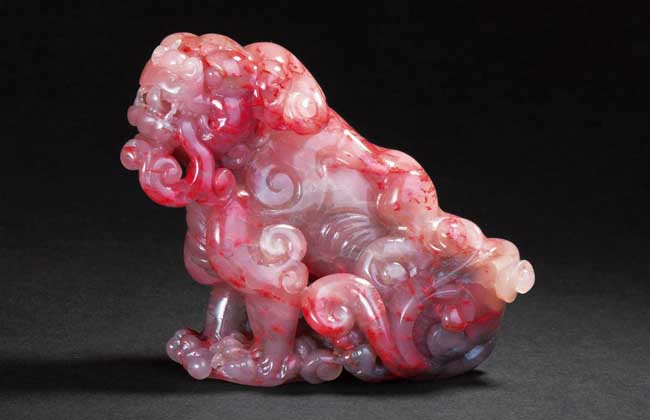
Balin chicken-blood stone is produced in Bairin Right Banner, Inner Mongolia. Its base is fine and smooth, with good transparency and relatively high hardness. It is mainly of the frozen-base type and contains no "sand nails." It is known as "northern stone." Its blood patterns are mostly pig-blood red and come with blood threads and yellow flesh. It is famous for being spiritual and changeable, and is mainly of the frozen-base type. By form, the red can be divided into several types, such as patch red, stripe red, spot red, dot red, and cluster red. Now let's take a look at how much Balin chicken-blood stone costs!
How much is the price of Balin chicken-blood stone?
The price of Balin chicken-blood stone depends entirely on its texture and weight. Although the overall price of Balin chicken-blood stone is not as high as that of Changhua chicken-blood stone, top-grade pieces are also very valuable. Quality is determined by the intensity of the blood color, the amount of blood, and the state, concentration, dispersion, and thickness of the blood pattern. Those with less than 10% blood are ordinary, those with less than 30% are mid-grade, those with more than 50% are treasures, and those with more than 70% are extremely precious and rare, called "Dahongpao." All-blood or six-sided blood is the finest grade. At present, the price of top-grade material can reach several hundred yuan or even over a thousand yuan per gram.
Identification methods for Balin chicken-blood stone
1. Balin chicken-blood stone has very high hardness, and ordinary metal tools cannot scratch it. This is something that most synthetic or dyed fake Balin chicken-blood stone on the market cannot imitate. The stone texture is relatively fine and smooth, with a jade-like feel, opaque, with a small amount slightly translucent, and is relatively easy for people to accept. The blood generally looks fluid in sunlight, like the feeling of flowing water and white clouds, with a breath of life and great spirituality.
2. Chicken-blood stone, as the name suggests, is related to chickens. Our ancestors' wisdom was absolutely profound. Naming it chicken-blood stone means the blood resembles chicken blood, and the stone body often carries yellow blocks or white spots like chicken meat, chicken bone, egg yolk, or egg white, similar to Tianhuang. This is an important feature for distinguishing genuine Balin chicken-blood stone from fake, and it is also something counterfeiters cannot produce with the current level of technology!
3. Balin chicken-blood stone itself has many varieties, and it is very difficult to find identical pieces. Its composition is complex, and the state cannot issue a standard for it either. Therefore, instruments cannot detect it, and distinguishing true from false depends entirely on experience. This provides opportunities for unscrupulous so-called experts and merchants to call genuine pieces fake and fake pieces genuine in order to earn high profits. Therefore, collectors must keep their eyes sharp, look more, learn more, and buy less. Because it is itself a stone material, the blood color is not very vivid, and it must be wetted or wiped with oil before it becomes dazzling. This is also a key point in distinguishing real from fake chicken-blood stone. Fakes will not change!
Identification of imitation Balin chicken-blood stone
1. Fake-blood chicken-blood stone: Fake-blood chicken-blood stone is mainly made by artificially infiltrating natural Changhua stone and Balin stone with poor texture and no blood or little blood, and dyeing them bright red. Organic dyes or stamp pad ink fill the cracks, and after drying, a layer of protective resin is applied. Fake blood is mostly unnatural, with a single blood color. Under sunlight or lamplight, the surface is sparkling and shiny because the fake blood contains resin. The blood shape, size, and form of fake blood are relatively uniform, while the blood shape of real blood is natural and smooth.
2. Cinnabar jade: Cinnabar jade is vein quartz containing cinnabar. Because its main body is quartz, and the cinnabar in it is mainly distributed in star-like and thread-like forms, it is relatively easy to distinguish from chicken-blood stone.
3. Blood chalcedony: Blood chalcedony has significantly higher hardness than chicken-blood stone. Its blood-red color often appears in spots, forming an obvious difference from the clustered and banded forms in chicken-blood stone, and its other physical characteristics are also clearly different.
4. Shoushan stone: In Shoushan stone, peach-blossom frozen is named because it is scattered with bright red blood spots the size of rice grains, just like countless brilliant peach blossom petals floating in a pool of clear water, but its distribution characteristics are clearly different from those of chicken-blood stone.
5. Dyed Xiuyan jade: Dyed Xiuyan jade is commonly known as "blood-thread jade" and is often used on the market to imitate chicken-blood stone, but it clearly has dyeing characteristics. In addition, its physical properties are obviously different, so it is also easy to identify.
6. Composite stone: There are generally two types, spliced chicken-blood stone and inlaid chicken-blood stone. When identifying, as long as you are careful, it is not difficult to find traces of splicing.
7. Artificial stone: Generally, slightly colored opaque plastic is used as the "base," on which cinnabar powder or red organic pigment is used as "blood," and a layer of protective resin is applied on the outside. It is commonly known as "craft chicken-blood stone." Identification is mainly based on the characteristics of its "base," along with hot-needle testing and the aid of chemical reagents.