What is the typical price of a red maple sapling?
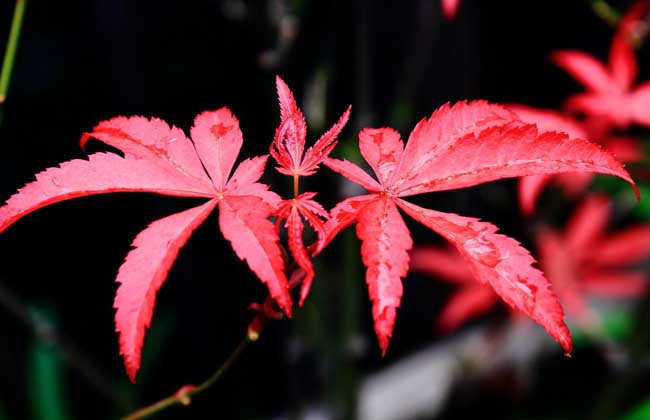
Red maple, also known as purple-red Japanese maple, red maple tree, red leaf, small Japanese maple, etc., is a deciduous tree of the genus Acer in the family Aceraceae. It prefers warm, humid and cool climates, likes light but fears scorching sun, and is a neutrally shade-tolerant tree species. It is a precious foliage tree, often grown as a potted plant for appreciation. It is commonly propagated by grafting and cuttings, and can also be propagated by sowing. Let's take a look below at how much red maple saplings cost!
Red maple sapling prices
Category Specification Price (per plant) Red maple sapling 2 cm 50 yuan Red maple sapling 3 cm 85 yuan Red maple sapling 4 cm 145 yuan Red maple sapling 5 cm 210 yuan Red maple sapling 6 cm 360 yuan Red maple sapling 8 cm 1300 yuanNote: Common cultivated varieties of red maple include Chinese red maple, Japanese red maple, American red maple, improved American red maple, etc. Prices of red maple saplings vary due to different varieties and different places of origin.
Ornamental value of red maple
1. Ornamental value: Red maple is a very beautiful foliage tree species, with elegant leaf shapes, bright and long-lasting red color, neat branching order, distinct layers, well-arranged form, and beautiful tree posture, giving it very high ornamental value.
2. Beautifying the environment: The branches and leaves of red maple are purple-red, dazzling and eye-catching, with high ornamental value. It is an important colorful tree species in China, widely used as an ornamental tree in garden green spaces and courtyards, mainly planted as solitary specimens or scattered plantings. It is suitable for placement in the center of lawns, in front of and behind tall buildings, at corners and other locations, where red leaves and green trees set each other off beautifully. It can also be potted into shapes such as exposed roots, leaning on rocks, cliff-style, and dry-trunk style, elegant and unique.
3. Soil and water conservation: Red maple's leaves gradually change color every autumn and winter. When planted in patches on hillsides and other places, it has very good ornamental value in autumn, and planting trees also plays a great role in preventing soil erosion and maintaining the ecological environment.
Red maple cultivation techniques
1. Soil selection: It has low requirements for soil and can adapt within a soil pH range of 5.5 to 7.5, so it can grow in slightly acidic soil, neutral soil and calcareous soil. It is suitable for growing in fertile, humus-rich acidic or neutral sandy loam.
2. Water management: Red maple likes moisture during its growth process, but apart from sufficient watering in summer, it should not be watered too much at ordinary times. It is best to keep the pot soil moist regularly, which helps maintain a beautiful tree posture.
3. Light management: Red maple likes warmth. In spring and autumn it can receive full sunlight. After summer begins, it should be moved to a semi-shaded place to avoid direct scorching sun at noon. In dry and high-temperature conditions, water should be sprayed appropriately to lower the temperature and increase humidity.
4. Temperature control: Although red maple likes warmth, it is still relatively cold-tolerant. In the Yellow River basin area, winter temperatures can reach as low as -20°C, but as long as the environment is good, it can still overwinter outdoors. As for areas north of the Yellow River, it is better to grow it in pots and move it indoors in winter.
5. Timely fertilization: From May to August each year, apply a thin cake fertilizer solution once a month to red maple. From September onward, switch to a liquid fertilizer mainly based on potassium fertilizer, such as a 1% potassium sulfate solution or wood ash extract, to help the leaves turn bright red.
6. Pest and disease control
① Underground pests such as white grubs and mole crickets gnaw on seedlings and stem bases, easily causing seedling death. Root drenching with 1000 times dilution of Losban or 1000 to 1200 times dilution of 50% phoxim emulsifiable concentrate can be used.
② Leaf- and branch-feeding pests such as scarab beetles, nettle grubs and aphids often eat the leaves of Japanese red maple, causing poor growth of the seedlings. For aphids and adult scarab beetles, a 1200 to 1500 times dilution spray of 10% imidacloprid powder can be used, and for nettle grubs, pyrethroid pesticides can be used for control.
③ Borer pests such as longhorn beetles and heart borers harm the branches and trunks of Japanese red maple, causing dead branches in large Japanese red maple saplings and even death of the whole plant. During the peak emergence period of adult longhorn beetles (June to July), spray the tree crown with 1500 to 2000 times dilution of 4.5% beta-cypermethrin, once every half a month or so, for 2 consecutive sprays, or inject pesticides such as dichlorvos or Losban into the branches and trunks at the insect tunnel openings and seal the openings with sticky mud.
④ Diseases include brown spot disease, powdery mildew, rust disease, etc. One- to two-year-old Japanese red maples rarely have pests and diseases. Japanese red maples with a trunk diameter of 3 cm or more are often infected by fungi from May to June each year. The symptoms are leaf tips curling back and turning white, dark red spots on the leaf surface, perforation after sun exposure, and by September to October only the veins and petioles remain, or even the whole leaves wither, tender shoots dry up, leaving only branches, and the whole plant dies in the cold winter and spring seasons. Some also die after leafing out in spring.