How much does an Anthurium cost per pot? Latest potted plant price reference
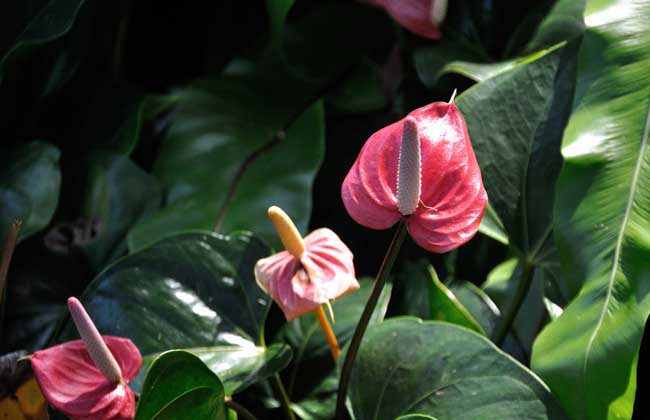
Anthurium, also known as flamingo flower and tailflower, is a perennial evergreen herbaceous plant of the genus Anthurium in the Araceae family. Its flowers are brilliantly colored and it blooms in all four seasons, giving it high ornamental value. It carries the meaning of a grand vision and passionate exuberance, making it very popular. Its market price is not expensive either. Let's take a look below at how much an Anthurium costs per pot!
How much does an Anthurium cost per pot
There are many varieties of Anthurium, and imported Anthurium is much more expensive than domestic Anthurium. Depending on the grade of the variety, imported Anthurium generally has a wholesale price of between 38 yuan and 280 yuan, with retail prices ranging from 80 to 450 yuan. Domestic tissue-cultured Anthurium flowers have a wholesale price of between 10 yuan and 80 yuan, with retail prices between 15 yuan and 150 yuan.
The benefits of growing Anthurium
1. Air purification: Anthurium can absorb benzene and trichloroethylene, which are harmful to the human body, giving it a healthy air-purifying effect.
2. Ornamental value: The Anthurium flower is unique, taking the form of a spathe, with bright and gorgeous colors and rich hues. Its flowering period is long; as a cut flower in water it can last up to 1.5 months, and its cut leaves can serve as filler foliage in flower arrangements. It can be grown as a potted plant, and a single flowering period in a pot can last up to 4 to 6 months, with the plant able to bloom year-round.
3. Economic value: Anthurium is an important tropical cut flower, with a spadix inflorescence. Its spathe is large, thick and fleshy with a waxy texture, and its colors include red, pink, white, green, and bicolor. With its brilliant colors, unusual shape, wide range of applications, and high economic value, it is currently one of the fastest-growing and most in-demand high-end tropical cut flowers and potted flowers in the world.
4. Feng shui effect: The main characteristics of Anthurium include slender stems, green and thick leaves, flowers as red as fire, and a golden-yellow spadix. The red flower growing on top (above the head) carries the meaning of good fortune raining down from above, and among the flowers and leaves there is a golden-yellow strip-like spadix, symbolizing gold (money) in hand.
How to grow Anthurium
1. Temperature management: The optimal temperature for Anthurium growth is 18°C---28°C. The maximum temperature should not exceed 35°C, and the minimum temperature is 14°C. Below 10°C, there is a constant possibility of cold damage. In summer, when the temperature is above 32°C, cooling measures need to be taken, such as increasing ventilation, spraying more water, and providing appropriate shade. In winter, if the indoor temperature is below 14°C, heating is required.
2. Humidity management: Anthurium growth requires relatively high air humidity, which generally should not be below 50%. High temperature and high humidity are more favorable for Anthurium growth. When the temperature is below 20°C, maintaining the indoor natural environment is sufficient. When the temperature reaches above 28°C, misting can be used to increase the relative humidity on the leaf surface and in the indoor air, so as to create a high-temperature, high-humidity growing environment for Anthurium. However, in winter, even when the indoor temperature is relatively high, excessive cooling and moisture retention are not advisable, because overly wet leaves at night will instead reduce cold resistance and easily cause cold damage.
3. Light management: When light is too strong, it may cause leaf discoloration, scorching, or withering. Whether light management succeeds or not directly relates to the quality of the potted flowers and to the number of flowers. Anthurium is a shade-loving plant, so indoors it should be placed in a bright spot with some scattered light. Be very careful not to place Anthurium in an environment with strong direct sunlight.
4. Water and fertilizer management: Anthurium is a flower variety that is relatively sensitive to salt, so the lower the salt content of the water, the better; tap water is best. Fertilizer is often applied together with watering. Generally, a compound fertilizer with a nitrogen-phosphorus-potassium ratio of 1:1:1 is chosen. Dissolve the compound fertilizer in water and apply it as a liquid fertilizer at a concentration of one-thousandth. In spring and autumn, generally apply fertilizer water once every 3 days. If the temperature is high, depending on how dry or wet the substrate in the pot is, apply fertilizer water once every 2 to 3 days. In summer, apply fertilizer water once every 2 days, and when the temperature is high, an additional watering may be given. In winter, generally apply fertilizer water once every 5 to 7 days. A dedicated Anthurium fertilizer can also be used directly.
5. Repotting at the right time: For Anthurium growing medium, it is advisable to use peat soil plus 1/4 perlite, mixed evenly with a small amount of bone meal or decomposed cake fertilizer powder. The bottom of the pot should be lined with coarse sand and other materials to facilitate drainage. A mixed soil made of peat soil, leaf chaff, and perlite in a 3:2:1 ratio can also be used.