Assessment of halving tariffs on processed imported agricultural and fishery products such as sea scallops and yams
Tariffs on imports of agricultural products and processed foods such as sea scallops, yams, satsuma mandarins, and prepared milk skin could be halved! In response to requests from industry operators, the Ministry of Finance is reviewing the possibility of reducing tariffs on agricultural and fishery products, processed foods, and grain alcohol. Of these, 5 items are related to the Council of Agriculture, and after review the Council of Agriculture's International Division believes the impact on the relevant industries will be limited. Reducing tariffs on these imported goods involves amending the law, which must be approved by the Executive Yuan meeting, then sent to the Legislative Yuan for deliberation, and can only be implemented after passage on third reading.
Regarding the 5 agriculture-related products, the International Division said that for sea scallops there has been no domestic production data since 2016; imported yams and domestic yams are clearly differentiated in price and way of eating; although satsuma mandarins are also produced domestically, the volume is very small, so the impact on the overall citrus industry is also small; as for prepared milk skin, there is no domestic production, and if the tariff is halved it could also benefit the processing industry, making it the only item with no tariff revenue loss.
The International Division pointed out that whether in the industrial sector or the agricultural sector, all must face the wave of trade liberalization, and in the future it will continue to review items for tariff reduction, and not only the several types this year. However, reducing tariffs requires amending the law, which must pass third reading in the Legislative Yuan. The International Division explained that after joining the WTO, reviews are conducted irregularly based on requests from importers, domestic raw material users, or processing plants, while also preparing for trade liberalization, which is a way to show determination.
Importers call for tariff cuts; domestic operators demand supporting measures
Regarding the halving of tariff rates on 10 imported agricultural and fishery products, processed goods, and grain alcohol including sea scallops and yams, a public hearing was also held recently to hear the opinions of domestic operators. International Division deputy director Lin Jiarong said domestic operators believe that if imported products may affect domestic consumption of related products, the substitutability of similar products should be assessed, and before there is a complete set of supporting measures, tariffs should not be reduced.
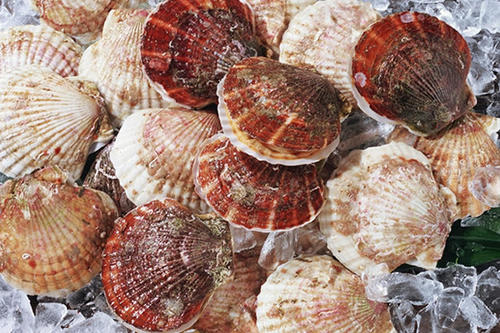
According to the Fisheries Agency's annual fisheries statistics report, sea scallops are not a major domestic product, with output of 2 metric tons in 2014 and 59 metric tons in 2015, and no production data since 2016. As for imports, the annual average import volume from 2014 to 2017 was 158 metric tons of live, fresh or chilled sea scallops, with a tariff rate of 10%, and 79 metric tons of dried, salted or brine-preserved sea scallops, with a tariff rate of 12.5%. If the tariff is halved, the tariff revenue loss would be about 6.372 million yuan. The International Division assessed that domestic sea scallop output is extremely small and is product-differentiated from other aquatic products, so reducing the tariff will have little impact on the industry.
As for yams, domestic output in 2017 was 14,711 metric tons, with the main producing areas in Nantou County, Changhua County, and New Taipei City. Imports are also not small, averaging 3,021 metric tons per year from 2014 to 2017, accounting for about 17% of domestic consumption. The tariff rate on imported yams is 16%, halved to 8%, with a tariff revenue loss of about 23.529 million yuan.
Most domestic yams are varieties that must be cooked before eating. The International Division pointed out that the wholesale price of domestic yams is 43 yuan per kilogram, while the average price of imported yams is 104 yuan per kilogram, an obvious difference. Imported yams are mostly supplied to mid- to high-priced supermarkets or Japanese cuisine restaurants and are mainly eaten fresh, while domestic yams are mostly cooked in dishes. The market is already segmented, so it is assessed that even if the tariff on imported yams is halved, the impact on our industry should be limited.
Satsuma mandarins belong to the citrus category. Domestic citrus planting area is large, and if the tariff on satsuma mandarins is halved from 30% to 15%, it may attract greater attention. Satsuma mandarins are also grown domestically, with output of 190 metric tons, mainly in Taichung City. The annual average import volume from 2015 to 2018 was 174 metric tons, almost equivalent to domestic output, but the International Division pointed out that satsuma mandarin imports account for only 0.03% of the total national citrus consumption of 530,000 metric tons. After the tariff is halved, the assessed tariff revenue loss is 4.584 million yuan. At the same time, our tariff on satsuma mandarins is relatively higher than in other countries, at 17% in Japan and 12% in China, so there is room for moderate reduction.
If tariffs on prepared milk skin are cut, tax revenue may rise instead of fall
However, there is one product for which reducing the tariff would instead increase tax revenue: prepared milk skin. The International Division said that our annual raw milk output is 386,000 metric tons, 84% of which is used for fresh milk products, with the rest made into flavored milk, fermented milk, long-life milk, and other dairy products. Therefore, 99.9% is made into liquid milk, and there is almost no production of the deeply processed product prepared milk skin. The annual import volume is 398 metric tons, with a tariff rate of 20%. If reduced to 10%, it could also enhance the competitiveness of the processing industry and ultimately increase tax revenue, with an assessed increase of 2.003 million yuan in tax revenue.
The International Division said that imported prepared milk skin mainly supplies the demand of the domestic baking industry and is product-differentiated from domestic raw milk. Reducing the tariff can lower import costs for operators and enhance the competitiveness of the processing industry.