Grape early-promoting cultivation technology, Shouguang solar greenhouse planting method
Puzhuangyuan, a provider of integrated solutions for the grape industry from planting to selling, is committed to producing the best winter table grapes. We handle grape orchard planning, seedling supply, technical guidance, and brand marketing. Join our "Grape Partner" alliance to jointly build the number one brand of winter table grapes -- "Puzhuangyuan". Our main early-promoting cultivation varieties are Rose Honey and Huangmi, with a yield of 5,000 jin per mu, coming to market in April, with a market wholesale price of around 10 yuan. The delayed cultivation variety Xiangyun No. 1 comes to market from November to March, with a yield of 5,000 jin per mu, and our wholesale price is 20-30 yuan. Open-field cultivation matures in October, with a price of around 5 yuan, and the price will be higher when put into cold storage. We hope like-minded friends will cooperate with us: you produce, we guide and sell, and together we will make the table grape industry bigger and stronger!
Shouguang solar greenhouse grape early-promoting cultivation technology
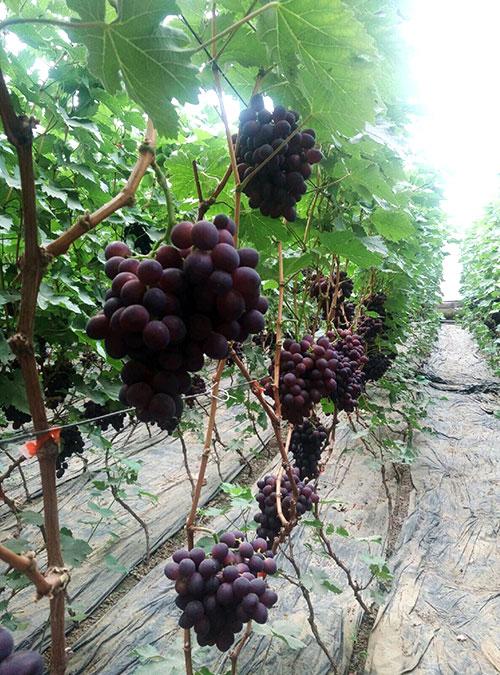
Rose Honey
Generally, heating and sprout forcing begin when the natural dormancy of grapes has not yet ended or is about to end. Through the heating and insulation functions of the solar greenhouse, early market availability of grapes is achieved, generally maturing 60-90 days earlier than open-field grapes. The varieties recommended by our company include Rose Honey (a red variety) and Huangmi (a green variety), which can come to market in April, with yield controlled at around 5,000 jin and a price of around 10 yuan, giving very considerable benefits.
Solar greenhouses belong to an industry with high capital investment, high labor intensity, and high output benefits. For forcing cultivation of grapes, the light and heat resources of the greenhouse must be fully utilized to maximize comprehensive benefits. The more than 20 years of greenhouse grape cultivation and management experience of Shouguang grape growers is summarized as follows:
1. Cultivation mode: The general trend for grape planting spacing is a shift from sparse planting to close planting. Grapes adopt close planting with single-dragon-trunk training and pruning, with a plant spacing of 50 cm, a row spacing of 90 cm, and about 1,500 grape plants planted per mu. The advantage of this cultivation mode is that it fully utilizes the light and heat resources of the solar greenhouse and maximizes input-output efficiency. Plant on May 1 this year, and sell grapes around May 1 next year. Plant 1,500 plants per mu, train one robust fruiting mother vine per plant, with each plant bearing about 3-4 jin, and yield per mu controlled at around 5,000 jin. Among them, red varieties such as Zaosheng Gaomo have a yield of 4,000-5,000 jin per mu, while green varieties such as Qingti have a yield of 6,000-7,000 jin per mu.
2. Pre-planting preparation and standardized post-planting management: Grape roots penetrate deeply and spread widely, so before planting the soil must be deeply plowed and sufficient base fertilizer applied. The fertilization standard per mu is about 8 cubic meters of well-decomposed farmyard manure and about 100 kg of superphosphate. Do not use quick-acting chemical fertilizers. In recent years, Shouguang grape growers in actual production directly broadcast organic fertilizer, then use a rotary tiller to deeply plow the entire greenhouse twice, so that the fertilizer and soil are mixed evenly.
Post-planting management: To put into production the following year, heavy fertilizer and heavy water are necessary. In addition to immediately watering thoroughly after planting, before the established seedlings sprout they must be watered heavily once more; for nutrient cup seedlings, it depends on humidity. When the new vine grows to 20 cm, water about once every 15 days until early August. During this period, if there is a heavy rain, one watering can be reduced, but light rain cannot replace watering. Starting from when the new shoots are 20 cm long, fertilizer must be applied before each watering or heavy rain. Because digital technology requires planting in the first year and a bumper harvest in the second year, while promoting rapid growth it is also necessary to promote flower bud formation, so each fertilization should apply nitrogen, phosphorus, and potassium together, opening shallow furrows and applying 10-15 kg/mu of high-quality quick-acting compound fertilizer, for a total of 7-8 applications.
3. Flower and fruit management technology
(1) Promoting flower buds: According to digital management technology, grapes enter a vigorous growth period one month after planting. At a height of 50 cm, pinch the first time; the second pinch is at the third leaf of the new shoot; the third pinch is at the second leaf of the new shoot that grew after the previous pinch; the fourth pinch is at the second leaf of the new shoot that grew. After four pinches, the vast majority of grapes can enter a high-yield state.
(2) Flower and fruit thinning: Set production at about 3 jin per plant, and determine the number of clusters to retain according to the cluster weight of the variety. Thin clusters 7 days before flowering. After the number of clusters is set, for varieties whose flowering time on the same cluster is very inconsistent, pinch off 1/4 of the cluster tip. Small berries will never grow large and should be removed promptly. For varieties with a high fruit-setting rate, berries must also be thinned to avoid excessive density and crowding.