Kiwifruit Orchard Winter Pruning Training, Part Two
In winter, running along the smooth village paths in the sunlight, looking at the bare tree trunks on both sides gives us a sense of responsibility and mission. The county has a kiwifruit planting scale of nearly 300,000 mu, but according to what we have learned, only 1/3 of the fruit growers reaped profits after a year of hard work; 1/3 of the fruit growers are still crossing the river by feeling for stones, studying and exploring; and 1/3 of the fruit growers lose money while watching others make money, yet they do not know how to cultivate or manage their orchards properly. Their tree vigor declines year after year, and their harvest decreases year by year.
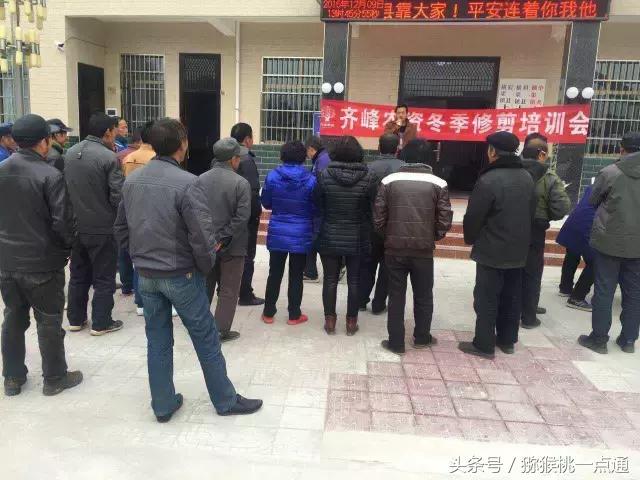
[Tuling Village Training Venue]
The growth of Qifeng Fruit Industry is inseparable from premium quality kiwifruit. In order to increase the area of high-quality fruit, make the fruit hometown beautiful and the brand strong, a powerful Qifeng agricultural materials expert technical team has been established - to convey market trends, teach standardized planting techniques, and deliver high-quality agricultural materials.
The Qifeng agricultural materials technical team today went to Qijiabao Village, Tuling Village, and Chang'ao Village respectively to provide free pruning guidance to the vast number of fruit growers: first small pruning, second large pruning, third bud setting, completing the pruning step by step.
[Orchard Guidance]
I. Small Pruning
Remove those branches and trunks that are easy to judge as needing to be discarded. For example: old branches that bore fruit in the previous year, branches overlapping in the same direction, branches too close to the ground, upright water sprouts, etc.
II. Large Pruning
Large pruning is divided into three steps: ① look ② think ③ cut.
① Look: look at the environment, look at the tree body. This means the environmental position where the tree is located, including row and plant spacing and terrain; the tree body means the strength of the fruit tree, the tree structure, the number of branches and the distribution positions of branches, etc. For example: look at the plant and row spacing of the trees. If the plant spacing and row spacing are long, branches can be appropriately cultivated outward; on the contrary, if the plant spacing and row spacing are short, appropriately shorten and cut back, so that each fruit tree can be allocated reasonable growth space;
Look at the terrain. Low-lying areas are susceptible to freezing damage. To prevent branches from freezing, two to three more branches can be retained to increase the probability of branch sprouting. Flat areas, according to standardized planting requirements, retain 2~3 branches per sq m; look at tree vigor. Vigorous trees can appropriately retain one or two more branches, while young trees and weak trees should be cut back with more branches and heavily thinned of fruit, increasing the proportion of vegetative growth of the tree body.
② Think: think about the principles
Remove diseased and keep vigorous, remove weak and keep strong, remove old and keep new, remove lower and keep upper, remove upright and keep slanting, remove water sprouts and keep moderate branches
Remove branches infected by disease and keep vigorous branches; remove weakly growing branches and keep vigorously growing branches; remove old branches of many years and keep new branches within three years; remove branches below the trellis surface and keep branches distributed on the trellis surface; remove upright-growing branches and keep spreading branches; remove useless water sprouts and keep moderate fruit-bearing branches.
③ Cut
When cutting, according to the situation after the previous pruning step, count enough reserved branches to ensure that next year's yield is not greatly disturbed, and remove excess branches according to the principles.
III. Bud Setting
Bud setting is the last step in fruit tree pruning. When setting buds, base it on the strength of tree vigor and the size of the tree body.
Adult vigorous fruit trees can retain 8 to 10 plump buds per branch. Young trees and weak trees should be cut back and shortened, retaining 4 to 5 buds, to strengthen tree vigor; they should not be left long.
Image and text source: Shaanxi Qifeng Agricultural Materials Company
Welcome to follow the WeChat public platform: Kiwifruit Planting Treasure Guide (mxmht123)
Shaanxi Province Kiwifruit Nursery Stock Breeding Base www.mht121.com
Operator WeChat: mmdh123