Zeng Lanying: The First Person to Cultivate Agarwood Artificially in Hainan
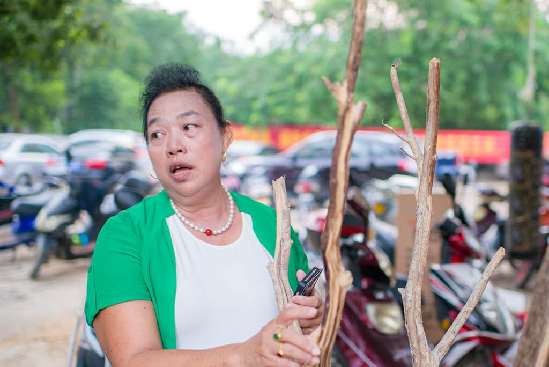
Over 15 years, Zeng Lanying promoted more than 1 million agarwood seedlings to over 2,000 farming households, making her truly the first person to cultivate agarwood artificially in Hainan.
Agarwood is a precious medicinal material, known since ancient times as the "treasure of traditional Chinese medicine" and "the finest of all fragrances," with extremely high medicinal and collectible value. It is a national second-class key protected plant species. Currently, good agarwood herbal decoction pieces cost 200-300 yuan per gram, agarwood essential oil on the market sells for over a thousand yuan per gram, and top-grade agarwood handicrafts start at tens of thousands of yuan.
Zeng Lanying, 57, chairman of Hainan Tunchang Jingying Agarwood Development Technology Co., Ltd., was the first person in Hainan to successfully cultivate agarwood seedlings. In 1992, Zeng Lanying sold 200 grams of black-oil sinking agarwood she had purchased to a Guangdong businessman for 5,000 yuan. She thought she had sold it for a high price, but after the deal, the Guangdong businessman told her that this piece of agarwood was harder to find than gold. Those words opened Zeng Lanying's eyes to the prospects of the agarwood industry.
At the time, outside fragrance hunters came to Hainan to make large-scale purchases, causing wild agarwood to be indiscriminately cut and almost driven to extinction. "Since agarwood is so valuable, why can't it be planted artificially?" Zeng Lanying put her words into action. Starting in 1995, after repeated breeding experiments, she finally succeeded in cultivating agarwood seedlings. Over the years, Zeng Lanying rode a motorcycle through most rural areas of every city and county in Hainan, promoting more than 1 million agarwood seedlings to over 2,000 farming households. Driven by her efforts, many merchants from outside the island came to Hainan to contract land and plant agarwood, and most growers rose out of poverty and became prosperous through agarwood cultivation.
In 2005, the agarwood trees promoted for planting had reached the age suitable for artificial fragrance production. Zeng Lanying spent tens of thousands of yuan buying agarwood trees from growers to experiment with artificial fragrance production. After several years of repeated trials, she invented the "artificial hole-drilling and medicine-injection fragrance-inducing technique." The "Tunchang Agarwood Fragrance-Making Technique" was also included in the fourth batch of Hainan provincial intangible cultural heritage items.
"Agarwood trees originally had to endure lightning strikes and insect bites, with resin secreted from the wounds, before agarwood could finally form. But now we have mastered the techniques of artificial fragrance production." Zeng Lanying told reporters that agarwood cultivation and management are relatively simple. Farmers can use idle land in front of and behind their houses to plant it, averaging 200 trees per mu, and each tree can yield a profit of 10,000 yuan over its 12-year growth and fragrance-forming cycle, making it a high value-added industry. Once the entire agarwood industry chain is formed, villagers can also work in agarwood processing factories, earning money while taking care of their families.
In Tunchang and other mountainous cities and counties in central Hainan, villagers mostly made a living by tapping rubber. In recent years, rubber prices have plummeted, and since planting agarwood trees, everyone's life has improved considerably. Deng Qi, a grower in Poxin Town, Tunchang County, said with a smile, "With Jingying Company providing full service and guaranteed purchase, farmers are only responsible for management and maintenance, which reduces the risks for farming households. Planting agarwood does not occupy farmland, and there are experts guiding the planting, so we just wait to make money..."
Although the prospects for the agarwood industry look good, there are still some weak links restricting its sustainable development. Industry insiders admit that although the local "hole-drilling plus fungal medicine" artificial fragrance-production technique in Tunchang was once the nation's leader, the fragrance yield can no longer meet market demand. The whole-tree fragrance-forming technique is still in the exploratory stage, and the cost of fragrance production is relatively high, ranging from 50 to 200 yuan per tree, with farmers facing high production and management costs in the early years. In addition, Tunchang's agarwood products are limited in variety and have not formed an industry chain. At the same time, there is a lack of government guidance and long-term industrial planning, a lack of financial support, and no support from large industrial projects or leadership from leading enterprises, causing Tunchang County farmers to mostly take a wait-and-see attitude toward agarwood cultivation.
To this end, in 2010, Zeng Lanying registered and established "Hainan Tunchang County Jingying Agarwood Development Technology Co., Ltd." to explore and research agarwood, selecting the excellent agarwood variety "black-oil sinking agarwood" seedlings, and successively developed a series of products including agarwood paste, agarwood tea, and agarwood wine. Wang Kangwen, general manager of Jingying Agarwood Company, said he hopes to build a full agarwood cultivation and processing industry chain through the company + cooperative + farmer model, with Jingying Company providing farmers with one-stop technical support and services from seedlings, management, fragrance production, deep processing, and sales. (Reporter Deng Weizhe)