Wheat genetics and breeding expert and Academician of the Chinese Academy of Engineering Liu Dajun devoted more than 60 years to his field
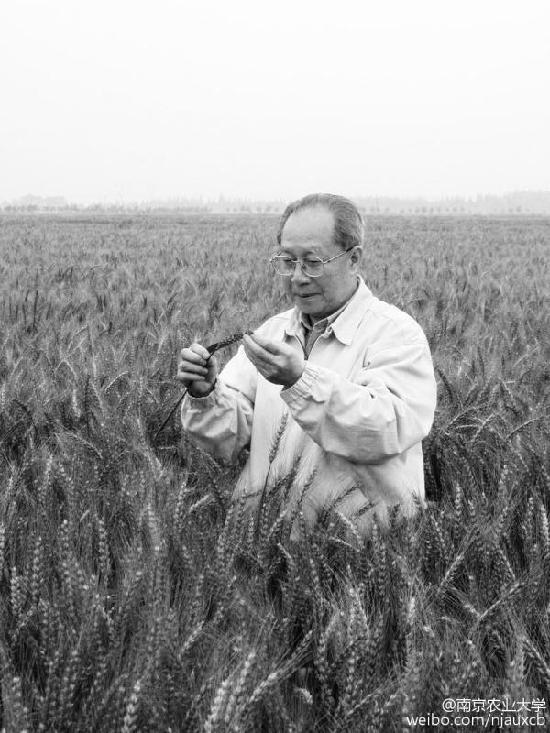
??? Professor Liu Dajun, an outstanding member of the Communist Party of China, an internationally renowned wheat genetics and breeding scientist, an outstanding agricultural educator, an academician of the Chinese Academy of Engineering, and former president of Nanjing Agricultural University, died in Nanjing at 19:50 on August 22, 2016 after medical treatment proved ineffective, at the age of 91.
Professor Liu Dajun, academician of the Chinese Academy of Engineering and former president of Nanjing Agricultural University. File photo from Weibo @Nanjing Agricultural University. Liu Dajun, male, was born on July 2, 1926 in Changzhou, Jiangsu Province.
In 1949 he graduated from the Department of Agronomy of Jinling University and stayed on to teach there.
In 1955 he was sent by the state to study at the Timiryazev Agricultural Academy in Moscow in the former Soviet Union, received a candidate of sciences degree in 1959, and after returning to China in 1960 worked for a long time at Nanjing Agricultural College (renamed Nanjing Agricultural University in 1984).
From May 1981 to November 1991 he successively served as head of the Department of Agronomy of Nanjing Agricultural College, vice president and president of Nanjing Agricultural College, and president of Nanjing Agricultural University, and in 1999 he was elected an academician of the Chinese Academy of Engineering.
He once served as deputy head of the second and third Crop Discipline Appraisal Groups of the Academic Degrees Committee of the State Council, member and standing member of the first and second Science and Technology Committees of the Ministry of Agriculture, standing director of the Genetics Society of China and director of its Plant Genetics Professional Committee, vice chairman of the Crop Science Society of China, chairman of the Jiangsu Provincial Genetics Society, and chairman of the Jiangsu Provincial Biotechnology Association.
He once served as deputy editor-in-chief of Acta Genetica Sinica and Hereditas, and as a member of the editorial boards of Scientia Sinica, Chinese Science Bulletin, Progress in Natural Science, and Acta Agronomica Sinica.
Mr. Liu Dajun was rigorous in scholarship, quick to think, diligent in practice, and skilled at innovation. He engaged in wheat genetics and breeding research for more than 60 years, devoting his whole life to wheat genetics and breeding work, and achieved outstanding results especially in fields such as the discovery of elite exogenous genes and germplasm innovation. With keen academic insight, he always stood at the forefront of disciplinary development, used radiation breeding technology to select and breed the new wheat variety "Ningmai 3", established a wheat chromosome and cell engineering technology system, was the first to combine molecular biology and cytogenetics to create new distant wheat germplasm, discovered the powdery mildew immunity gene Pm21, and promoted the widespread application of new distant germplasm in wheat breeding. The team he led won funding from the U.S. Wheat Foundation for three consecutive periods, becoming a successful model of our university's international cooperation. His research results respectively won the second prize and third prize of the National Award for Technological Invention, the second prize of the National Science and Technology Progress Award, and the first prize and second prize of provincial and ministerial science and technology progress awards. In 2000 he received the Ho Leung Ho Lee Foundation Prize for Scientific and Technological Progress.
Mr. Liu Dajun was an outstanding agricultural educator in our country. During his tenure as a university leader, he innovated educational concepts and, with a broad vision and forward-looking thinking, formulated discipline development plans for agricultural universities in the new period and promoted the university's strategic transformation toward a multidisciplinary university; he attached great importance to the building of the teaching staff, selected young and middle-aged backbone personnel through multiple channels to go abroad for further study, and trained a large number of outstanding academic backbones, effectively alleviating the situation at the early stage after the university's restoration when talent was scarce; using extensive personal connections and skilled diplomatic ability, he vigorously advanced and established exchanges and cooperation with internationally renowned universities and research institutes; he actively sought World Bank loans to improve school conditions and expand the university's international literature resources, making an indelible contribution to the rapid development of Nanjing Agricultural University after reform and opening up. He loved the cause of education, cared about students' growth, taught and educated people, and instructed tirelessly, offering and lecturing on courses such as "Cytogenetics" and "Plant Genome Analysis", compiling and publishing more than 10 textbooks, and successively training more than 60 doctoral and master's students, most of whom have become well-known scholars and professional backbones at home and abroad. With his profound learning and elegant demeanor, he won the affection of the broad masses of teachers and students.