A village doctor uses a single phone to see patients offline and diagnose them online
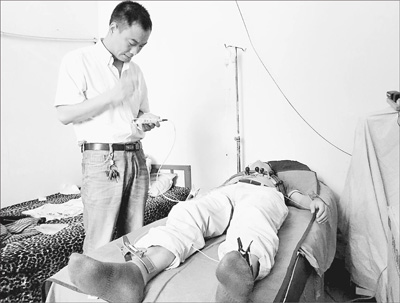 ????
????In Beichen Village, Ningjin County, Xingtai City, Hebei Province, village doctor Zhang Xianhu uses a portable electrocardiograph to perform an ECG examination for a villager.
????Photo by Li Haibo
The internet opens village doctors' eyes
Zhang Xianhu opened a Weibo account called "Medical Common Mind," and has posted more than 9,000 entries to date. In just a few short years, he became an "internet celebrity" among village doctors.
"Can I pay with WeChat?"
"Yes, scan the QR code."
At the Beichen Village clinic in Ningjin County, Xingtai City, Hebei Province, village doctor Zhang Xianhu was having a young patient pay for medicine via WeChat.
Zhang Xianhu is 37 years old this year. He began practicing medicine in 1996 and "got online" in 1997. In his spare time from seeing patients, he often browses online information, and he has become increasingly familiar with the internet. In 2008, he began visiting some professional medical consultation websites, and often replied online to patients' inquiries. In 2009, he became a moderator of a well-known medical forum, where doctors from all over the country gathered. Through organizing online and offline activities, Zhang Xianhu met many like-minded doctor friends, and set up a professional QQ group to share medical knowledge and discuss healthcare reform policies.
Zhang Xianhu said: "Village doctors in the county usually find it hard to get together, and doctors who live close to each other also have reservations when chatting. Communicating online makes it easier to speak one's mind."
In 2010, Zhang Xianhu opened a Weibo account called "Medical Common Mind," and has posted more than 9,000 entries to date. In just a few short years, he became an "internet celebrity" among village doctors. Now, Zhang Xianhu has dozens of doctor WeChat groups on his phone. In addition, he also set up a patient group, and often shares health knowledge and clever treatment tips with patients. Zhang Xianhu said: "With the help of the internet, my vision is no longer limited to a small village, but sees a broader world."
Chen Guoqing, a village doctor in Pingfeng Village, Pengxi County, Suining City, Sichuan Province, only began using the internet in 2008. With only a secondary vocational school education, he is now the "web administrator" of the "Shanyixing" village doctor public welfare project website, responsible for the website's daily maintenance and information updates. The 46-year-old Chen Guoqing said that whenever he has free time, he goes online at home. He takes online classes three or four times a week, studying traditional Chinese medicine diagnostic and treatment techniques and clinical training courses, and has kept this up for more than 7 years.
"Remote diagnosis" is a diagnostic method Chen Guoqing often uses. For some patients who live far away, he uses WeChat video to learn about their condition. Chen Guoqing said: "The internet is so developed now, and village doctors also need to keep pace with the times."
Zhai Dalong, a village doctor in Shuangweicheng Village, Daming County, Handan City, Hebei Province, is currently attending a training class in Beijing. He saw information about this training class on a WeChat public account and signed up. In recent years, Zhai Dalong has attended more than 10 training classes, large and small. He said: "I used to be a rather closed-off person. Later, through the internet, I attended some doctor training classes, met many peers, and came into contact with many new ideas and new knowledge."
Seeing patients offline and diagnosing them online
After a village doctor measures an ECG, he transmits the ECG image online via mobile phone, and an online doctor will immediately "grab the order," then transmit the diagnostic result back.
"Look, I've transmitted the ECG online. A doctor in Beijing will immediately grab the order, analyze it for me, and the result will come out in a moment." At the Beichen Village clinic, Zhang Xianhu had just finished measuring an ECG for a villager.
The remote ECG device in Zhang Xianhu's hand is a product specially "tailor-made" for frontline primary-level doctors. According to Zhou Po, general manager of Yitikang (Beijing) Technology Co., Ltd., compared with ECG machines in hospitals, this device is light in size, simple to operate, and highly accurate. Through just a few simple operations, village doctors can measure an accurate ECG. Then, through the "Yilubang" APP on the mobile phone, the ECG image is transmitted online, similar to "placing an order" on a ride-hailing app. After online doctors see this information, they can immediately "grab the order." After successfully "grabbing the order," they transmit the diagnostic result back.
Zhang Xianhu skillfully tapped his mobile phone, and soon a doctor from a major Beijing hospital "grabbed the order." After waiting a while, the ECG diagnostic result was uploaded to "Yilubang." After seeing the result, Zhang Xianhu immediately gave feedback to the patient. From image upload to return transmission, the whole process took just over 10 minutes.
Dr. Li of Fuwai Hospital in Beijing is one of the contracted doctors of "Dajia Yilian," which cooperates with Yitikang. On average, he can diagnose 20 ECGs per day on "Yilubang," mainly using his lunch break and after-work hours. The income for reading one ECG is 5 yuan, which adds up to nearly 3,000 yuan a month. For an ECG specialist, this is a decent income.
Zhang Xianhu said that he charges 15 yuan for an ECG examination for a patient, while the county hospital charges 18 yuan for an ECG examination. Having an ECG done in the village and diagnosed by a doctor from a Grade 3A hospital in Beijing, this service model is very popular among farmers. A village doctor needs about 2,000-plus yuan to buy an ECG device, which includes 100 remote services, equivalent to using the device for free.
Zhou Po introduced that the cost price of this remote ECG device exceeds 3,000 yuan. Yitikang Company directly compensates village doctors 1,000 yuan, and during consultations, village doctors can also receive compensation based on actual usage. In this way, each time a village doctor performs an ECG for a patient, he can earn more than 10 yuan. As of July 31 this year, a total of 4,079 primary-level medical institutions had cooperated with Yitikang Company, covering 26 provinces, with more than 52,000 consultations.
Feng Dongmei of the Hengxiang Village clinic in Ji'an County, Jiangxi Province, is one of the earliest village doctors to use remote ECG monitoring. She has 232 consultation records in "Yilubang." At the beginning of this year, 69-year-old villager Liu Binggen suddenly fainted at home, his face was deathly pale, and his blood pressure plummeted. Feng Dongmei ran to Liu Binggen's home with the ECG device. From ECG testing and image transmission to receiving the result, it took a total of more than 10 minutes, and the test showed that the patient had sinus bradycardia. So she immediately gave Liu Binggen medication to increase his heart rate, and rushed him to the county hospital. Later, Liu Binggen's son called Feng Dongmei and said that Liu Binggen was out of danger. Feng Dongmei said: "If there had been no ECG to diagnose the condition, the consequences would be unimaginable."