Chen Jianping: Controlling crop diseases, letting wheat waves fragrance the air
?
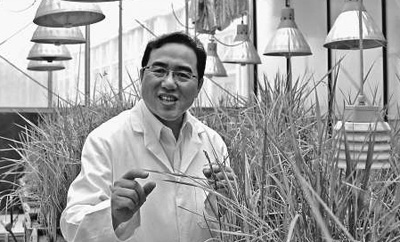
Academician Chen Jianping (see photo above, file photo), a "diagnostician" of plant diseases. He discovered 2 barley viruses inside Polymyxa graminis, and was the first in the world to present the first direct evidence of fungal transmission of plant viruses, elucidated the relationship between virus deletion mutations and fungal transmission, and explained the functions of multiple fungus-transmitted wheat virus genes. He also identified 13 new species of plant viruses, and intercepted more than 1000 batches of foreign plant pathogens invading...
This plant virologist, highly respected internationally, once resolutely gave up generous treatment abroad; this "young man who came out of the countryside" returned to the countryside, taking root in the vast fields, dedicating his youth to the wheat waves and rice fragrance of the motherland.
????Applying learning to practice is his motto
Chen Jianping was born in 1963 in Ningbo, Zhejiang. Through hard work, he was admitted to Zhejiang Agricultural University to study plant protection, but was mocked by neighbors that "getting into university means jumping into the farm gate after all," and that "the major is just carrying a sprayer to apply pesticide and kill insects." Chen Jianping paid no attention to the disdainful looks and ridicule.
After graduating from university, Chen Jianping stayed at the Zhejiang Academy of Agricultural Sciences to do scientific research. "The conditions at the academy were tough, but the work was what I loved." Chen Jianping was assigned to work in the plant virus research laboratory. From 1989 to 1995, Chen Jianping studied in the UK, made major breakthroughs, and began to stand out in the field of plant virus research. At the time, Chen Jianping followed his supervisor in plant virus research. After completing the assigned tasks, Chen Jianping proposed taking on an "impossible task" - studying the intrinsic relationship between Polymyxa graminis and plant viruses. Many plant virologists internationally had already explored this research field painstakingly for 30 years, but had never made progress.
Chen Jianping forgot food and sleep, throwing himself into the research, cutting Polymyxa graminis with a diameter of 5 micrometres into 100 slices, preparing a total of 10,000 ultrathin sections of Polymyxa graminis for electron microscope observation. Finally, in repeated bouts of "pushing himself," he captured photographs through an electron microscope at 80,000 times magnification showing the presence of Barley mild mosaic virus and Barley yellow mosaic virus inside Polymyxa graminis. After the paper was published, it set off a wave of attention in the relevant academic field.
Chen Jianping was not moved by the flood of praise and glory. He decided to return to China, to apply the knowledge he had learned in the UK to safeguarding the motherland's food supply and developing agricultural science and technology.
????He treats his students as his own children
From returning to China alone to now leading a team of fifty or sixty people, Chen Jianping, speaking of team building and talent cultivation, is full of feeling: "However my supervisor treated me well back then, that is how I treat my students."
In Chen Jianping's journey of growth, he encountered far too many "masters" and "benefactors." When he was studying in the UK, his supervisor unreservedly brought out 17 years of accumulated research materials for Chen Jianping's reference. When Chen Jianping captured electron microscope photographs of the virus inside Polymyxa graminis and published a paper, his supervisor insisted on putting Chen Jianping's name in the first-author position. These things left an indelible mark in Chen Jianping's heart: "My greatest gain in the UK was not the scientific research results I achieved, but learning the supervisor's selfless scientific spirit."
Chen Jianping treats his students just like his own children. He often walks into the laboratory and talks with students about work and life, carefully guiding each person according to their characteristics, focusing mainly on encouragement and rarely criticizing, creating an academic atmosphere of respect, equality and openness.
An interesting phenomenon has emerged in Chen Jianping's team: everyone competes to be "the person in the back." Whenever there are awards, honors or paper publications, team members always rush to recommend others, and no one "elbows their way in" for personal gain. This moved Chen Jianping and made him feel gratified.
After returning to China, Chen Jianping led his team to a series of dazzling achievements. From 1996 to 2005, of the SCI papers published worldwide in the field of fungus-transmitted plant virus research, those published by their laboratory accounted for about 28%; from 2006 to 2015, this proportion reached more than 60%. Over 20 years, their research results won 5 first and second prizes of the National Science and Technology Progress Award, and 9 first prizes of the Ministry and Provincial Science and Technology Progress Award.
?Combining personal interests with the needs of the motherland
Now, in addition to continuing to do well in plant virus research, Chen Jianping has set his sights on the issue of agricultural development. He conducts research on modern agricultural development strategy, and proposes the concept, connotation, model, mechanism and path of the agricultural complex, carrying out exploration and practice.
Why make this change? Chen Jianping told a story. Once he went to a rural area in Chun'an, Zhejiang, for poverty alleviation and met a little girl. The little girl said she most looked forward to the time when the hickory nuts ripened, because "then Mom and Dad can come home." This made Chen Jianping uneasy: "Many farmers go out to work to make a living, and countless rural children are forced to be separated from their parents. As an agricultural science and technology worker, what exactly can I do?" Chen Jianping hopes to do something so that farmers can have good production, a good life and good livelihoods at home, and so that rural children can grow up happily by their parents' side.
From this, Chen Jianping proposed the concept of the agricultural complex, exploring a system of integrated diversified industries, hoping to comprehensively solve the "three rural issues." He also thinks about innovation in the agricultural science and technology system and mechanism, hoping to promote the integration of science and technology with the economy.
"Besides starting from interest and actively exploring scientific and technological issues, a scientist must also have the motherland in his heart and consider the country's needs. Only by combining personal interests with the country's needs can one be a scientist with feeling and a sense of mission," said Chen Jianping.
Our reporter Liu Shiyao