Two farmers from Hebei win praise from foreign media after being reported by Xinhua News Agency
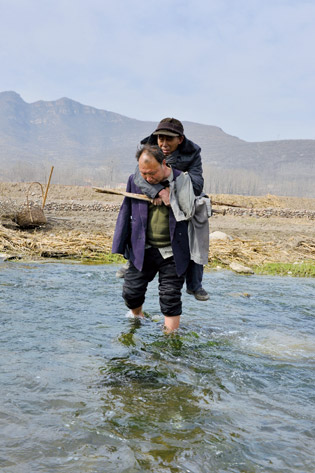
On March 13, 2014, Jia Wenqi waded through the cold river water and carried Jia Haixia on his back to the tree-planting site.
On March 13, 2014, Jia Wenqi propped Jia Haixia up with his shoulder, and Jia Haixia used a sickle to cut off the excess branches from the large trees to serve as cuttings for saplings.
On March 13, 2014, Jia Wenqi used his foot to insert the branch into the hole, and Jia Haixia used both hands to push it forcefully into the soil. Photo by Zhang Zhen
"You are my eyes, I am your hands": two disabled farmers planted tens of thousands of trees over 14 years, turning more than 50 mu of barren riverbank into an oasis
These two farmers from Hebei also won praise from foreign media after being reported by Xinhua News Agency
In Yeli Village, Jingxing County, Hebei Province, two disabled villagers - one blind in both eyes, the other with no arms - have for more than a decade been each other's hands and eyes, planting tens of thousands of trees and turning more than 50 mu of barren riverbank into an oasis.
On the riverbank land by Yeli Village, there is a lush patch of forest. Fourteen years ago, this was still a barren riverbank where not even weeds grew. Villager Jia Haixia, 55 this year, and Jia Wenqi, 54, were brought together by this barren riverbank, and from then on their fates became tightly linked.
"You could say we disabled people help each other. We are often together - he helps me, I help him, he encourages me, I encourage him," said Jia Haixia.
For income, and to regain the courage to live
Jia Haixia's left eye had been blind since childhood due to congenital cataracts, and his right eye was disabled in 2000 while he was working, leaving him blind in both eyes. Jia Wenqi lost both arms at age 3 after an electric shock. The same misfortune made the two become each other's support in life. In 2002, in order to earn a little income and also to regain the courage to live, the two decided to plant trees on that ignored, weed-free barren riverbank land by the river east of the village. But at that time, they did not even have the money to buy saplings, so they could only cut branches everywhere to stick into the ground and grow seedlings.
"A few years ago, a major flood washed away all the nearby trees. Jia Wenqi and I could only go to other villages two or three li away to cut willow branches. As the saying goes in the countryside, you just have to put on a thick face. If people saw us, they would scold us; if they did not see us, we would cut them and take them away. That is how it was," Jia Haixia said somewhat embarrassedly.
Cutting branches was a "skilled job" for Jia Haixia, who is blind in both eyes, and Jia Wenqi, who has no arms. "Cutting branches is not just one or two trees, or one or two branches - we needed tens of thousands of saplings," Jia Wenqi told the reporter. "At the beginning, we could not cut many. Brother Haixia was already a man in his forties, and he could not see. Climbing trees was not easy, and I was worried he would fall." After a period of practice, the two became more and more in sync. Jia Haixia, who has all his limbs, was responsible for climbing trees to cut branches and bundling them, while Jia Wenqi used his feet to "pick up" the branches.
After cutting the branches, they had to go to the riverbank on the opposite side to plant trees. Jia Wenqi first had to wade across the river to carry the tools and bundled branches to the other side, then come back to carry Jia Haixia across. Every year from the second lunar month to the Start of Winter, he walked this river countless times. For Jia Wenqi, who has no arms, keeping his balance was not easy either. "Especially carrying someone weighing more than 100 jin, when crossing the river your foot has to step into the cracks between stones, and only when you step firmly can you avoid slipping. If you step even a little off, you slip and fall. In early spring and winter, our cotton clothes were often soaked through when we crossed the river. Now we have learned from experience, and in recent years falling into the water happens less often."
"Oh brother, look, this tree has survived"
After much difficulty, they reached the opposite bank of the river, and only then did the tree-planting work truly begin. The natural conditions of the riverbank land were harsh, with stones and sand everywhere. When people in the village heard that they were going to plant trees on this barren riverbank, they all found it hard to believe. "During that time, many people in the village mocked us. 'You can plant trees there too? Not even grass grows. You are fooling around,'" said Jia Haixia.
The stubborn Jia Haixia and Jia Wenqi ignored the ridicule of others. In the spring of 2002, they planted 800 branches they had cut themselves on the riverbank, hoping they would take root, sprout, and grow into towering trees.
"Every day we went out showing off that we had planted 800 trees. At that time we were quite proud. At the time, it was just to supplement the household income. We were not as great as people say now - afforestation, purifying the air. At the time it was just to exchange for some money."
Two people who had suffered misfortune shared the same simple wish. But as time passed, the branches planted in spring had almost all died by summer. Only two trees survived, and the two old brothers also began to doubt themselves. "So we were quite troubled. Were we pessimistic? To tell the truth, we really were pessimistic. Would it work or not?" Jia Haixia said.