Coal boss Zhang Ming returns home to seek treasures in the mountain forest
Though based in Inner Mongolia, "coal boss" Zhang Ming keeps close track of his hometown's development and changes. Beijing-Tianjin-Hebei integration, Beijing joining hands with Zhangjiakou to host the 2022 Winter Olympics, and other developments have brought unprecedented opportunities to Zhangjiakou. Outsiders are all coming to Zhangjiakou to look for business opportunities, so as a Zhangjiakou native, why not return home and start a business? In 2012, Zhang Ming brought his capital to Wanquan to develop green ecological farming and specialty tourism, embarking on a new entrepreneurial path.
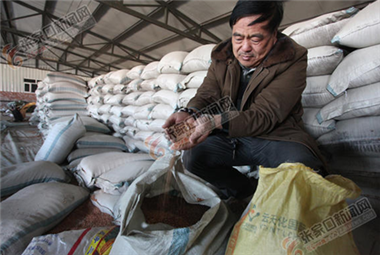
Zhang Ming inspecting the grain used for brewing liquor.
Becoming a "coal boss"
Zhang Ming is from Ximalin Town, Wanquan District, and is 48 this year. In 2004, he left Wanquan for Hohhot, Inner Mongolia, and with friends opened a coal yard. Coal shipped from Ordos was transferred through their coal yard, then transported to Wanquan, and from Wanquan the coal was shipped to Shandong, Tianjin, Beijing and other places.
Zhang Ming was a "coal boss" in Hohhot for nearly 10 years, which allowed him to accumulate capital. In recent years, coal usage has been declining day by day, and the coal business has become increasingly difficult. Zhang Ming realized that in order to protect the environment, the coal yard industry would be restricted, and he wanted to follow the trend and change trades, taking on some green ecological projects.
Though based in Inner Mongolia, Zhang Ming keeps close track of his hometown's development and changes. Beijing-Tianjin-Hebei integration, Beijing joining hands with Zhangjiakou to host the 2022 Winter Olympics, and other developments will bring unprecedented opportunities to Zhangjiakou. Outsiders are all coming to Zhangjiakou to look for business opportunities, so as a Zhangjiakou native, why not return home and seek out a world of his own?
In 2012, Zhang Ming returned to Wanquan, intending to look for development opportunities in his hometown.
In Deshengbao Village, Beishacheng Township, there is a 150-mu stretch of forest land. This forest land was contracted by a Beijing businessman who originally wanted to raise rare animals, but because of high-voltage power lines nearby, it was not suitable for raising rare animals, and he had to give up. When Zhang Ming learned of this, he contracted this stretch of forest land to supply the market with natural, safe, pollution-free livestock products, forest fruit products, and more.
As people's living standards rise, returning to nature, enjoying what is natural, and aspiring to consume pollution-free food have become a new social trend. This will be the mainstream of the food industry in the future and has enormous market space. He wanted to shift the focus of his business to green ecological farming, providing customers with end products such as free-range mutton, black-haired pork, and distillers-grain beef.
Setting his sights on green waters and green mountains
In order to lay a solid foundation for ecological farming, Zhang Ming extended the industry chain, starting with feed, to ensure it is green and natural and to supply the market with high-quality livestock products.
Zhang Ming drilled a deep well, and testing showed the well water to be high-quality mineral water. Using this well water, with sorghum, corn, millet bran and other materials as raw ingredients, he produces baijiu, and through the processes of fermentation, sterilization and saccharification, the distillers' grains produced are a high-quality feed -- sterile saccharified feed.
Saccharified feed is rich in nutrients, which ordinary grain feed cannot compare with. Feeding 100 kg of sterile saccharified feed directly to ruminants such as cattle and sheep yields a feeding benefit equivalent to the combined feeding benefit of 450 to 600 kg of corn, 30 to 40 kg of pasture grass and 40 to 100 kg of wheat straw. Animals raised on sterile saccharified feed are healthy and do not fall ill, requiring no epidemic prevention or treatment, which eliminates veterinary drug residues.
At the same time, Zhang Ming planted economic forest trees such as large apricot-kernel apricots, flesh apricots and crabapples in the forest, so the company can harvest natural, safe, pollution-free forest fruit products. At the same time, he planted miscellaneous grains and other crops between the fruit trees to provide supplementary feed for fattening in the farming area. The manure of cattle and sheep is high-quality farmyard manure, all of which is applied to the orchard, which in turn promotes the growth of the fruit trees, realizing a three-dimensional circular business model.
Transitioning to ecological farming
Zhang Ming fenced in the forest land and built breeding pens. In the first year he bought lambs from the Bashang area at 800 yuan each, and he raised 300 of them. Fattening sheep on the market take only three or four months from lamb to market; but the sheep Zhang Ming raises take 7 months to reach market weight. He does not feed them fattening feed, but lets them graze on the pollution-free grassland in the apricot forest land, and after grazing they drink mineral water, while also being given supplementary forage and distillers' grains. Hand-grazed sheep have good meat quality and are beneficial to human health when eaten.
The original idea was good, but he ran into a poor mutton market, and the sheep he worked so hard to raise sold for only 230 yuan each. In his first year of raising sheep he lost 300,000 yuan. "The mutton market is bad, so I can only reduce the number of sheep I raise, but I can't stop raising them. The market will always improve," Zhang Ming said.
After losing money on sheep, he brought in more than 100 black pigs. Black pigs are closely related by blood to wild boars. Black pork has marbled patterns, is delicious, and has good intramuscular fat deposition, and the fat is not greasy at all.
Unlike pork on the market, black pigs have a long growth cycle, taking more than 1 year to reach market weight. He set the price of black pigs at 29 yuan, and if sold in Beijing they could fetch more than 50 yuan. But local people did not accept black pigs, and the high price made them hard to sell. By then the black pigs had grown to sixteen or seventeen months old and reached a body weight of more than 200 jin, and keeping them longer would be even less worthwhile, so he had to sell the black pigs off at a reduced price.
Raising black pigs did not make money, but experts evaluated the black pigs Zhang Ming raised, saying that his black pigs were clearly raised for more than a year. Six or seven people in the urban area engaged in pork sales also took a liking to the black pigs Zhang Ming raised and stocked up from him, and city residents gradually came to recognize that black pork has good quality, which gave Zhang Ming more confidence.