Textile worker Liu Sha: If you do it, do it well
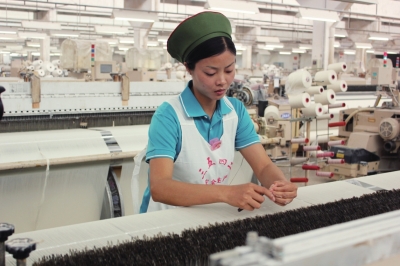
??? The workshop temperature is 30°C, the humidity is 80%, and the noise is 100 decibels. On April 25, the reporter experienced the working environment of textile worker Liu Sha in the weaving workshop of Jihua 3524 Textile Co., Ltd. in Xiangyang, Hubei Province. 479 air-jet looms operate 24 hours a day, and Liu Sha, the shift leader of D shift, and her colleagues work year-round on a four-shift, three-start schedule.
Liu Sha, born in 1985, is from Qinzui Village, Dongjin Town, Xiangzhou District, Xiangyang. In August 2009, she left the countryside to work in the factory, and has since won titles including Hubei Province's "Top Ten Migrant Workers" and National Model Worker. Liu Sha told the reporter, "Compared with farming in the countryside before, the factory environment, workload and income are pretty good. From the moment I finished the paperwork when I entered the factory, I made up my mind that if I do it, I will do it well, and I will definitely not embarrass rural people." Diligence and hard work led to the "quick hands" specialty
"Farming at home used to be working alone, and I was used to being free and undisciplined. At first, going from the countryside to work in the factory, I was a bit unused to it." Because she had not mastered the technical essentials, at first she was slow at tying knots in weaving and the quality was poor. "At that time I was anxious and also lacked confidence, and I often doubted whether I was a bit clumsier than others because I was from the countryside." Liu Sha said, "But I just did not believe that rural people are worse than city people."
After work, when they returned to the dormitory, her sisters all rested early. In order not to disturb others, Liu Sha went to the corridor to keep practicing. In the dead of winter, the cold wind in the hallway froze her hands stiff. Liu Sha placed a basin of hot water beside her. When her hands were too cold to obey, she soaked them in the hot water for a while, then continued practicing tying knots.
Hard work pays off. In less than half a year, Liu Sha could already tend 16 machines, 4 more than the other workers. She also developed a "quick hands" specialty. Compared with the women workers who entered the factory the same year, the number of knots she handled per minute was 38% higher, and her speed in handling broken warp was 25% faster, breaking the company record and earning her the title of "champion."
Driven by technology, giving play to the team's role
"It is not enough for only me to be skilled; I also have to motivate the sisters around me, so that the team's production efficiency is high. If the task is completed well, everyone can have corresponding economic income." In April 2012, Liu Sha went to C shift, which had the poorest operating skills, as a shift trainer. Aiming at the problem that the loom operators' skill levels varied unevenly, she used her own technical strengths to teach according to each person, give separate coaching, and have them operate repeatedly until the employees fully mastered the technique.
At the beginning of 2013, the former shift leader of D shift in the weaving workshop resigned because serious staff loss made it impossible to guarantee normal production. At that time, no experienced shift leader was willing to take over. In the end, Liu Sha took on D shift under pressure, busy every day as if wound up.
When staffing was tight, she went from village to village herself to publicize recruitment; when efficiency could not be raised, her explored and summarized "one stop, two looks, three checks" patrol method increased production efficiency by 10%; when production tasks were tight, she put forward the slogan "seize the start of the looms five minutes before shift," and was the first to form a "youth shock team" of more than 20 people, reasonably arranging new and old employees as partners and strong and weak employees as partners, greatly improving the overall loom start-up efficiency. Very soon, all production indicators of D shift rose and ranked at the forefront among the teams, but Liu Sha had lost a full 10 jin.
Whether serving as a trainer or a shift leader, Liu Sha always put training her sisters' operating skills first. She successively mentored more than 50 apprentices, of whom 39 became quality pacesetters or skilled operators, playing an important role in the workshop.
Retaining people through emotion, treating the team as a family
Work in a textile factory is tiring and the environment is poor, and many employees left because of this. In order to stabilize the workforce, Liu Sha treated the team as a family and exchanged heart for heart at work, and soon won over the hearts of all the members of D shift. She said, "People's hearts are made of flesh. As long as I treat them well, they will also treat me sincerely."
Liu Sha and the group leaders regularly visited the singles' building. Each of the 10 group leaders in the shift had a heart-to-heart talk notebook. During every shift rest, she would lead the group leaders to the employee dormitories to learn everyone's thoughts, grasp their ideological trends, and help them solve inconveniences in life. For example, contacting and urging the property management company to repair broken light bulbs and water pipes, helping employees charge the batteries of electric bikes, and visiting employees' sick relatives in the hospital, and so on.
In her spare time, Liu Sha organized her sisters to carry out activities such as mountain climbing, karaoke competitions and cooking contests to advocate a healthy lifestyle and deepen affection and cohesion. The attendance rate of the team's employees reached more than 95%, and the staff loss rate was reasonably controlled within 2%.
In May 2015, Liu Sha was honored with the title of National Model Worker. After Liu Sha became a model worker, she still busily moved among the machines. The company planned to allocate her an apartment, but when Liu Sha heard that apartment units were in short supply and many married college graduates were still waiting in line, she gave it up without hesitation. "Let the college graduates live there, so that they can work in the company with greater peace of mind."
?